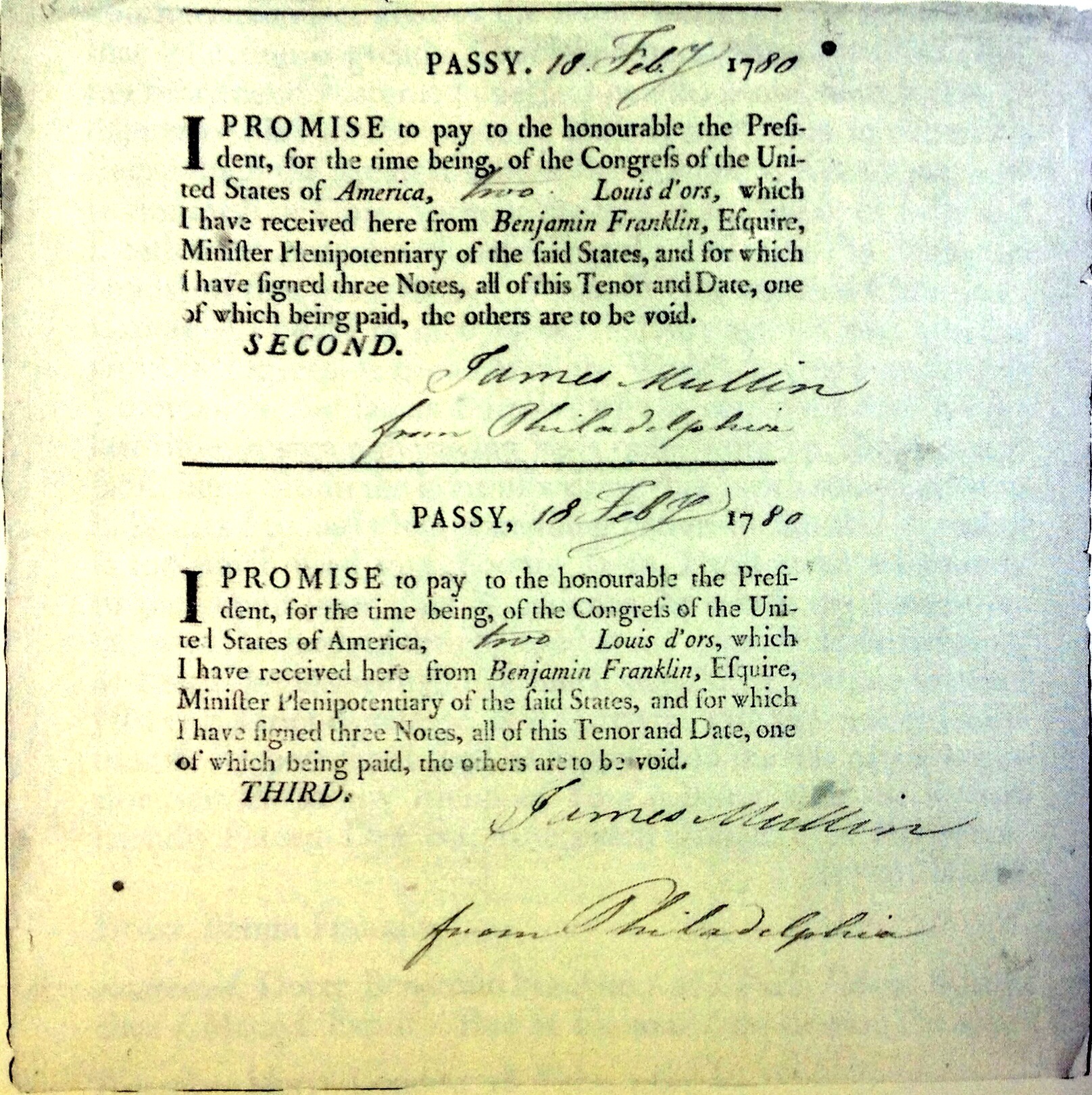
 Earlier this week, I found myself sitting at my desk at the Franklin Papers faced with photostat copies of an “Alphabetical List of Escaped Prisoners” and a huge pile of promissory notes printed in triplicate by Franklin himself on the press he kept at his home in Passy, a suburb outside Paris. While I was going through them, I could not help but think back to the recent events surrounding the return of U.S. Army Sergeant, Bowe Bergdahl, the last remaining prisoner of the nation’s longest continuous period of war since the American Revolution. Politics aside, the Bergdahl affair speaks to the importance placed on coming to the aid of Americans detained in wartime. And what I had before me at my desk spoke to the same during the War for Independence. These men—largely privateersmen who had been captured on the high seas by the British and transported to English prisons—were among the very first Americans imprisoned on foreign soil during wartime and these documents reveal an often untold story about how the United States government and Benjamin Franklin dealt with this new problem.
Category Archives: Research
“It is now translated to America”: British Hymns in the Revolutionary Era
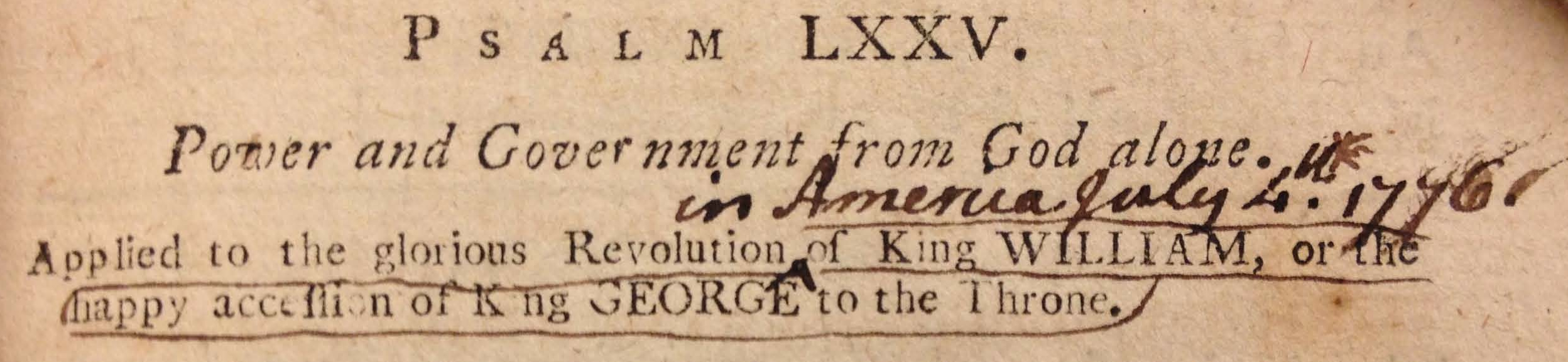 The Watkinson Library at Trinity College has an impressive collection of manuscript music from the late eighteenth century. Thanks to a grant from the Bibliographical Society of America, I spent a few weeks in June on a research road trip in New England, and Trinity was my first stop. Although I was focusing on musical commonplace books and copybooks, at the suggestion of librarian Sally Dickinson I also worked with their collection of annotated hymnals. It was while perusing these volumes that I came across something I hadn’t seen before: a hymnal in which every reference to Britain had been crossed out and replaced with the word “America” or related terms (New England, Western States, United States, etc.) As the assiduous penman noted at the bottom of one page, the entire volume had been “translated to America.”
 The Junto