What happens when you mix early American history nerdyness with basketball geekyness? Junto March Madness!
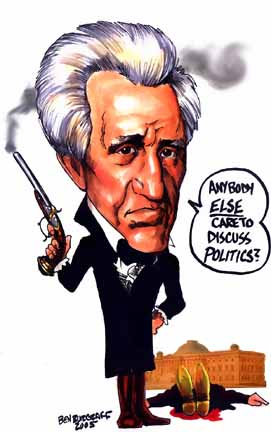
Jackson would obviously have won any physical competition, likely by cheating, but will any books dealing with Jacksonian America win the historiographical tournament?
In honor of the NCAA Tournament games tipping off in a few hours, and in reaction to the recent announcement of Bancroft Prize winners (which tragically did not include any book explicitly dedicated to early America), we here at the Junto decided to jump in on the competition atmosphere with brackets of our own: a several-bracket-tournament of books in early American history. Today, we submit competitors. The Junto team will then narrow the field to either 32 or, if we get enough submissions, 64, and rank them in brackets. (The organization of brackets is still up in the air—we could go with thematic regions like political, cultural, religious, and synthetic, or we could even go chronological with colonial, revolutionary, early republic, or Civil War-era, or we could even go with histiographical eras—and largely depends on the submissions. We are very open to suggestions, though, so please chime in in the comments!)
IMPORTANT NOTICE: The beauty of this competition depends on being fun, so the first and most important rule is not to take it too seriously. Deciding the winner is purely subjective and based on what are likely a widely variegated criteria of excellence including, but not limited to, most influential, best-written, most sophisticated, or even most popular. When in question, go with your gut reaction. Or, just go with your favorite. A debate between Laurel Ulrich’s A Midwife’s Tale and Eric Foner’s The Fiery Trial is, of course, silly, because both books can be categorized as the top of the field yet they examine completely different issues through very different approaches. But it is, nonetheless, fun to compare, debate, and, indeed, vote. This is designed to be fun, people, so once again: DO NOT TAKE THIS SERIOUSLY. (But we still expect the winner to add this great accolade to the top of her/his C.V.)
Once again, today we nominate books; tomorrow we start voting. Here are your rules for adding submissions in the comments below:
- Each person is limited, at least at first, to five books. If we are getting close to the end of the day and we are still sorely lacking in titles, we will open it up to more submissions.
- Books are eligible if they cover any period of American history up until and including the Civil War. Books that cover the entirety of American history, or go beyond the Civil War, are not eligible.
- Submissions will not count unless they are accompanied with a one-two sentence justification for their inclusion. (Ok, they will likely still count, but we will give you a stern look as a result.)
- Besides your five submissions, feel free to “second” other submissions if you think they are a great choice, or if you would have mentioned them had no one else already done so. This will help in our seeding process.
- Submissions from funny historic pseudonyms are not only accepted, but perhaps even encouraged. They may not make the cut, but they will at least keep this fun.
To get things started, I will offer my five submissions:
- Laurel Ulrich, A Midwife’s Tale: The Life of Martha Ballard, Based on Her Diary, 1785-1812 (New York: Knopf, 1990). This book changed the way history was done: its attention to the detail of a single document, its provocative questions, its broad archival and theoretical background, and its lyrical prose make it both very informative and superbly engrossing.
- Annette Gordon-Reed, The Hemingses of Monticello: An American Family (New York: W. W. Norton, 2008). I was amazed at how this book is able to construct such a rich narrative of a family that hardly left a written record. But besides archival and interpretive brilliance, it offers a lot of lessons that transcend historiographical arguments.
- Gordon Wood, The Creation of the American Republic, 1776-1787 (Chapel Hill: University of North Carolina Press, 1969). Ok, ok, anyone who has gone through graduate school in the last few decades has experienced the ritual of beating up this book and the accompanying “republican thesis” (not to mention the focus on white men). But no one can dispute its influence (how many other books command a roundtable twenty years after its publication?), and anyone who deals with the political culture of the revolutionary period is forced to familiarize themselves with the text.
- Jill Lepore, The Name of War: King Phillip’s War and the Origins of American Identity (New York: Knopf, 1998). Again, there are definite holes that the current generation of scholars like to point out, but I am still energized anew whenever I re-read this book. Her imaginative and innovative interpretation and mix of narrative and analysis is more engaging and makes me more excited about the field than most other books.
- Catherine Brekus, Sarah Osborn’s World: The Rise of Christianity in Early America (New Haven: Yale University Press, 2012). Ok, so this book is brand-spanking-new, but it completely awed me when I recently read it that it is already in my pantheon of books. Plus, I wanted to make sure there was something on religion in my five, so this does the trick.
 (Close runners-up, though I could certainly name many, include Taylor’s William Cooper’s Town, Foner’s The Fiery Trial, and Ely’s Israel on the Appomattox. And I ended up not going with classics like Beard’s Economic Origins of the American Constitution, Miller’s Errand Into the Wilderness, or Bailyn’s Ideological Origins of the American Revolution, but those should definitely be considered.)
Your turn. What are your suggestions for the brackets?
CATCH THE MADNESS!!!!!
 The Junto
This is a great idea! I would like to second the nomination of _The Name of War_. I’ll be adding my favorite 5 later today–I’m taking a few hours to think about it, while not taking the whole thing too seriously.
A. Bailyn, Ideological Origins – this classic speaks for itself.
B. Waldstreicher, Slavery’s Constitution – short, sweet, and valid.
C. Onus, Mind of Thomas Jefferson – anyone willing to explore those depths deserves a bid.
D. Jasanoff, Liberty’s Exiles – recent, but wonderful.
E. Gally, Planter Elite – excellent study of colonial / revolutionary South.
second for Onus, Mind of Thomas Jefferson
Though Onuf often takes the onus upon himself for creative Jefferson scholarship, we should probably keep his name spelled correctly.
My five nominations for the Junto Early American History March Madness tournament:
William Cronon, Changes in the Land. What are today common understandings of the role environment and land use played in shaping encounters between Europeans and Native Americans were quite uncommon when this book was first published more than a quarter century ago. This book opened up a huge new area of inquiry for early American historians.
Bernard Bailyn, Ideological Origins of the American Republic. A classic, of course, written when dinosaurs still roamed the earth. But it was the book that made me want to go to grad school. So maybe I actually hate it.
Frances M. Clarke, War Stories: Suffering and Sacrifice in the Civil War North. We need some young upstarts in this tourney. War Stories might be the Cinderella team of the tournament. This book changed my understanding of the Northern experience of the Civil War dramatically, and has me revising old lectures in my Civil War course. I think it will have long term impact on the field.
Michael Allen, Western Rivermen, 1763-1861: Ohio and Mississippi Boatmen and the Myth of the Alligator Horse. This semi-obscure book (LSU Press, 1990) wins its play-in game to get to the big dance. A great book to assign in undergrad courses, which uses flatboat culture to glean insights into Jacksonian America.
Laurel Thatcher Ulrich, A Midwife’s Tale. Has come to define that genre of writing often called “microhistory.” Has served as a model for so many books published after it.
Second Cronon.
1. Robert Gross, The Minutemen and the World. This is an excellent social and microhistory of the town of Concord during the revolutionary era.
2. Margot Minardi, Making Slavery History: Abolitionism and the Politics of Memory in Massachusetts. Minardi is one of very few scholars to explore the memory of the Revolution, and this book makes an strong case for the relationship between historical narration and historical action.
3. Charles Sellers, The Market Revolution: Jacksonian America, 1815-1846. Twenty years after its publication, most graduate students of American history are still likely wrestling with this important text, which covers the religious, social, political, and economic history of the era.
4. Albert J. Raboteau, Slave Religion: The “Invisible Institution” in the Antebellum South. This book is still the classic work on the topic after nearly 40 years.
5. Paul Johnson and Sean Wilentz, The Kingdom of Matthias: A Story of Sex and Salvation in 19th century America. This is one of the most well-written historical narratives I have ever read and an excellent work for introducing undergraduates to the impact of the rise of evangelical religion and impact of the market economy in the nineteenth century.
I’m going to second the nomination of Johnson & Wilentz. One of the best micro-histories ever. And as Chris notes, great for undergraduate teaching. My students have universally loved it.
My nominations:
Jon Butler, Awash in a Sea of Faith: The single best treatment of American religion to the Civil War. Huge influence on my thinking and scholarship. Nobody has done it better.
Jim Horn, Adapting to a New World: A great treatment of early Virginia in the Atlantic context. Trans-national history done really well.
David Waldstreicher, In the Midst of Perpetual Fetes: It looks like I am going to be the first person to throw this out there. This book is in turns brilliant, frustrating, insightful, obtuse, and turgid. I do, however, learn something new every time I come back to it.
Monica Najar, Evangelizing the South: As I said in recent post this book is the single best example of a work using the “democratization thesis” to great affect. Speaks to questions across a lot of different sub-fields (women’s history, religion, etc.) and brings heaps of fresh insight.
John Brooke, The Heart of the Commonwealth: Brooke’s largely forgotten first book but I’ve been coming back to it again and again as I have worked on my dissertation prospectus. “Heart” is a masterful synthesis of social, cultural, and intellectual history that we just don’t do anymore. The sheer number of primary and secondary literature Brooke mastered to write this book is impressive!
—
I’d like to second the nominations of Ulrich, Lepore, and Gordon-Reed.
Najar’s book is incredible.
1) T. H. Breen, The Marketplace of Revolution: How Consumer Politics Shaped the American Revolution. An excellent study of early American material culture and how it changed colonial conceptions of themselves and the empire. This interpretation of the American Revolution deserves to be on this list.
2) Daniel Richter, The Ordeal of the Longhouse: The Peoples of the Iroquois League in the Era of European Colonization. An amazing study of the peoples of the Iroquois League and how they struggled to preserve their land and autonomy in an area divided by foreign powers.
3) Woody Holton, Forced Founders: Indians, Debtors, Slaves, and the Making of the American Revolution in Virginia. Other than the fact that I just really liked this book, Holton does an excellent job at demonstrating the quite non-ideological origins of the Revolution in Virginia.
4) Ann Smart Martin, Buying into the World of Goods: Early Consumers in Backcountry Virginia. A superbly written book. Far more than most accounts of the colonial backcountry, it introduces real people making choices about how to construct their worlds and how to present themselves to their neighbors and friends.
5) Gerald W. Mullin, Flight and Rebellion: Slave Resistance in Eighteenth-Century Virginia. The essential classic on slave resistance in 18th Century Virginia. Though dated, it proves to be a valuable resource to any historian.
Perhaps some of my choices will make it to the “Elite Eight.”
Second on Holton! Great book!
Loved Ann Smart Martin’s book, too. glad you nominated it.
Second (or third I guess) on Smart Martin and Breen
I second Bailyn’s “Ideological Origins”, Gordon-Reed’s “The Hemingses of Monticello” and Jasanoff’s “Liberty’s Exiles,” and add as my five:
– Pauline Maier, “Ratification: The People Debate the Constitution” – to quote Maier herself, “It’s no easy thing to tell the story of an event that happened in thirteen different places, sometimes simultaneously.” But Maier pulls it off.
– Alan Taylor, “William Cooper’s Town” – Maybe I’m partial to this one because I grew up near Cooperstown, but really I think it’s just a darn good book.
– Andrew J. O’Shaughnessy, “Empire Divided” – a book that’s stuck with me, offering an important and (then-)understudied empire-wide perspective on the Revolution.
– Woody Holton, “Abigail Adams” – an innovative, readable, and thoroughly fascinating biography.
– Kevin J. Hayes, “The Road to Monticello” – a biography of Jefferson through his books and writings, encompassing the many and varied ways he interacted with books: as reader, collector, promoter, writer, recommender …
Second on Taylor’s “Cooper’s Town.”
I second O’Shaughnessy’s Empire Divided and Holton’s Abigail Adams.
Seth Cotlar, Tom Paine’s America:The Rise and Fall of Transatlantic Radicalism in the Early Republic.
Rebecca Anne Goetz, The Baptism of Early Virginia: How Christianity Created Race.
Seth Rockman, Scraping By: Wage Labor, Slavery, and Survival in Early Baltimore.
David R. Roediger, The Wages of Whiteness: Race and the Making of the American Working Class.
Daniel Vickers, Farmers and Fishermen: Two Centuries of Work in Essex County, Massachusetts, 1630-1850.
I tried to steer away from the established canon of obvious classics. This fun little exercise became more stressful than I thought. I ended up feeling guilty for excising some books on slavery and native Americans. I hope the tournament committee has to struggle over the final few selections.
I’ll second Cotlar and Vickers!
I second Rockman
I nominate:
-Thomas Kidd’s “The Great Awakening: The Roots of Evangelical Christianity in Colonial America.” Clearly argued and written. Offers a valuable exploration of the sociological dimensions of the first major evangelical movement in the American colonies.
-Winthrop Jordan’s “.White of Black: American Attitudes Toward the Negro, 1550-1812.” This classic study of African American History continues to be a valuable source.
-Peter Charles Hoffer’s “When Franklin Met the Reverend Whitefield.” This slim, portable study is a delightful crash course in an unlikely partnership.
more to come…
Second Winthrop Jordan!
I second Bailyn’s Ideological Origins, Breen’s Marketplace of Revolution, and Cronon’s Changes in the Land. They are brilliant, original studies. For my five, I’ll pick:
Edmund Morgan’s American Slavery, American Freedom. It’s incredibly well-written, provocative, and hugely ambitious.
Patricia Bonomi’s The Lord Cornbury Scandal. A great historian-as-detective book, and a reminder to historians to always second-guess received wisdom.
Ira Berlin’s Generations of Captivity. An example of how synthetic works can make us see a field in a new light.
David Hall’s Worlds of Wonder, Days of Judgment. An inspiring and creative work.
Kathleen DuVal’s The Native Ground. A great example of how much continental perspectives on colonial history have to offer.
Second Hall’s “Worlds of Wonder”
In no particular order. . .
Ann Smart Martin; Buying Into a World of Goods
Alfred Young; The Shoemaker and the Revolution
Rhys Isaac; The Transformation of Virginia: 1740-1790
T.H. Breen; The Marketplace of Revolution
Lois Carr and Lorena Walsh; Robert Cole’s World: Agriculture and Society in Early Maryland
That was a lot harder that I thought it would be! Small suggestion to make this even more interesting. . .can we throw in a wildcard here and add Wiencek’s Master of the Mountain to this list? Only for its amazing ability to stimulate conversation and debate this year?
second T.H. Breen!
Second Young!!
This is a really fun idea!
I stuck with classics and “instant classics” since we’re only looking for 32, or tops, 64 books.
Alan Heimert, Religion and the American Mind. It’s the starting point for discussing the relationship between religion and the politics of the revolution and early republic. Also for the sheer amount of negative attention direct at it by the luminaries of the field (Edmund Morgan said it “partakes more of fantasy than history”) it deserves to be in the conversation.
Edmund Morgan, American Slavery, American Freedom. Simply because I can’t believe we made it this long without mentioning it already!
Max Edling, A Revolution in Favor of Government. Short, punchy, and to my mind the most original contribution to our understanding of the founding since Wood’s Creation.
Rosemarie Zagarri, Revolutionary Backlash. Another short but incredibly important book. Nobody else in the field has been able to combine women’s history and political history in such a compelling way.
Christopher Tomlins, Freedom Bound. A stunning, massive reinterpretation of early American history writ large that reveals the persistent importance of colonization through the Civil War.
A strong second for Edling’s fantastic revisionist account. It was one of my last cuts. I also second Cronon, Jordan, Richter(Ordeal of the Longhouse), Breen, Morgan, Greene, Young, and Zaggari.
I need to check out the Edling – I suspect that my reading list, itself, is going to undergo a revision after this wonderful project is played out!
I’ll stick mostly with classics since, with a lot of people trying to go “out of the box,” somebody has to do it. 😉
Michael Warner, The Letters of the Republic: Publication and the Public Sphere in Eighteenth-Century America. Warner’s book touched off the “public sphere” craze in early American history while also linking it to the previous dominant historiographical paradigm of republicanism.
Edmund Morgan, American Slavery, American Freedom: The Ordeal of Colonial Virginia. Morgan’s classic is one of the most impressive syntheses of politics, class, economics, and race in any early American sub-period.
Richard Bushman, The Refinement of America: Persons, Houses, Cities. This work is another masterful synthesis, this time of cultural, material and political history made all the more impressive by the fact that it is Bushman is detailing a process which occurred over more than a century.
Jack P. Greene, Pursuits of Happiness: The Social Development of Early Modern British Colonies and the Formation of American Culture. After decades of New England-centricity, Greene tackles the formation of American identity by re-shifting the focus of colonial cultural history.
Mary Beth Norton, Liberty’s Daughters: The Revolutionary Experience of American Women, 1750-1800. Norton, along with Kerber, uncover the social, cultural, and political aspects that informed revolutionary gender roles, while in the process re-defining the character of the development of those gender roles for the many scholars who had been working on women in the 19th century.
SECONDS: Bailyn, Holton, Taylor, Breen, Butler
I’d second Greene. In addition to your rationale, that book is also a feat of synthesizing the seemingly impossible to synthesize mass of social history that was written in the preceding 20 years.
Second Greene and Morgan, for sure!
Second on Green, “Pursuits of Happiness.” That was in my top 10
Second Warner and Greene!
In your “seconds,” do you mean Forced Founders, William Cooper’s Town, and Marketplace of Revolution?
Indeed.
Love this idea! To name some of my favs that haven’t already been named…
I nominate:
Edmund Morgan, _American Slavery, American Freedom_ (ancient, I know. but still a favorite!)
David Shields, _Civil Tongues and Polite Letters in Early America_
Richard Godbeer, _Sexual Revolution in Early America_
Are primary sources excluded?? Because any bracket of Early American History books is almost certainly incomplete without Franklin’s _Autobiography_.
Second to Shields!
i second Morgan!
No primary sources in this round–perhaps next year!
In the interests of getting some women’s/gender history on the list, I add:
-Catherine Allgor, Parlor Politics
-Godbeer, Sexual Revolution in Early America
-Martha Hodes, Sea Captain’s Wife
-Lyons, Sex Among the Rabble
-Karlsen, Devil in the Shape of a Woman
I also second the suggestion of Brekus, Sarah Osborn’s World – a great book.
(Sorry for the lack of blurbing – I must run to class.)
I’ll second Allgor, Godbeer, and Lyons.
Did someone mention Al Gore? 🙂
can we analyze why this exercise so far has produced lists almost entirely comprised of male white authors with token women thrown in? are gender/race playing into perceptions of historical authority a wee bit? do popularity contests tend to reinforce our social biases?
I would also point out the not coincidental neglect of books dealing with gender on this list.
How could this exercise have produced only one mention of Kathleen Brown’s _Good Wives, Nasty Wenches_ one of the most influential books of early American history to be published in the past twenty years?
You are right! Nathan Huggin’s “Deforming Mirror of Truth” is also at work here. One would think there would be more works on that most central of institutions, slavery. I am just as guilty. Perhaps we could also generate a study of which graduate programs have produced all these nominations and discuss notions of merit and privilege.
Best Wishes,
I am busy the rest of the day. I can’t wait to see how this exercise turns out this evening.
Indeed. How could so few books about slavery have made it to the list? I frame my early American survey and upper division courses around slavery as a central problem, drawing on a vast historiography to that point…
Actually, in my rolling tally of books thus far (128!), I would say at least 40% are on slavery. Were you expecting more than that?
I think the range of texts expanded significantly as the conversation moved forward. Hooray!
In my defense, four of my five original nominations were women! 🙂
And I did second Brown, which I should have mentioned as one of the runners-up to my five.
But seriously, I wondered if this type of distinction would turn up. Sad, but expected.
It would be great if you would engage that on the blog so this discussion doesn’t end up buried in the comments.
From a non-academic who is jealous of all you youngsters “still in school”:
(1) Palmer, The Age of Revolution v.1
(2) Higginbotham, George Washington and the American Military Tradition
(3) McDonald, Novus Ordo Seclorum
(4) Carp, Defiance of the Patriots
(5) Wood, Empire and Liberty
(6) Fischer, Washington’s Crossing
Note: I agree with many of the above (e.g. Franklin, Bailyn, Wood’s Origins)so I’ve restricted my list to titles I’ve not seen mentioned and I’ve only submitted a single Wood title for diversity’s sake. Thanks for the entertaining parlor game!
Second Higginbotham, Carp, and Fischer and feel great sympathy for the selection committee.
1. Cornelia Dayton, Women Before the Bar
2. Mary Beth Norton, Founding Mothers and Fathers
3. Susan Scott Parrish, American Curiosity
4. Daniel Richter, Facing East from Indian Country
5. David Hancock, Citizens of the World
Second Parrish!
James Oakes: Freedom National -Simply put, the most important work on the antislavery origins of the Civil War in the last 20 years. His research assistants were also incredibly good looking!
Edmund Morgan: American Slavery, American Freedom- Equal parts historical monograph tracing the rise of American Slavery in Colonial Virgina, Equal parts poetry.
William Wiecek The Sources of Antislavery Constitutionalism in America, 1760-1848- A brilliant examination of abolitionist thought prior to the civil war.
Gordon S. Wood: The Creation of the American Republic, 1776-1787- Does this one really need justification? It’s one of the most beauifully crafted dissertations ever written…
Final nomination is a three way tie…
Sean Wilentz: Rise of American Democracy
Eric Foner: Free Soil, Free Labor, Free Men
James McPherson: Battle Cry of Freedom
Second McPherson’s Battle Cry of Freedom!
Fantastic contributions thus far, everyone, though the process of seeding and bracketing all these nominations is getting a bit daunting….
Do you know what Dr. Frankenstein felt like, yet?
Edmund Morgan, American Slavery, American Freedom—deceivingly simple, but multilayered, masterfully told—a model of scholarship and historiographically influential
Daniel Richter, Ordeal of the Longhouse—took ethnohistory to a new level for methodology and style, integrated Indian and colonial history, broke out of the English, or Dutch, or French mold
Laurel Thatcher Ulrich, Good Wives—an outstanding exploration of the lives of New England women and an expose on New England life more generally
David Hackett Fischer, Paul Revere’s Ride—a masterpiece of scholarship and prose, deeply insightful into the details of New England society and the American Cause
Winthrop Jordon, Roll, Jordan, Roll—Somebody has to suggest this classic
Yes, Roll, Jordan, Roll must make the tournament as should Mind of the Master Class.
Eugene Genovese, of course–I was asleep at the stick . . .
A second to Morgan’s “American Slavery,” Ulrich’s “Good Wives,” and Jordan’s “Roll, Jordan, Roll.” these were in my top 10.
I think it’s important NOT to pick the best 64 books, but to make sure there are champions from underrated conferences represented. For instance, I see nothing from the Frontier History Conference, from which I’d posit Faragher, Sugar Creek, or Aron, How the West Was Lost, as a 13-seed. Meanwhile, I see Ann Smart-Martin has several worthy nominations from the Material Culture Conference, but I see few from the literary side of interdisciplinary studies, and I’d nominate Fliegelman’s Declaring Independence as a classic powerhouse, ala Gonzaga or Butler. Finally, from the somewhat larger Native American League, deserving of a higher seed, I see that Richter’s Ordeal has gotten some suggestions, but I would posit his later Facing East, which is a broader study, or perhaps Richard White’s much-debated Middle Ground, though I also like DuVal here. It’s a tough power conference, probably worthy of multiple bids. This whole project was a brilliant idea.
I think Ken here has a great idea for next year’s tournament. A series of “conferences” could provide content for those days when the creative juices aren’t flowing, or when Life interferes. Plus it is difficult to judge books which are diverse and different. I think this fun little exercise can illustrate the variety of topics and approaches in the study of early America.
I’ll second White’s The Middle Ground.
1. Nathan Hatch, “The Democratization of American Christianity” – It steered the entire field of early republic religious history, and in many ways, continues to do so. And a great read to boot!
2. David Hackett Fischer, “Washington’s Crossing” – I don’t know if anyone produces such solid scholarship in such exciting narrative prose as Fischer, and this is his best.
3. Alan Taylor, “The Divided Ground” – I almost went with Richard White’s classic “The Middle Ground,” but in the end, Taylor’s won out. Deep (really deep) research, engaging story. This book demands that we reconsider Indians and early American politics and society in a new way.
4. Mary Beth Norton, “In the Devil’s Snare: The Salem Witchcraft Crisis of 1692” – Having grown up interested in the Salem trials, I thought I knew a lot about this subject. Then I read Norton’s book. I had clearly thought wrong. This book goes on the list for its sheer boldness in asking us to reconsider a story we all thought we knew, and for convincing us that she’s right.
5. Rhys Isaac, “The Transformation of Virginia, 1740-1790” – This book has it all: religion, politics, architecture, race, war, and much more. The first time I read this book in graduate school, I thought to myself, “Man, I hope I can write something that good someday.” Now I’m past graduate school, and I still think that.
Brian Franklin
Associate Director
Center for Presidential History
Southern Methodist University
Second the Taylor book!
Second Taylor’s “The Divided Ground” (the only reason I didn’t include it in my own list was that I didn’t think having *two* Taylor books in my five was fair.
Second Isaac.
Many great nominees already. Nominating only 5 books is tough, but here’s mine:
1. Woody Holton, Forced Founders
Excellent example of social history applied to the origins of the American Revolution.
2. Charles Sellers, The Market Revolution
Classic and still relevant despite the awkward jargon.
3. Charles Joyner, Down by the Riverside: A South Carolina Slave Community
Ethnohistory applied to the slave community. Still enlightening all these years later.
4. Gregory Dowd, A Spirited Resistance: The North American Indian Struggle for Unity, 1745-1815
Excellent attempt to speak about Indian resistance in eastern North America during this time period in a comprehensive way.
5. Kathleen M. Brown, Good Wives, Nasty Wenches and Anxious Patriarchs: Gender, Race and Power in Colonial Virginia
Spectacular research, complicated issues of gender and race, a model.
Strong second on Brown. (Also, as editor and compiler, I’m not mentioning all the “seconds” I am silently adding. MWHAHAHAHA
Second on the Dowd & Brown book!
1. Alan Taylor, William Cooper’s Town
2. Eugene Genovese, Political Economy of Slavery
3. Michael Morrison, Slavery and the American West
4. James Merrell, Into the American Woods
5. Eric Foner, Free Soil, Free Labor, Free Men
Second Merrell!
Has anyone mentioned Gross, The Minutemen and their World?
If not I’ll add it in.
In a seemingly fun-poking sort of way, a few nominations to get some Early Americanists out of their comfort zone:
Pierre Gervais, Les Origines de la révolution industrielle aux Etats-Unis : entre économie marchande et capitalisme industriel, 1800-1850
Claudia Schnurmann, Atlantische Welten : Engländer und Niederländer im amerikanisch-atlantischen Raum, 1648-1713
Marie-Jeanne Rossignol, Le ferment nationaliste : aux origines de la politique extérieure des États-Unis : 1789-1812
Jan Willem Schulte Nordholt, Voorbeeld in de verte : de invloed van de Amerikaanse revolutie in Nederland
Hermann Wellenreuther, Von Chaos und Krieg zu Ordnung und Frieden : der Amerikanischen Revolution erster Teil, 1775-1783
Which includes the winners of the Willi Paul Adams Award of the OAH for the best book on American history published in a foreign language, 2007, 2001, and 1996.
Well, if we have a non-English seed, I’ll throw in Een Zegenrijk Gewest because Jaap is too modest to do so. Although Denys Delage and Cecile Vidal deserve mentions, too.
Thanks for the compliment, Megan! There are several other books in foreign languages that I would list if I could exceed the limit of five nominations. All in good fun, of course!
1. Elizabeth Fenn, Pox Americana
2. Ian W. Toll, Six Frigates
3. Fred Anderson, A People’s Army
4. Judith Giesberg, Army At Home
5. Holly A. Mayer, Belonging to the Army
Chime on Allgor & Kathleen Brown.
1. Midwife’s Tale
2. Death of a Notary
3. Soul by Soul
4. Kingdom of Matthias
5. Runaway America
Ok, people: we now have 103–One Hundred and Three!–nominations. I don’t want to expand this into a 164-book bracket, so “seconds” will be the deciding factor. Make sure your favorite book is not ignored!
My nominations are:
1. Laurel Thatcher Ulrich, Good Wives. I know a lot of people prefer Midwife’s Tale, but this book really transformed early American historiography on women’s history. I don’t think a bookshelf is complete without it.
2. WInthrop Jordan, White over Black. Amazing intellectual triumph. Who can write books like this anymore?
3. Edmund Morgan, American Slavery, American Freedom. An argument that made people question all of early American history for decades.
4. Patricia Bonomi, Under the Cope of Heaven. Bringing religion back to where it should be.
5. Gary Nash, Urban Crucible. A social history tour de force.
I second the following nominations:
Richard Godbeer, Sexual Revolution;
Kathleen Brown, Good Wives, Nasty Wenches and Anxious Patriarchs
Jill Lepore, In the Name of War
David Hall, Worlds of Wonder
Second to Jordan, “White over Black”
Second Bonomi!
Since no one else has, let me bring Drew McCoy’s masterful The Elusive Republic to the selection committee’s attention.
Four more:
William Lee Miller, Arguing About Slavery
Paul Longmore, The Invention of George Washington
Pauline Maier, The Old Revolutionaries
Alan Taylor, American Colonies
Just missing out because something had to go, and it drew the short straw:
Jack Rakove, Original Meanings
The following had votes already so I left them off my list.
Morgan, American Slavery, American Freedom
Wood, Creation of the American Republic
McDonald, Novus Ordo Seclorum
Richter, Facing East from Indian Country
Second McCoy!
Also second McCoy
Black Majority by Peter H. Wood.
Second
Second
Here are my five nominations in no particular order:
Tiya Miles – The Ties That Bind – creative in terms of methodology and insightful in matters of intricate race relations.
Walter Johnson – Soul by Soul – it certainly made me look much differently at the domestic slave trade in antebellum America.
Gregory Dowd – A Spirited Resistance – already nominated and very worthy of that nomination.
Colin Calloway – One Vast Winter Count – reminds us all that we need to look at early America in much more expansive terms.
Anne Hyde – Empires, Nations, and Families – another nominee from the Western conference, and a brilliant look at the network of relationships that comprised the North American West during the first half of the 19th century.
And of course I second the numerous comments that this is a great and fun exercise.
Second Calloway’s multi-award winning One Vast Winter Count.
Walter Johnson’s Soul By Soul is a book that I’ve read multiple times and it has lingered in my mind for weeks afterwards.
Robert Remini’s Andrew Jackson (3 vols.) has influenced the interpretation of Old Hickory (for good or for ill) for nearly two generations.
Edward Pessen’s Jacksonian America: Society, Personality, and Politics offers important critiques of the idea of Jacksonian Democracy.
Lance Banning’s The Jeffersonian Persuasion is a brilliant explication of the emerging partisan differences of the 1790s.
I second Bailyn’s Ideological Origins and McCoy’s The Elusive Republic.
Second Banning.
Wow, I go to a department meeting and in the meantime all this explodes!
My nominations:
Simon Newman, Parades and the Politics of the Street. One of the most influential books I read in getting me to think about how I structured my own dissertation, in the breadth of construction of the political realm.
Francois Furstenberg, In The Name of the Father. Possibly just out of frustration that I didn’t come up with the ideas for the early chapters, which I found fascinating and creative.
Ira Berlin, Many Thousands Gone. One of the books I remember captivating me as an undergraduate.
Patrick Griffin, American Leviathan. I really enjoyed this for casting new attention to the way people on the frontier looked toward government for help.
Harry Watson, Liberty and Power. Still my favorite introduction to the Jacksonian era.
If I can throw a cheeky extra nomination (thanks, Ben!) – Holly Brewer, By Birth or Consent
As far as seconds go:
Ulrich – A Midwife’s Tale
Wood – Creation
Sellers – Market Revolution
Jordan – White Over Black
Morgan – American Slavery, American Freedom
Edling – A Revolution in Favor of Government
Zagarri – Revolutionary Backlash
Second on Berlin, “Many Thousands Gone”
Second Berlin.
Second Berlin.
Seconds:
Brown, Good Wives, Nasty Wenches
Cronon, Changes in the Land
Dowd, A Spirited Resistance
Jasanoff, Liberty’s Exiles
Johnson and Wilentz, Kingdom of Matthias
Merrell, Into the American Woods
O’Shaughnessy, Empire Divided
Parrish, American Curiosity
Richter, Ordeal of the Longhouse
Taylor, Divided Ground
My votes:
Virginia Anderson, Creatures of Empire, for making me think about early America in an entirely new way
Colin Calloway, The American Revolution in Indian Country, for its sweep
Patricia Cline Cohen’s The Murder of Helen Jewett, for a kick-ass microhistory
Sidney Mintz, Sweetness and Power because the food historian in me can’t leave it out
Jim Piecuch, Three Peoples, One King for an easy-to-follow book on the Revolutionary South
Colin Calloway’s The American Revolution in Indian Country is outstanding.
Also, while I’m thinking of it – Christopher Brown’s Moral Capital is excellent.
First time commenter here. My five nominees are:
Catherine Allgor, Parlor Politics
Carol Sheriff, Artificial River
Ira Berlin, Many Thousands Gone
William Cronon, Changes in the Land
James Brooks, Captives and Cousins <–can we really ignore the borderlands here?
But, if we are only doing seconds, I would go with Parlor Politics, Liberty's Daughters, Many Thousands Gone, A Midwife's Tale, and American Slavery, American Freedom. I also like the idea of having conferences next year to ensure that women's history, Western history, etc. are adequately represented.
This was an excellent idea, btw!
This is a tremendous idea!
I nominate:
1. Cronon, Changes in the Land
2. Richard White, The Middle Ground
3. Foner, Free Soil, Free Labor, Free Men
4. Faragher, Sugar Creek
5. Berlin, Many Thousands Gone
I also second Taylor’s William Cooper’s Town, Sellers’ The Market Revolution, and Ulrich’s A Midwife’s Tale.
I second The Middle Ground.
Second the Middle Ground as well
What a delightful exercise. Here are my nominations.
1. Jill Lepore -The Name of War. A thoughtful and well-written account of King Philip’s War that works well for teaching identity formation in colonial America.
2. Walter Johnson-Soul by Soul: Life inside the Antebellum Slave Market. Another wonderful book to teach. Johnson shows the centrality of the slave trade for understanding the peculiar institution.
3. Richard D. Brown-Knowledge is Power: The Diffusion of Information in Early America. A masterful synthesis of American communications from the colonial era through the Civil War.
4. William J. Rorabaugh-The Alcoholic Republic: An American Tradition. This classic takes me back to my M.A. days when I worked on agricultural journals and temperance promotion in the antebellum Northeast.
5. Trish Loughran-The Republic in Print: Print Culture in the Age of U.S. Nation Building, 1770-1870. An innovative study that re-examines the relationship between print and nation formation.
Also strong seconds for Cronon-Changes in the Land, Taylor-William Cooper’s Town, and White-The Middle Ground.
Second to Loughran. Love that book.
Second Brown “Knowledge is Power” and Loughran!
OMG Ponies!
In just four hours this thread may have become the most valuable compendium of early American history texts on the web. Soon we’ll be to a point where grad advisors can simply point their students here and tell them to report for their comps at the end of the year.
I’ll offer my seconds for the following:
– Lepore’s _The Name of War_
– Ulrich’s _A Midwife’s Tale_
– Morgan’s _American Slavery, American Freedom_
For as-yet-unmentioned “Cinderella” books I’ll throw out:
– Dell Upton’s _Another City_ (it can hold the standard for architectural history and the built environment), and
– Alexis de Tocqueville’s _Democracy in America_ (It can be both a primary and a secondary source!)
I will happily second The Republic in Print, too – I considered adding that to my extra nominations, and valuable in getting us to think of what did bind a nation together in the 19th century.
Although Marcus Rediker’s works are more Atlantic in perspective than American, I must add his _Slave Ship: A Human History_ and _Between the Devil and the Deep Blue Sea: Merchant Seamen, Pirates, and the Anglo-American Maritime World_. Also great secondary sources for the classroom.
A worthy exercise! To wit:
1. Allgor, Parlor Politics (2d)
2. Watson, Liberty and Power
3. Noll, America’s God
4. Wilentz, Chants Democratic (2d) vs. Stansell, City of Women
5. Anderson, Crucible of War
6. Maier, The Old Revolutionaries (2d)
7. McCardell, The Idea of a Southern Nation
8. Howe, The Political Culture of the American Whigs
9. Rael, Black Identity & Black Protest in the Antebellum North
10. Perry, Boats against the Current
Limit of five, Georgini! CUT NOW
*sigh* OK, Park, 5 it is: Allgor, Watson, Noll, Stansell, Perry.
By Stansell, I’m guessing you mean City of WOmen?
And Allgor and Watson were already nominated, so you are allowed two more.
Also, I second Noll.
Yes, City of Women. 2 more: Rael, McCardell
Second Noll, “America’s God”
Nominations are up to 150.
NOTE: submissionare are over at 5pm, so that it will give us time to determine seedings and brackets before tomorrow.
Wow, guys. There must be something wrong with me (or all of you), because skimming down the list of nominees I don’t think a single one of my five has actually been mentioned.
1. Peter Onuf and Cathy Matson, A Union of Interests – If we’re nominating Onuf for anything it should be this, because it shows off his strength as a master collaborator, and it does such important paradigm-busting work on moving our thought about political economy in the new republic beyond liberalism and republicanism.
2. Woody Holton, Unruly Americans – Holton can be very happy here because we’ve now nominated all three of his books. For me this is the favourite because, even though it’s less original than Forced Founders, it’s an extremely powerful progressive foray into the most dangerous ground of all: the constitution.
3. Mark Kann, A Republic of Men – Gender history doesn’t mean women’s history. This was a really important book for me in understanding the deeper problematics of American liberalism, and its patriarchal implications – problematics and implications that remain urgently relevant today.
4. Paul Boyer & Stephen Nissenbaum, Salem Possessed – This book made data analysis fun for me; don’t underestimate how tough that is. It’s still, to my mind, one of the best models of mixed-methodology history that actually tells a compelling story about humanity.
5. Richard K. Matthews, The Radical Politics of Thomas Jefferson – Like Salem Possessed, this is one from the undergrad years. What I love about it in retrospect is that despite being spectacularly, flambouyantly wrong about Jefferson, Matthews’ book taught me so much about how and how not to think about intellectual history and political thought – and, just as importantly, about philosophy and politics themselves.
I thought about nominating Unruly Americans, Tom, but I much, much prefer the triptych of articles covering similar topics to the book, which I find at turns polemical and oddly organized. That’s why I opted to second Forced Founders – I think it was more imaginative and one of the best attempts to create a new narrative of the Revolution.
And I’ll add my second to Jordan, White Over Black; Edling, A Revolution in Favor of Government; Griffin, American Leviathan; and Brewer, By Birth or Consent.
Second Boyer & Nissenbaum!
Second Matthews and Onuf/Matson.
I’m taking this more as a best-of list type thing, where just reading these nominations calls your attention to titles you might want to check out and stimulates debate.
Books I haven’t seen mentioned above but I’m tossing in for both their scholarship and writing are:
James Deetz, In Small Things Forgotten
Paul Johnson, Sam Patch, The Famous Jumper
Pekka Hamalainen, The Comanche Empire
Jon Sensbach, Rebecca’s Revival
John Demos, Entertaining Satan
Seconds (not that these books need yet another seconding, but more for the fun of listing favorites among the likely suspects).
Lepore, The Name of War
Ulrich, A Midwife’s Tale
Merrell, Into the American Woods
Cronon, Changes in the Land
Taylor, William Cooper’s Town
Second Commanche Empire
Yes, I second that too. Another one that was close to making my top five.
Strongly second Comanche Empire, and upset at myself for not thinking about it earlier.
Some more to consider, in no particular order:
1. Stephanie McCurry, Masters of Small Worlds
2. Philip Morgan, Slave Counterpoint
3. Joanne Freeman, Affairs of Honor
4. Fred Anderson, Crucible of War
5. Susan Juster, Disorderly Women
Can’t believe I forgot Freeman
Woody Holton, “Forced Founders”
Peter Wood, “Black Majority”
Mary Beth Norton, “Founding Mothers and Fathers”
Peter Silver, “Our Savage Neighbors”
Second Silver, Our Savage Neighbors
I posted three above. Here are two more.
Phillip Round’s “Removable Type: Histories of the Book in Indian Country, 1663-1880.” Compact and well-written study.
Lisa Brooks’s “The Common Pot: The Recovery of Native Space in the Northeast” Very influential on my thinking and research.
*****SUBMISSIONS ARE CLOSED*****
Check back tomorrow to vote!
Rats! I got distracted by work (and some bball). I wanted to submit the following
The People’s History of the United States by Howard Zinn
Empire of Liberty by Gordon Wood
The Unknown American Revolution by Gary B. Nash
Battle Cry of Freedom by James McPherson
The Middle Ground by Richard White
I find it interesting that so many Gordon Wood books are being nominated.
Pingback: Colonial Money Exchange Rate Calculator: The Work of John J. McCusker - Elizabeth M. Covart | Elizabeth M. Covart
Pingback: What We’re Reading: March 21, 2013 - American Historical Association
Pingback: March Madness 2016 at the Junto – The Panorama