 Today I want to make an argument for doing something without knowing and without being able to ever know its full pedagogical value. Let me explain.
Continue reading
Monthly Archives: September 2019
Interview with David Doddington, Author of Contesting Slave Masculinity
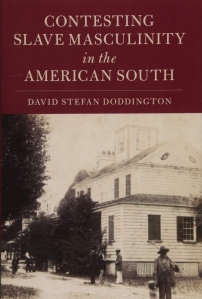 David Doddington is a Senior Lecturer in North American History at Cardiff University. His research interests centre on slavery, race, and gender in the antebellum South, with a particular interest in examining resistance, survival, and solidarity within slave communities. Today he speaks with Rachel Herrmann about his new book, Contesting Slave Masculinity in the American South. Find him on Twitter at @d_doddington. Continue reading
Q&A with Joseph Adelman
 Today, The Junto interviews our own Joseph Adelman about his new book Revolutionary Networks: The Business and Politics of Printing the News, 1763–1789. Jordan Taylor’s review of the book appeared yesterday.
Junto: Let’s start off on a hostile note: Why should anyone care about early American newspaper printers?
JMA: Well if you’re going to be hostile, I’m tempted to just say “because I said so.” But assuming that will work about as well here as it does with my kids, let me make the case as best I can. At its core, Revolutionary Networksargues that the material realities of texts matters, and that scholars have tended to elide or simply stipulate their importance. Or, to put it in historiographic terms, we need to integrate book history methods more fully into our understanding of politics in Revolutionary America. So when I started doing research for the book when it was a dissertation, I focused on the production and circulation of texts and the impact those processes had on how American colonists and British officials made political decisions.
Continue reading
Review: Adelman, Revolutionary Networks
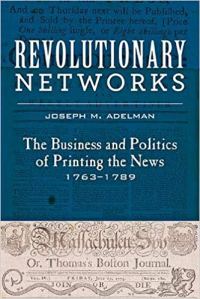 Joseph M. Adelman, Revolutionary Networks: The Business and Politics of Printing the News, 1763–1789 (Baltimore: Johns Hopkins University Press, 2019).
Historians often rely on a pair of archetypes to think about early American newspaper printers. First, in colonial British North America, printers evaded regulators by pretending to be “meer mechanics” who simply passed along information as it came to them. When he published the Pennsylvania Gazette in the early eighteenth century, for example, Benjamin Franklin famously protested that “Printers naturally acquire a vast Unconcernedness as to the right or wrong Opinions contain’d in what they print.” Second, historians of the American Revolution and the early U.S. republic often valorize printers as ideologically-driven leaders whose presses pushed forward political causes. Beginning with Isaiah Thomas’s history of printing and David Ramsey’s history of the American Revolution, scholars have often been inclined to treat printers as central heroes of the revolutionary era. Continue reading
 The Junto