 Last week, the Library Company of Philadelphia and the McNeil Center for Early American Studies hosted the Early American Literature and Material Texts Workshop, generously sponsored for the fifth time by the Andrew W. Mellon Foundation. Led this year by Meredith McGill, the workshop offers a chance each summer for some material-texts scholars to get together and talk about their work and reflect on what attention to the material conditions of texts can bring to the study of, primarily, history and literature. This year there was a particular focus on materiality as it relates to how we think about form and genre–we had great sessions on nineteenth-century autobiography as a genre, P.T. Barnum, the print transmission of colonial media narratives, and the meaning of format from manuscript to magazine to mp3. It’s always humbling and exciting to glimpse the high level on which other scholars are thinking about some of the things I’m interested in. Continue reading
Category Archives: Commentary
A PhD Student’s Case for Embargoes
Note: I welcome this opportunity to expound more fully on a few quotes from me in a New York Times piece about the AHA statement. You can find my Storify of the debates on Twitter and in the blogosphere related to the statement here. It is also worth reminding readers that the opinions in our pieces are those of the author and not of the blog as a whole.
 A recent policy recommendation by the AHA on the embargoing of dissertations—i.e., limiting online access and distribution for a specified period of time—has created quite a stir in the blogosphere and on Twitter. Many are criticizing the AHA for a reactionary policy that concedes the status quo, i.e., the undue influence and interest of university presses in hiring and tenure decisions and the profession’s overall laxity in adapting to the digital revolution.
Let me be clear from the outset: I am not defending the AHA’s statement, per se. It does indeed ignore the broader issue of what the AHA intends to do about the long-term, systemic problem of the profession’s transition into the digital era, more generally. I am, however, going to defend the policy of allowing students the option to embargo. Continue reading
Guest Post: Sports Talk Radio, Sabermetrics, and Carl Becker
Mark Boonshoft is a PhD candidate at Ohio State University. His work focuses on colleges and academies, especially the networks forged in them, and their role in the formation of revolutionary political culture.

“Long time listener, first time caller.” These are words I heard often as a kid. I grew up listening to sports talk radio—mostly 660AM, WFAN-New York—and this is how many a caller introduced themselves. I’ve limited my habit—I no longer keep a transistor radio quietly playing under my pillow while I sleep—but I have not shaken it entirely. Long car rides are still a good chance to binge, and binge I did this July Fourth weekend. Driving through Albany, I called in for the first time ever. Continue reading
Violence, Revolution, and Lessons from Egypt
There’s a nasty undercurrent of triumphalism latent in much analysis of recent events in Egypt. When considering how the “Egyptian Revolution” seems to have gone awry in recent weeks, some commentators have lauded the experience of the American Revolution and proclaimed the importance of civil society. If only Egypt had the mature society America possessed in the 18th century, they seem to say, maybe there wouldn’t be a necessity of military control. It’s as if they read Tocqueville and assumed that he spoke timeless truths about the entirety of American history, rather than really thinking deeply about the process of winning Independence. (Then again, we already knew that about George Will, didn’t we?) Continue reading
Why A Brit Should Teach American Revolutionary History
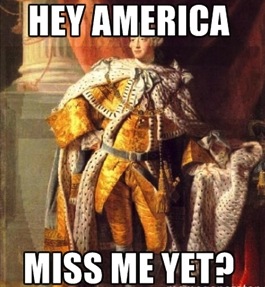 “There’s just one question I have to ask,” said the pleasant young man at the US Embassy, reviewing my visa application. “You are aware that we won, right?”
As a Brit teaching early American history in the U.S., I get some version of this question quite a lot. And it’s something I play up to in my own classes, as well. Many of my courses begin with the warning: “If you learn nothing else over the next 15 weeks, you will understand what it is like to be subject to arbitrary British despotism.” When teaching the Boston Massacre, I jest that I’m worried to give too much information, just in case my students get ideas. And in teaching colonial history, I remind my students that the history we cover is as British as it is American.
The New Left’s Usable Past
Recently, the USIH blog has been debating what historians mean by “a usable past,” and whether that concept is, well, useful. It reminded me of a clash of views from fifty years ago, which has always struck me as a defining expression of the tension at the heart of the New Left, and perhaps the historical enterprise itself: Eugene Genovese’s argument with Staughton Lynd.
In Intellectual Origins of American Radicalism, Lynd gave a provocative summary of his goals. “I am less interested in eighteenth-century radicalism than in twentieth-century radicalism. […] The characteristic concepts of the existential radicalism of today have a long and honourable history. Acquaintance with that history may help in sharpening intellectual tools for the work of tomorrow.”[1] He was, in other words, presenting a usable past; not a false one, but one constructed for the purpose of the present. Continue reading
Process and Protest
 One of the biggest difficulties I find in teaching the American Revolution is explaining to my students the large time gaps between so many of the most seminal events of the Revolution. The popular narrative of the Revolution has a tendency to conflate the Stamp Act with the Declaration of Independence with the Constitution, with perhaps a quick pause to celebrate Washington’s victory at Yorktown. Yet if the Stamp Act crisis happened today, it would be 2024 before we reached the Declaration of Independence, and 2035 before the Constitutional Convention met.
Over the last month or so, it’s been difficult to follow world news without seeing protests of some sort. Turkish protestors in Istanbul have attended demonstrations in opposition to Prime Minister Erdogan; Brazilians have protested the huge sums being invested in the 2014 World Cup at the same time many inhabitants are suffering from crushing poverty. In future years, it’s quite possible we will look at both protests as a seminal moment in their countries’ histories; stepping stones en route to a considerably more substantial change in governmental systems. Continue reading
Remembering “Jefferson’s Statute”
 Few documents in the history of American religious freedom are as famous as Virginia’s “[A]ct for establishing religious freedom” – also known as Virginia’s Statute for Religious Freedom or (more colloquially) as Jefferson’s Statute. A quick glance at Jefferson’s text (carefully edited by the Virginia General Assembly) shows us why. Few other documents are such a clear and powerful exposition on the need for freedom of conscience.[1] The text has also aged well and appeals both sides of our modern church-state conflicts. On one hand the Statute suggests that religious freedom is a gift from god, for the “Almighty God hath created the mind free,” and on the other argues that religious beliefs are no different from “our opinions in physics or geometry.” In the Statute what the twenty-first century reader would think of as distinct “religious” and “secular” discourses are melded with spiritual coercion denounced as both “sinful and tyrannical.”[2] Who can disagree with that? It is no wonder why, then, that Jefferson had his role in drafting Virginia’s Statute for Religious Freedom engraved on his tombstone. Continue reading
Teaching Narrative in Graduate School
This past Monday I turned in my final paper in a graduate seminar given by John Demos entitled, “Narrative and Other Histories.” I initially registered for the class not long after watching Bill Cronon’s Presidential Address at this year’s AHA Annual Meeting and engaging in conversation about it on Twitter as well as in a piece for The Junto. With all the focus on “storytelling” and narrative as a means for carving out a twenty-first-century model of the historical profession, the course offering appeared quite timely. Continue reading
Thomas Hobbes and Post-Revolutionary American Citizenship
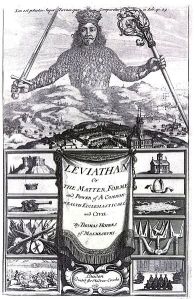 “Considered broadly,” says Douglas Bradburn, “the problem of ‘citizenship’ remains one of the most compelling contexts to attempt to understand the process, limits, and meaning of the American Revolution.”[1] This post is a brief exercise in the problem of American citizenship in the immediate post-revolutionary era (and a note towards an article-length project on international law in the new republic). It begins with the dilemma of dealing with the fallout of a civil war like the War of Independence, and it follows the reception of a slightly unexpected figure in the history of American political thought: Thomas Hobbes.
 Continue reading
 The Junto