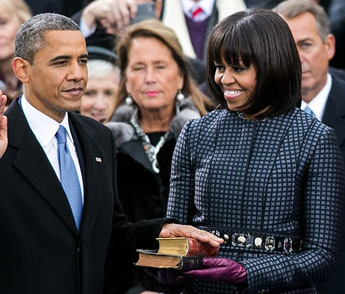
A Stack of Bibles

President Barack Obama takes the oath of office, Jan. 21, 2013.  <a href="http://www.whitehouse.gov/sites/default/files/imagecache/embedded_img_full/image/image_file/20130121-oath.jpeg">Official White House photo by Sonya N. Hebert.</a>

As has been widely reported, on Monday President Obama swore on a stack of bibles to uphold the Constitution. On one hand, maybe doubling-up on the sacred iconography will reassure those on the right who doubt the President’s sincerity, but the primary purpose was to honor two periods of American history simultaneously. This year marks the 150th anniversary of the Emancipation Proclamation and the 50th anniversary of the March on Washington, and the bibles were direct material links to those eras: one was the bible on which Abraham Lincoln took the oath of office in 1861, and the other belonged to Dr. Martin Luther King, Jr.

United in this one event, they are very different books. The Lincoln bible has, for all intents and purposes, never been used.  Continue reading
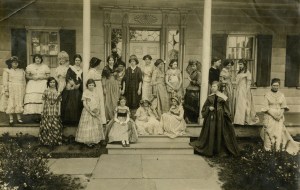
Early America, with a Brooklyn Accent

Historic reenactors at Lefferts House, Prospect Park (1938)

Last week, we asked how digital projects are transforming our study of early American life and culture. Here’s the first in a series of interviews with historians who tell us what worked, how digital tools shaped the narrative, and where they want to go next on the digital frontier. This week, we asked the Brooklyn Historical Society for a peek at the making of a special digital exhibit on the Lefferts family of New York. As Breuckelen becomes Brooklyn, readers can link to local sites where the Lefferts family lived and worked, including the Lefferts Historic Homestead in Prospect Park (shown here: Historical re-enactors gathering on the front steps in 1938). The Leffertses were influential landowners, politicians, historians, financiers—and also one of the county’s biggest slaveholding families. Their letters, farm accounts, and recipe books offer a new and very personal window on New York’s development.Our thanks to Jacob Nadal, the Director of Library and Archives, and Julie Golia, Public Historian and Curator, who kindly took our questions on bringing nearly four centuries of Brooklyn to digital life. Continue reading

About a Book

allen_bible_tp

Ceci n’est pas une book.

She was encased in stolen books, buried in them as if in dirt. The thought of the countless hundreds of thousands of names that surrounded her, vainly scrawled in top right-hand corners – the weight of all that ignored ink, the endless proclamations that this is mine this is mine, every one of them snubbed simply and imperiously….The ease with which those little commands were broken.

She felt as if all around her, morose ghosts were milling, unable to accept that the volumes were no longer theirs.

China Miéville, The Scar

So, on the heels of Christopher’s eloquent framing of the questions of historical distance, a material-texts take on the joys of negotiating that distance by using dead people’s books: Continue reading