Over the last week, Joseph Adelman, Ken Owen, Jessica Parr, and I have compiled a four part series of posts describing our attempts to incorporate digital methods into our early American history classes. As all of us are aware, however, we’re not experts–nor do we consider our posts the last word on such assignments. Continue reading
Category Archives: Pedagogy
Digital Pedagogy Roundtable, Part 2: Pitching Courses for Non-Majors
This week, The Junto features a roundtable on digital pedagogy, in which we discuss our different approaches to using digital sources in the classroom. Today, Joseph Adelman talks about working with students on technical knowledge. You can also read Part 1 by Rachel Herrmann on source accesibility, and Part 3 by Joseph Adelman on the role of technical knowledge in digital pedagogy.
 In her kick off of this week’s roundtable on Digital Pedagogy, Rachel talked about the shades of Digital History, noting Lincoln Mullen’s 2010 post “Digital Humanities Spectrum; or, We’re all Digital Humanists Now.” I have written on spatial humanities approaches to religious history, and I do have some experience with text mining and coding. (XML, CSS, as well as some rudimentary Perl and Python.) By virtue of my library science background, I also have some training and experience in digitization, metadata, and digital stewardship. I am not a coder in the sense that true digital scholars like Mullen are, but I can speak techie and navigate that world with relative ease. Continue reading
Digital Pedagogy Roundtable, Part 1: Students’ Access to Sources
This week, The Junto will feature a roundtable on digital pedagogy, in which we discuss our different approaches to using digital sources in the classroom. Today, Rachel Herrmann talks about the challenge of access. Jessica Parr, Joseph Adelman, and Ken Owen will also contribute.
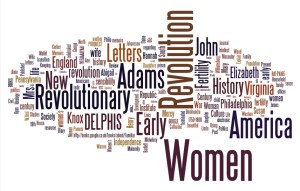
A Wordle made from sources my undergraduates located for our in-class source-finding competition
Let me preface this post by saying that I’d hesitate to call myself a digital humanist; I don’t code or map or mine texts. As Lincoln Mullen pointed out a while back, however, digital practices exist on a spectrum. There are some things I do for my own research and in the classroom—tweeting, running my department’s social media accounts, using Amazon’s “Look Inside” feature to chase up a footnote so as not to use up one of my precious Interlibrary Loan requests, and of course, blogging for The Junto—that digital humanists also do. These approaches have been helpful in my teaching for three problems related to access to sources. Continue reading
Graphic Novels in the Classroom
 This week we’ve discussed the graphic novels as historical fiction, the strengths of using graphic novels to discuss fraught material, and complex process of adapting historical research to sequential art. We would like to end our roundtable discussing more broadly the possibilities of using graphic novels in the classroom.
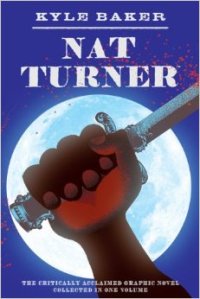
The first strength of graphic novels is their novelty. Assigning works like Kyle Baker’s Nat Turner or Fetter-Vorm and Kelman’s Battle Lines is a surprise to most students. By not being another monograph or set of primary sources, graphic novels shake up a syllabus. This is good for students, who may be interested in exploring a subject in a more unconventional way, and for teachers, for it forces us to reconsider how to teach subjects we may have taught many, many times. This novelty also adds some additional accessibility for students who might be skeptical of reading more traditional assignments. Continue reading
Teaching Trauma: Narrative and the Use of Graphic Novels in Discussing Difficult Pasts
Roy Rogers kicked off yesterday’s 4-day roundtable with a review of the graphic novel, Rebel. For day two of our roundtable on graphic novels and history, I will discuss the use of graphic novels in teaching traumatic histories.
 As anyone who has taught the history of slavery knows, it can be challenging. It is an important, but also emotionally loaded subject that can provoke spirited responses from students. Some students are resistant to discussing what they view as an ugly event in the past. Others may become defensive. And, for others, the history of slavery may be personal. The challenge becomes presenting the history in a thoughtful way that will engage students, but does not whitewashing history. Other traumatic events—genocide, war, etc.—can present similar pedagogical challenges.
Guest Post: Incorporating History and the Humanities into International Business
Chryssa Sharp is an Associate Professor of International Business in the Robert W. Plaster School of Business and Entrepreneurship at Lindenwood University in St. Charles, Missouri. She earned a PhD in Management from the University of Calgary in Canada and an MBA in International Management from the Thunderbird School of Global Management. Dr. Sharp’s industry experiences encompass aspects of marketing, strategic planning, and cross-cultural communications. She has also been involved with developing programs to support small business exporting.
 Historical knowledge plays an important role in the international business field. Ironically, as programs in the humanities are forced to justify their relevance to administrators, elected officials, and the general public, we, as a society, are in need of those fields’ contributions to creating the desired “global citizen.”
I’d Like to Teach Students About, Some Teleology

If only Don had read Hofstadter on the paranoid style.
Like many of my friends, I’ve spent the past few weeks anxiously awaiting the series finale of Mad Men. I started watching a bit late, but caught up, and eagerly watched each week in April and May to find out how show creator Matthew Weiner would leave the stories of the main characters. And in the past few days, I’ve been mulling over the finale and in particular how it ended. Then yesterday, I realized that the finale of a beloved TV series actually has quite a bit to tell us (and possibly our students) about the omnipresent specter of teleology in the study of the past. [NOTE: Spoilers ahead, just in case.]
When the Old is New
 Sometime in the 1990s, NBC decided to promote its usual lineup of summer reruns with the tag line, “if you haven’t seen it, it’s new to you!” I’ve thought about that line occasionally since I started grad school, and came to it again this week as I’m working on syllabi (including, yes, a belated book order) for the fall semester. The problem I’m facing is a familiar one: how to balance the desire to engage in discussions of the newest work on a given topic—in this case the American Revolution—with the fact that they haven’t yet encountered some of the classic arguments.
Teaching the Historiographical Intervention
 Last year, my university shifted its policy on assignments, meaning that faculty members suddenly got the option to change extant assignments, make new ones, and alter the weighting of any of them. This was a big transition, given that in previous years assignments were set by the department and students in each of our three class years could expect similar assignments in their courses. As a result, I’ve been playing around with assignments of zero or very little weight to try to prepare students—especially first year students—for the sometimes daunting task of the final essay assignment. Whereas before there was one low-weighted writing assignment before the final essay was due, I now have the low-weighted writing assignment (it’s half the length it was in previous years), an unassessed research proposal, and an annotated bibliography worth 10%. I want to talk about one of the problems with this last assignment. Continue reading
Guest Post: Barton Price on Academic Support in the Survey Course
Today’s guest post comes from Barton Price. Barton is the Director of the Centers for Academic Success and Achievement at Indiana University – Purdue University Fort Wayne (IPFW). He has taught courses in American history, religious studies, and history of rock and roll at IPFW. Price has a Ph.D. in American religious history from Florida State University. His research interests vary from religion in the American heartland to the scholarship of teaching and learning in religious studies and history. Here he offers some thoughts on teaching the U.S. History survey course gleaned from his administrative experience in an academic support center.
 The start of another semester is upon us. It is a new opportunity to teach students about America’s past, to correct longstanding inaccurate assumptions about that past, and to introduce students to the ways of thinking like a historian. It is also an opportunity to foster student academic success. The introductory survey course is a venue for such accomplishments. Continue reading
 The Junto