Forgotten Giant: Restoring Simms

"Washington Irving and His Literary Friends at Sunnyside." Simms stands, leaning against the chair, center left.

“Washington Irving and His Literary Friends at Sunnyside.” Simms is seated at the left end of the table, shown in full profile.
(Christian Schussele, Oil on canvas, National Portrait Gallery, Smithsonian Institution, 1864)

Meet a Southern man of letters, William Gilmore Simms, through his life’s work of literature—much of it now available in the form of free, digital editions thanks to the Simms Intitiatives at the University of South Carolina. A well-known editor, critic, poet and historian of Southern life and culture in his day, Simms (1806-1870) occupies a unique position in early American literature, and (re)introducing him to modern readers has presented new challenges for scholars. The Junto asked the Initiatives’ Todd Hagstette, Simms Curator, to talk about creating a digital portrait of  the author, and why Simms’s work belongs on the syllabus. Continue reading
Early America, with a Brooklyn Accent

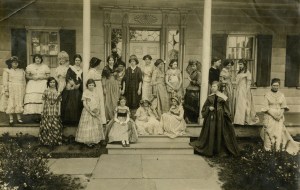
Historic reenactors at Lefferts House, Prospect Park (1938)

Last week, we asked how digital projects are transforming our study of early American life and culture. Here’s the first in a series of interviews with historians who tell us what worked, how digital tools shaped the narrative, and where they want to go next on the digital frontier. This week, we asked the Brooklyn Historical Society for a peek at the making of a special digital exhibit on the Lefferts family of New York. As Breuckelen becomes Brooklyn, readers can link to local sites where the Lefferts family lived and worked, including the Lefferts Historic Homestead in Prospect Park (shown here: Historical re-enactors gathering on the front steps in 1938). The Leffertses were influential landowners, politicians, historians, financiers—and also one of the county’s biggest slaveholding families. Their letters, farm accounts, and recipe books offer a new and very personal window on New York’s development.Our thanks to Jacob Nadal, the Director of Library and Archives, and Julie Golia, Public Historian and Curator, who kindly took our questions on bringing nearly four centuries of Brooklyn to digital life. Continue reading

Edutainment and the Boston Tea Party

In recent years, the museum world has become inundated with edutainment sites and exhibits that hope to entice younger, more tech-savvy visitors, as well as people who do not tend to frequent museums, with all the bells and whistles of electronics and media. Videos, audio recordings, touch screens, and smart phone apps attempt to make history relevant to modern-day audiences by drawing them in with high-resolution graphics and multi-sensory experiences. At a time when funding for cultural institutions often takes a back seat, and when technology is everywhere and impossible to ignore, this push to increase revenue, visitation, and visitor interaction is unavoidable and understandable.

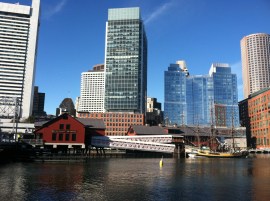
I recently ventured to the Boston Tea Party MuseumHistoric Tours of America’s updated and expanded building (to the tune of $28 million) along the Boston waterfront, and one of the most extreme examples of edutainment that I’ve seen. My visit got me thinking about the ways in which history museums use technology and media to attract visitors, and the ways in which this technology can both clarify and obscure the historical information that is presented to the public. After touring the Boston Tea Party Museum I couldn’t help but wonder, when does a museum stop being a museum and become something else entirely?  Continue reading