About a Book

allen_bible_tp

Ceci n’est pas une book.

She was encased in stolen books, buried in them as if in dirt. The thought of the countless hundreds of thousands of names that surrounded her, vainly scrawled in top right-hand corners – the weight of all that ignored ink, the endless proclamations that this is mine this is mine, every one of them snubbed simply and imperiously….The ease with which those little commands were broken.

She felt as if all around her, morose ghosts were milling, unable to accept that the volumes were no longer theirs.

China Miéville, The Scar

So, on the heels of Christopher’s eloquent framing of the questions of historical distance, a material-texts take on the joys of negotiating that distance by using dead people’s books: Continue reading
Enough Already! Or, Do We Really Need More Haitian Scholarship?

My apologies for my first Junto post being a bit of shameless self-promotion.  But here it is: a piece I just wrote for The New York Times on Haiti’s role in the Civil War.  In short, it’s about how a small but significant portion of black Americans saw Haiti as a better option than the United States during the conflict.  As Matt Karp wrote on his Junto post today, the most groundbreaking Haiti-related scholarship today deals with what happened after the Haitian Revolution, that is, post-1804. Continue reading

Journal Articles in 2012: A Retrospective

AHR

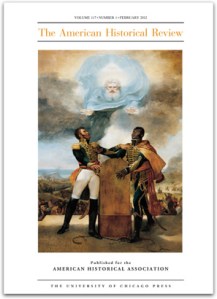
BuzzFeed would point out that God is totally portrait-bombing Pétion and Dessalines here.

“The list,” says Umberto Eco, “is the origin of culture… What does culture want? To make infinity comprehensible.” This impossible project has inspired dauntless gallants from Homer to BuzzFeed, and even in our own brief existence, The Junto has already made a valuable contribution to that noblest of list genres, the year-in-review inventory.

Today I’ll attempt to advance the cause of culture with a few notes on the particular infinity of early American history articles published in 2012. Unfortunately I can’t apologize for my own personal and intellectual biases, which lean toward international politics, slavery and abolition, and historiography, all of it within the nineteenth century. A successful list is usually just private prejudice, artfully compressed and shrewdly disguised—Homer, after all, chose to focus on the Achaeans’ black ships and famous spearmen rather than their haircuts or favorite foods; the BuzzFeed guy sems to have a thing for marine mammals. But you should know where I’m coming from before we proceed. Continue reading