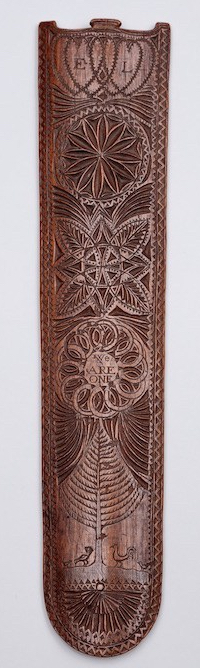
A busk for a woman’s stays, wood, American-made in Canada, 1782. Photo courtesy of the Museum of the American Revolution.
Welcome to #ColonialCouture, our second annual roundtable on fashion in early America and material culture in the Atlantic World, which will run here for the next two weeks.
Today’s post is by Cynthia Chin, a doctoral student at Georgetown University who is researching eighteenth-century material culture, with a particular focus on what Martha Washington’s surviving extant gowns tell us about her, and the world in which she lived. Follow her @cynthiawriter.
“Off with that happy busk, which I envy…” John Donne, To His Mistress Going to Bed
While Fashion Week Fall 2018 finds iconic designer John Galliano (ironically, and not so ironically) “liberating men with corsets”[1] – the women of eighteenth-century British America were confined and complexly bound by stays and busks. Women during this period wore stays[2], often with a busk inserted inside. A busk is a flat, stiff, oblong object, and in eighteenth-century British America, most frequently carved from wood.[3] Providing additional structure and shaping to a pair of stays, a busk would be slipped inside a vertical channel in the stay’s center-front.[4] The wearing of a busk ensured that a woman achieved the fashionable (and socially prescribed) straight, flat, conical, enlongated torso that dominated the female aesthetic in the long eighteenth century. Continue reading
 On May 21, 1796, as George and Martha Washington ate their supper in the Philadelphia Executive Mansion, their twenty-two year old house slave, Ona Judge, walked out of the house and into freedom. With the help of the free black community in Philadelphia, Judge made her way to Portsmouth, New Hampshire where the free black community and white supporters provided refuge.
 The Junto