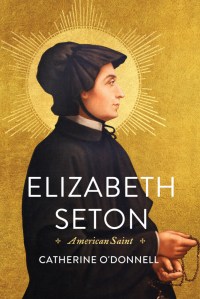
 Today’s guest post is authored by Catherine O’Donnell. Her book, Elizabeth Seton: American Saint was published this month by Cornell University Press. She is also the author of Men of Letters in the Early Republic (UNC Press, 2008) and is an associate professor of history at Arizona State University.
When I arrived at the archive in Emmitsburg, Maryland, my heart sank. My subject was Elizabeth Seton, woman of the early American republic and saint in the Roman Catholic Church, and the archives to which I’d traveled are held on the grounds of her shrine. In order to be at the archives first thing Monday, I’d arrived on a Sunday and decided to see what was happening nearby. The building adjacent to the archives is a minor basilica, so what was happening was Mass. When a guide asked whether I’d visited the Altar of Relics, I winced. I felt oddly guilty about bring my historian’s purposes and questions into this reverent world. I also knew that biographers pride themselves on not writing hagiographies, and that many academic historians pride themselves on not being biographers at all. I felt I was blaspheming both a faith and a profession. Continue reading

 Maryland’s religious history is unique in colonial British North America. We largely remember Maryland as the Catholic colony that embraced religious toleration and religious freedom, in contrast to New England’s stodgily Puritan establishment or Virginia’s scattered Anglican church. Scholars and commentators looking for sources or influences on the First Amendment are consistently drawn to the colony’s justifiably famous 1649 “Act concerning Religion.” This act made it a crime to “declare call or denominate any pson or psons whatsoever inhabiting” Maryland “an heritick, Scismatick, Idolater, puritan, Independant, Prespiterian popish prest, Jesuite, Jesuited papist, Lutheran, Calvenist, Anabaptist, Brownist, Antinomian, Barro-wist, Roundhead, Sepatist, or any other name or terme in a reproachfull manner relating to matter of Religion.” “[T]he free exercise” of Christian religion was explicitly protected by the act, with repeat violators of their fellow colonialists’ conscience were to be “severely punished by publick whipping & imprisonmt.”[1] The “Act concerning Religion” places Maryland next to Rhode Island and Pennsylvania as one of the colonial regimes committed, for European Christians at least, to religious freedom in the seventeenth century.
 The Junto