I’ve been reading, writing, and thinking about Virginia’s colonial Anglican establishment since I entered graduate school (back when the Galactica had just uncovered the fate of Earth and Lehman Brothers was still short-selling subprime mortgages). This work led me to decide to write a dissertation on the religious politics and fate of the colonial establishments in the post-Revolutionary Chesapeake. Beginning the real work on my dissertation, however, has hammered home one important insight: despite all that reading I still don’t have a real sense of what the hell was going with Virginia’s colonial establishment. Continue reading
Tag Archives: Virginia
Remembering “Jefferson’s Statute”
 Few documents in the history of American religious freedom are as famous as Virginia’s “[A]ct for establishing religious freedom” – also known as Virginia’s Statute for Religious Freedom or (more colloquially) as Jefferson’s Statute. A quick glance at Jefferson’s text (carefully edited by the Virginia General Assembly) shows us why. Few other documents are such a clear and powerful exposition on the need for freedom of conscience.[1] The text has also aged well and appeals both sides of our modern church-state conflicts. On one hand the Statute suggests that religious freedom is a gift from god, for the “Almighty God hath created the mind free,” and on the other argues that religious beliefs are no different from “our opinions in physics or geometry.” In the Statute what the twenty-first century reader would think of as distinct “religious” and “secular” discourses are melded with spiritual coercion denounced as both “sinful and tyrannical.”[2] Who can disagree with that? It is no wonder why, then, that Jefferson had his role in drafting Virginia’s Statute for Religious Freedom engraved on his tombstone. Continue reading
Digging Out My Cannibal Girl Hat
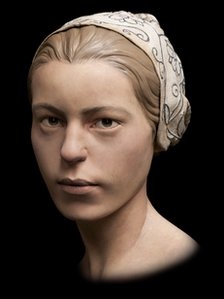
A reconstruction of the skull of a 14-year-old girl that researchers have named “Jane.”
I have some initial thoughts on new reports of cannibalism at Jamestown, so I’ve cross-posted them from my personal blog.
So, funny story. When I first submitted my article on cannibalism and the Starving Time at Jamestown to the William and Mary Quarterly, the piece strongly argued against any occurrence of cannibalism. When I got my readers’ reports back, Editor Chris Grasso pointed out that I didn’t really have the evidence to convincingly make that claim. He said that he’d accept the article only if I agreed to temper the argument—which was really fine with me because the main point of the essay was to ask why the stories of cannibalism mattered, not to argue for or against the existence of cannibalism in colonial Virginia. Continue reading
 The Junto