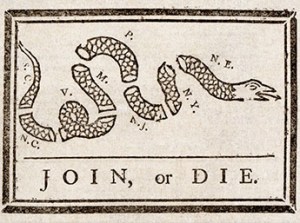
 At the risk of overkill, I have thoughts about the “So Sudden an Alteration” conference hosted by the Massachusetts Historical Society, which I attended along with a number of my Junto colleagues. I’d like to pick up on the themes of the conference to discuss an underlying tension in the conversation that never quite reached the surface in explict terms.
Author Archives: Joseph M. Adelman
Live Coverage of “So Sudden an Alteration” Conference
As you know from last week’s posts by Michael and Ken, this weekend is the second major conference in two years on the American Revolution, So Sudden an Alteration, hosted by the Massachusetts Historical Society.
There have already been a number of great papers, and some hot debates on the meaning of studying the Revolution, with more to come today.
We will have full coverage next week, but in the meantime, you can keep up with the conference on Twitter by following the hashtag, #RevReborn2, or Juntoists at the conference, including me (@jmadelman), Jessica Parr (@ProvAtlantic), Michael Hattem (@MichaelHattem), and Tom Cutterham (@tomcutterham).
You can also follow several friends of the blog: Liz Covart (@lizcovart), John Bell (@Boston1775), and the MHS institutional account (@MHS1791).
UPDATE (4/12, 8pm): Now that the conference is over, you can also check out several summations of the conference.
Michael Hattem created a Storify for each of the three days of the conference:
And there is also a more basic archive of tweets and an interactive explorer.
The Week in Early American History
 Happy Sunday, and welcome to another edition of The Week in Early American History. Here at the Junto, we’re gearing up for the Sweet Sixteen beginning tomorrow (since Villanova, Iowa State, and Baylor have basically thwarted our brackets for that “other” March Madness). Here for your enjoyment before you get distracted by basketball (or by trying to avoid basketball), are today’s links.
The Junto Guide to Early America at #AHA2015
 Happy New Year from all of us at The Junto! We hope you had a restful and enjoyable holiday break. For historians, the turn of the calendar to 2015 means that many of us are en route to the AHA Annual Meeting in New York City. Having grown up in the area, I’d like to welcome you all to New York, where the bagels and pizza are really just better, and we stand “on line” for coffee, not “in line.”
Telling the Story of Women in Printing
 Today is Ada Lovelace Day, an international celebration of women in STEM fields (Science, Technology, Engineering, and Mathematics) both past and present named after the early nineteenth-century British mathematician. Here in our corner of early American studies, I want to mark the occasion by working through a question that I’ve worked on in my own writing for years: how do we effectively integrate women into the history of printing in early America?
Summer Book Club, Week 6
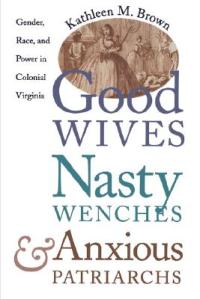 And so we’ve come to the end of the road, a consideration today of the final chapter of Kathy Brown’s Good Wives, Nasty Wenches, & Anxious Patriarchs (the full set of posts is available here). We’ve enjoyed working through the book over the past several weeks, and look forward to a healthy conversation about the final chapter.
Summer Book Club, Week 1

Welcome to the Junto Summer Book Club, where over the next six Fridays we will be reading and discussing Kathleen Brown’s 1996 book, Good Wives, Nasty Wenches, & Anxious Patriarchs. Each week, a Junto representative will write a brief post on that week’s chapters to offer a few opening remarks and raise some questions to get the discussion started. We will then open up the comments section for you to address any topic related to the book—its argument, Brown’s use of sources, the historiography, using it in the classroom or in a public setting, to name just a few. We look forward to a lively conversation and to seeing how it develops over the next several weeks.
This week, we begin our conversation with the Introduction and Chapter 1, “Gender and English Identity on the Eve of Colonial Settlement.”
Announcing the Junto Summer Book Club
With summer upon us, many of us are turning our attention to reading lists, whether for upcoming graduate exams, syllabus preparation, research, or pleasure. For many, it’s an opportunity to catch up on new work that sat neglected during the push through the final weeks of the semester and exams, but it’s also an opportunity to return to more classic books that have shaped the field and deserve reconsideration. Plus, we at the Junto love nothing more than to discuss and argue about history. Therefore, we would like to introduce a new feature: the Junto Summer Book Club.
Triggers in the Past
 Over the past few weeks, a discussion about trigger warnings has percolated across the blogosphere. Educators, op-ed columnists, and pundits have debated the use of these warnings about potentially upsetting content on syllabi or in the classroom (and leave it to the Chronicle to publish a disdainful mockery of the concept). As I’ve developed my courses, both at the survey and upper levels, I have confronted some of these same questions about the past: Is there anything in history from which we should shield our students? Or, to put it more broadly, how should we approach material that some of our students may find offensive, hurtful, or painful?
Guest Post: “Early Modern France and the Americas” Conference Recap
Craig Gallagher is a PhD candidate in History at Boston College. His dissertation analyzes Scots and their religious and economic networks in the late seventeenth century British Atlantic World.
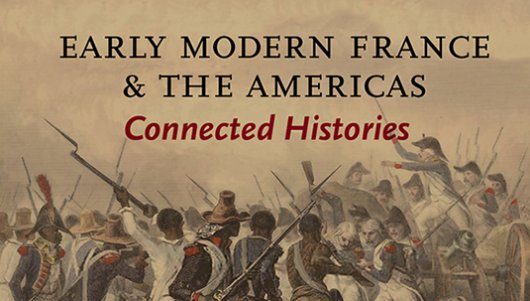 Atlantic history has always had at its heart a simple enough goal: to connect the histories of Europe, Africa, and the Americas so that historians can better understand each in relation to the others. Scholars have disagreed about how best to realize this goal, and about whether it is a goal worth realizing at all, but few have denied that Atlantic history as a pursuit has enriched our understanding of the early modern world. Although this has been particularly true for historians of the British and Spanish empires in the Americas, it is a more recent development among scholars of the French empire. By convening the “Early Modern France and the Americas: Connected Histories” Symposium (Program; #FrenchAtlantic on Twitter) at Boston College on May 2-3 – an event co-sponsored by the Institut des Amériques – the organizers, Owen Stanwood (Boston College) and Bertrand van Ruymbeke (Université de Paris VIII), sought to showcase those historians of France and French North America whose work, either in print or in progress, has extended an Atlantic perspective to the history of France and its early modern empire in the Americas.
 The Junto