
In looking at the weeks ahead, I note with some chagrin
That my work remains unfinished though my lectures must begin.
And so instead of planning class, which should engage my time,
I present the Week in History, to YOU! Today! In rhyme!
In looking at the weeks ahead, I note with some chagrin
That my work remains unfinished though my lectures must begin.
And so instead of planning class, which should engage my time,
I present the Week in History, to YOU! Today! In rhyme!
 Readers will be pleased to note that blog posts might indeed be worth something—though how much remains up in the air.
As you may have read, the Junto is cross-posting some of the pre-conference highlights for the Society for Historians of the Early American Republic’s (SHEAR’s) upcoming July conference in Saint Louis. Continue reading
As you may have read, the Junto is cross-posting some of the pre-conference highlights for the Society for Historians of the Early American Republic’s (SHEAR’s) upcoming July conference in Saint Louis. Continue reading
 In his essay on “Eating American,” the anthropologist Sidney Mintz relates a class conversation during which he admitted that he “did not think that there is such a thing as an American cuisine.”[1] Around this time of year, it’s impossible to ignore the influx of commercials, ads, and general hullabaloo pushing “American food” for the Fourth of July. I have to admit that I’ve been convinced by Mintz’s point for a long time, especially as that assertion pertains to the world of early American cuisine.
I first encountered these definitional problems while writing my undergraduate thesis, (over-)ambitiously titled “A Brief Treatise on the Culinary Nature of America During the Time of the Early Republic. In Which the Author Examines Pumpkins, Puddings, Poems, and People. Calculated to Give the Reader a Better Knowledge of American Food and Foodways, and an Easier Understanding of the American Character.” Needless to say, I was a bit keen on imitating early modern cookbook titles back in the day, but the title betrays more than my need to come up with tongue-in-cheek titles (“Roll, Jelly, Roll” and “Peace Came in the Form of a Cookie” were the fake titles of my dissertation for quite some time): it demonstrates how even though I’d written a long paper about food in the late eighteenth and early nineteenth centuries, I still wasn’t sure what that cuisine offered as a cohesive whole. Continue reading
As you may have read, the Junto is cross-posting some of the pre-conference highlights for the Society for Historians of the Early American Republic’s (SHEAR’s) upcoming July conference in Saint Louis. Continue reading
As you may have read, the Junto is cross-posting some of the pre-conference highlights for the Society for Historians of the Early American Republic’s (SHEAR’s) upcoming July conference in Saint Louis. Continue reading
As you may have read, the Junto is cross-posting some of the pre-conference highlights for the Society for Historians of the Early American Republic’s (SHEAR’s) upcoming July conference in Saint Louis. Continue reading
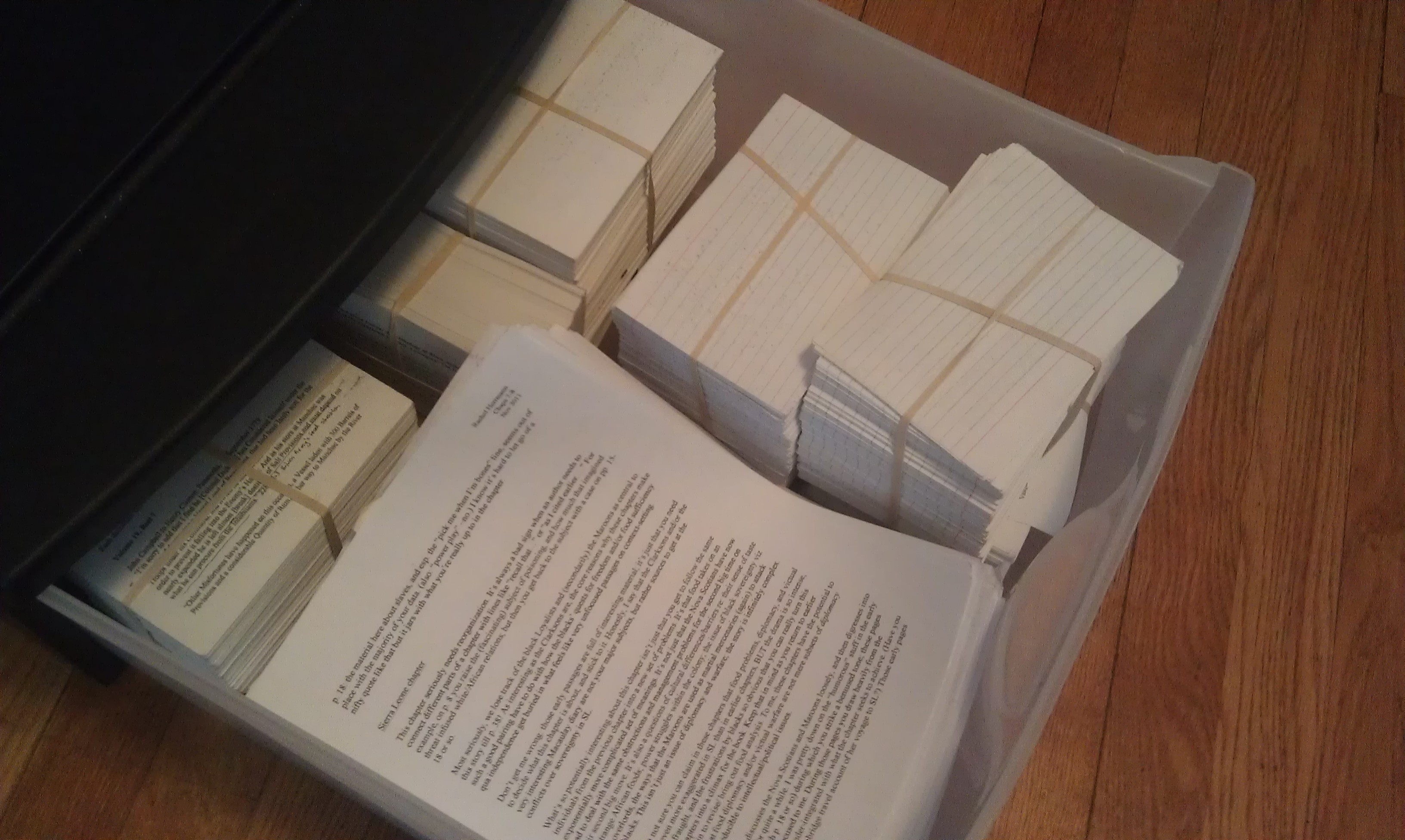
A dissertation’s worth of index cards, a draft, and comments from my adviser
When I was in Philadelphia recently to present a paper at the McNeil Center, I also enjoyed the opportunity to meet undergraduate students who were working on research papers as part of the MCEAS Undergraduate Research Workshop. I was asked to talk about my research methods—how I go about finding sources, how I organize them, and how I pull them together into (sometimes) coherent prose. In doing so, I outed myself as a very old-fashioned researcher, indeed. Continue reading
The Junto is pleased to announce that we will be cross-posting some of the pre-conference highlights for the Society for Historians of the Early American Republic’s (SHEAR’s) upcoming July conference in Saint Louis. Continue reading
 The Junto