Readers of early American history blogs will undoubtedly have come across the recent kerfuffle regarding the divide between academic and public historians of the American Revolution, which stemmed from a series of posts by Peter Feinman assessing the conference. Much of the debate has centered around this post, in which Feinman chided academic historians for their failure to answer the question: “Was the American Revolution a good thing?” Roy Rogers posted an excellent response to this here last week; J.L. Bell at Boston 1775 had other reflections on Monday (and is continuing to address the topic in other posts).
Category Archives: Opinion
When Was the Last Time You Loved America?
Few issues trouble historians of all stripes more than the disconnect between “popular” and “academic” history. Somewhere in the mists of the recent past the Age of Hofstadter gave way to, at best, the Age of McCulloch and, at worst, the Age of Barton.[1] The waning influence of professional historians in the public sphere particularly troubles the historical blogosphere. The popular-academic history disconnect is something addressed a lot here at The Junto, including with a podcast.
I am, as I said on the JuntoCast episode, particular dour about the possibility of bridging this gap. Academic historians, public historians, and interested members of the public more often than not talk past each other. How each group defines “good” or “useful” history is often so at cross-purposes that it sounds like one side is speaking English, another French, and another Dothraki.[2] My attention was recently drawn to a series of posts by Peter Feinman at New York History, which deeply entrenched my Eeyore-like-sullenness when it comes to these questions. Continue reading
SHEAR 2013: Presidential Plenary Session
This post comes to you from the annual meeting of the Society for Historians of the Early American Republic in St Louis. If you’re at the conference, please come and say hello!
 The SHEAR Annual Meeting kicked off this year with the Presidential Plenary session, “Missouri: Crossroads of the Early Republic?” Using the conference’s location as a jumping-off point for discussions of the diverse and multifaceted history of the early nineteenth century, four distinguished historians offered reflections as if located in Missouri, looking across the North American continent in different directions. Walter Johnson then concluded the roundtable with the notional title “Looking Forward,” but calling attention to some ways in which the session might profitably be used by historians looking to introduce new themes and stories into their teaching. Continue reading
The Problem of Virginia’s Colonial Establishment
I’ve been reading, writing, and thinking about Virginia’s colonial Anglican establishment since I entered graduate school (back when the Galactica had just uncovered the fate of Earth and Lehman Brothers was still short-selling subprime mortgages). This work led me to decide to write a dissertation on the religious politics and fate of the colonial establishments in the post-Revolutionary Chesapeake. Beginning the real work on my dissertation, however, has hammered home one important insight: despite all that reading I still don’t have a real sense of what the hell was going with Virginia’s colonial establishment. Continue reading
Violence, Revolution, and Lessons from Egypt
There’s a nasty undercurrent of triumphalism latent in much analysis of recent events in Egypt. When considering how the “Egyptian Revolution” seems to have gone awry in recent weeks, some commentators have lauded the experience of the American Revolution and proclaimed the importance of civil society. If only Egypt had the mature society America possessed in the 18th century, they seem to say, maybe there wouldn’t be a necessity of military control. It’s as if they read Tocqueville and assumed that he spoke timeless truths about the entirety of American history, rather than really thinking deeply about the process of winning Independence. (Then again, we already knew that about George Will, didn’t we?) Continue reading
History Is Not Science
Over at Slate last week, our Junto colleague Eric Herschthal reviewed some of the latest popular histories of revolutionary America, including two new studies of the years around 1776 by Richard Beeman and Joseph Ellis. Eric takes a very critical view of the analytical stance of the books–arguing that they are too in thrall to outdated and invalidated historical techniques; focusing too much on elites and ‘leadership’ at the expense of more recent trends in scholarship, such as the new emphasis on those who stayed (or tried to stay) neutral during the Revolutionary War.
Perhaps the most provocative part of the review is this statement:
“If you bought a popular book on science, one that came with a similar sheen of intellectual prestige, and learned that it essentially ignored years’ worth of scholarship, you’d demand your money back. Why should history be any different?”
To me, the answer seems self-evident. Continue reading
Food in America and American Foodways
 In his essay on “Eating American,” the anthropologist Sidney Mintz relates a class conversation during which he admitted that he “did not think that there is such a thing as an American cuisine.”[1] Around this time of year, it’s impossible to ignore the influx of commercials, ads, and general hullabaloo pushing “American food” for the Fourth of July. I have to admit that I’ve been convinced by Mintz’s point for a long time, especially as that assertion pertains to the world of early American cuisine.
I first encountered these definitional problems while writing my undergraduate thesis, (over-)ambitiously titled “A Brief Treatise on the Culinary Nature of America During the Time of the Early Republic. In Which the Author Examines Pumpkins, Puddings, Poems, and People. Calculated to Give the Reader a Better Knowledge of American Food and Foodways, and an Easier Understanding of the American Character.” Needless to say, I was a bit keen on imitating early modern cookbook titles back in the day, but the title betrays more than my need to come up with tongue-in-cheek titles (“Roll, Jelly, Roll” and “Peace Came in the Form of a Cookie” were the fake titles of my dissertation for quite some time): it demonstrates how even though I’d written a long paper about food in the late eighteenth and early nineteenth centuries, I still wasn’t sure what that cuisine offered as a cohesive whole. Continue reading
The New Left’s Usable Past
Recently, the USIH blog has been debating what historians mean by “a usable past,” and whether that concept is, well, useful. It reminded me of a clash of views from fifty years ago, which has always struck me as a defining expression of the tension at the heart of the New Left, and perhaps the historical enterprise itself: Eugene Genovese’s argument with Staughton Lynd.
In Intellectual Origins of American Radicalism, Lynd gave a provocative summary of his goals. “I am less interested in eighteenth-century radicalism than in twentieth-century radicalism. […] The characteristic concepts of the existential radicalism of today have a long and honourable history. Acquaintance with that history may help in sharpening intellectual tools for the work of tomorrow.”[1] He was, in other words, presenting a usable past; not a false one, but one constructed for the purpose of the present. Continue reading
The Language Question
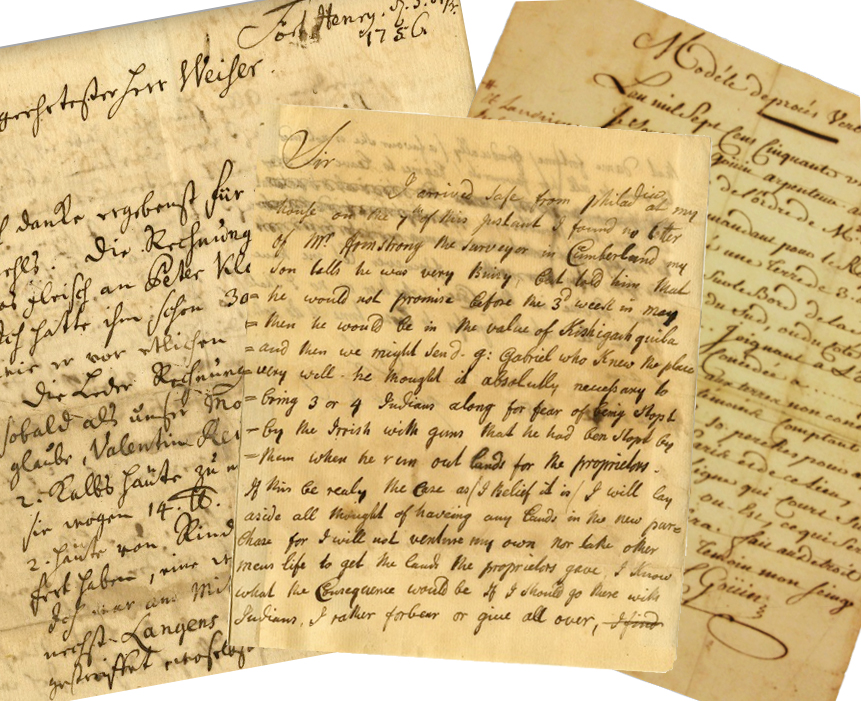 What is the current state of early American language training, what is its future, and why aren’t we more concerned?
A quick survey of more than a dozen graduate programs (all known for their strengths in colonial and early American history) reveals that three quarters of these departments require only one foreign language for early Americanists. To put this into context, the guidelines for European historians at all but one of these same institutions—guidelines often broken down by Early Modern, Western, and British subfields—require at least two foreign languages (yes, even in British history). Yet the issue is not simply the number of languages required of Americanists, but rather what constitutes proficiency. While language guidelines surely vary some from school to school, if the “proficiency” exams and reading courses across History programs even vaguely resemble ones that I’ve encountered, then even these lenient requirements themselves mean very little.
I suspect the numbers and realities of language training surprise very few. But even if we’re not surprised, maybe we should be a little worried. Continue reading
Driving the Dissertation
 For the past several days, I’ve been on the road, driving highways and back streets of Pennsylvania, West Virginia, Kentucky, and Tennessee. Weeks before, with an invitation to an Alabama wedding, and a school year (and orals) finally behind me, I realized I had the perfect opportunity for a road trip. And being the impossibly hip grad student that I am, I also decided I’d be driving my dissertation.
Part of my research entails recovering the mid-eighteenth-century transportation and communication paths that cut across and radiated out from Ohio Valley. While I’ve studied maps, charts, letters, and travel accounts, I’d never traveled on or along those waterways, roads, or footpaths—even the well-known routes of Braddock’s and Forbes Roads.
 The Junto