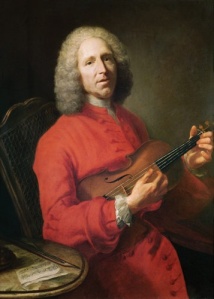
 Recently I’ve been taken by the music of Jean-Philippe Rameau, a French Baroque composer and Enlightenment-era music theorist. Rameau was a divisive figure in his day because he broke from the supremely elegant and nuanced style that had made the court of Louis XIV the center of late-17th-century musical life in Europe. This excerpt from Jean-Baptiste Lully’s 1676 opera Atys gives a sense of the sensitivity and sophistication of 17th-c. French music. Compared to Lully, Rameau’s music was daring and experimental. He turned the orchestra into a powerful beast and wrote music that more dense, more harmonically adventuresome, and more aggressive. He was Frank Sinatra to Lully’s Bing Crosby, the Rolling Stones to Herman’s Hermits, N.W.A. to De La Soul; etc. (making analogies is curiously addictive). Continue reading
Category Archives: Opinion
Constitutional Interpretation and Historians
Yesterday I learned that some Republican state legislators in North Carolina have sponsored a bill to declare an established religion—or at least, to declare that the federal Constitution wouldn’t prohibit such a declaration. In doing so, of course, they disregard a mainstream of constitutional jurisprudence on the issue that goes back into the ninteenth century but was really firmly established in the middle of the twentieth century. I’m not here to talk about that question, but I found it particularly interesting in light of the conversation I’ve been having by email over the last few weeks with Dr. Sean Wilson, an assistant professor of law at Wright State University, about his new book The Flexible Constitution. Continue reading
Policy and Constitutional Principle
As a Brit teaching early American history in the US, I’m often asked how I came to be fascinated by the American Revolution. My answer is generally some version of the following: I’m fascinated by the American Revolution because there are so many reasons why it shouldn’t have ended with the creation of an American republic. Not only was the notion of independence from Britain a daring and risky move, but there were many reasons why the North American colonies could not cohere once they had broken with the mother country. Investigating the ways in which Americans tried to bridge the many gaps between themselves to create powerful and lasting governmental structures is one of the key themes of my research.
A large part of the answer to that conundrum, at least once historical focus shifts to the early republic, is the Constitution. Though, as I have written elsewhere, the mechanics of writing and ratifying the Constitution were scarcely the pristine and perfect process of popular imagination, the longevity of the Constitution must rank as one of the most significant achievements of the revolutionary era. Yet a close look at pretty much any period of American history sees the Constitution wielded as a partisan weapon as often as it is venerated as a ligature holding the separate states together. That is a curious paradox, for there is an implicit and serious criticism in describing a governmental act as “unconstitutional.” It suggests a lack of patriotism and a lack of common feeling; it implies mistrust, rather than emphasizing shared responsibility. Continue reading
After Democratization?
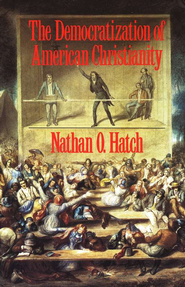 Next year marks the twenty-fifth anniversary of the publication of Nathan Hatch’s seminal The Democratization of American Christianity.[1] Few books have had as wide an influence and impact in my field of the cultural and political history of religiosity in the early American republic. In his masterwork Hatch achieves what most scholars yearn for throughout their entire careers. Democratization crystallized an interpretative scheme (the “democratization thesis”) and shoved its rival interpretation into the historiographical abyss. Continue reading
Reprint This! Thomas Buckley’s “Church & State in Revolutionary Virginia”
 Every sub-field has its classic books. It should not take long for most of us to rattle off a couple of titles. In my field of church-state relations in the early American republic (particularly in the upper South), few books tower over the field more than Thomas E. Buckley’s Church and State in Revolutionary Virginia, 1776-1787.[1] Despite being published thirty-six years ago references to this classic litter the footnotes of subsequent books from fellow classic histories like Rhys Isaac’s Transformation of Virginia to more recent works such as David Sehat’s Myth of American Religious Freedom.[2] Anyone grappling with the politics of religion in early national Virginia, that overheated cauldron of disestablishment, must grapple with Buckley’s work. But this great historian did not stop there; in a series of articles Buckley expanded his analysis to include much of the evolution of religious freedom in the Old Dominion over the nineteenth century.[3] Continue reading
“There was a great argument yesterday on female excellence”: Gender & the Newest Political history
One of the most striking features of the “newest political histories” has been their careful attention to questions of gender. Four essays (for example) in Beyond the Founders, the capstone-cum-manifesto of this particular historiographical moment, deal directly with the political nature of gender identities in the early American republic.[1] The privileged place of gender in these histories makes a great deal of sense–if the goal of the “newest political histories” is to broaden cast of characters in political history and explore the intersection of “cultural” and “ordinary” and “traditional” politics then questions of masculinity, femininity, and sexuality should be central. Gender, along with race, was a key way to demarcate between who was in and who was out of respectable politics in the new nation.
The most productive, and perhaps influential, use of gender as an interpretive lens has been in the political history of women. Many of the earliest works of what could be called the “newest political history,” and those which best exemplify the movement, are histories of women and politics.[2] This generation of historians has shown that women were clear actors in early national politics and print culture–through newspapers, the theater, parades, books, and the salon. Not only were women a direct participant in politics “out of doors” and in print, femininity was deeply politicized in the early national period. In the highly charged politics of the early republic, much was up for grabs–a great deal of prestige and power would be gained (or lost) depending on where the line of respectable political behavior of men and women was drawn. Continue reading
The AHA and the Future of the Profession

This past weekend, historians from all over the country invaded the Big Easy for the American Historical Association’s 2013 Annual Meeting. Thanks to Twitter, those of us unfortunate enough to not be in attendance were kept abreast of the discussions occurring regarding the state of the field. Most notably, the traditional AHA Presidential Address by outgoing President William Cronon has sparked much debate among historians as well as articles in the New York Times and the Chronicle of Higher Education. Before that, Cronon oversaw a panel entitled “The Public Practice of History in and for a Digital Age,” which explored academic historians’ failures to reach the general public and the profession itself failing to sufficiently adapt to the rise of digital technology. Changes to the profession discussed included a renewed focus on storytelling and narrative to better engage the general reader in academic history, weighing digital history equally with print history (when of equal value), and rethinking the monograph as the standard mode of delivery of academic historians’ work. Due to my lack of attendance, I am indebted to the excellent Twitter and blog coverage of these events by John Fea, Lincoln Mullen, and others, as well as the History News Network‘s video recording of Cronon’s address (see below). Continue reading
Sympathy for the Founders
One day soon, someone will write the history of the bankers, fund managers, lawyers and accountants who helped make our present financial crisis. When they do, they’ll need to be careful not to lose sight of the far larger group of people – really, everyone – who were also part of that process, the suffering they endured and the resistance they enacted. It would need to be a cultural, intellectual, legal, political, and social history that gave account not only of how the financial elite thought and acted, but how that thought and action was shaped by structures and events. It would see the world reflected in their eyes. In that moment, it might show a little sympathy.
 That’s how I feel about my own project, a history of power and ideology among American elites in the 1780s. The first question that troubles me – why study elites? – tends to dissolve into a slightly different one – what does it mean to study elites? To be meaningful it has to be a way of studying how historical change happens and how the conditions of life are produced. Elites are both separate and inseparable from the rest of society, linked in a complex, ambivalent embrace that constitutes a kind of class struggle. And class struggle is history in action.
 The Junto