If you have gone hunting for early American music, you probably came across warhorses like 17th-century psalms, “Yankee Doodle” and other Revolutionary songs, maybe William Billings’s extremely popular “Chester” (don’t know this last one? Watch a very earnest John Adams sing it here). All of these can make for excellent musical examples to enliven a class or conference presentation (and I’ll write about music for both those scenarios in the future). However, sometimes listening to recordings of psalms or military marches feels too much like eating a virtuous salad, and not enough like eating ice cream. My survey of recordings is completely unscientific—happily, there is far too much diversity in early American music to provide anything like comprehensive coverage in a blog post—but it seems to me that there is a dearth of albums that are meant for pleasure rather than instruction. Continue reading
Sympathy for the Founders
One day soon, someone will write the history of the bankers, fund managers, lawyers and accountants who helped make our present financial crisis. When they do, they’ll need to be careful not to lose sight of the far larger group of people – really, everyone – who were also part of that process, the suffering they endured and the resistance they enacted. It would need to be a cultural, intellectual, legal, political, and social history that gave account not only of how the financial elite thought and acted, but how that thought and action was shaped by structures and events. It would see the world reflected in their eyes. In that moment, it might show a little sympathy.
 That’s how I feel about my own project, a history of power and ideology among American elites in the 1780s. The first question that troubles me – why study elites? – tends to dissolve into a slightly different one – what does it mean to study elites? To be meaningful it has to be a way of studying how historical change happens and how the conditions of life are produced. Elites are both separate and inseparable from the rest of society, linked in a complex, ambivalent embrace that constitutes a kind of class struggle. And class struggle is history in action.
Herman Husband and Failures of the Historical Imagination
At this time of the semester, amid my ever-increasing piles of grading, my thoughts naturally turn to the syllabi for next semester’s courses. One of my guiding principles in preparing syllabi is the importance of introducing students to the breadth of historical writing; to demonstrate the ways in which diverse groups of people reacted to the same event in very different ways. When teaching early American history, this often casts me in the position of “debunking” various myths about the past—or, at least, forcing my students to think more clearly and carefully when making statements about the foundations of America. This, I like to think, serves the useful purpose of demonstrating how ordinary citizens—those outside the pantheon of “Founding Fathers”—imagined the development of their society, and to show how their vision of political participation was often very different from that claimed today as ‘what the Revolution was all about’.
In many ways, though, my take on the Revolution relies less on “debunking” myths than in widening the participants in the historical story. I suppose “problematizing” or “complicating” the myths is a more accurate description—after all, it’s impossible to escape the fact that the historical significance of the American Revolution rests on the creation of a new nation-state and several new political polities. More recently, though, I’ve come to wonder exactly what I’m hoping to achieve with the broadening of the understanding of the past. No matter how far we widen “founding myths” to encompass a variety of explanations for the promise of America, reliance on these myths can never help us explain the present—they can be a guide only. At my most cynical, I wonder even what sort of guide they can be. Continue reading
The Early Americanist Holiday Book List; Or, My Favorite Books from 2012
If there is a better purpose for an academic blog than to make lists of must-have books and dents in your Amazon budget, I am not aware of it. As the first of what I hope will be an annual tradition, here are ten of my favorite books from the past 12 months. It is obvious that I have particular interests and tastes (early republic, religion, politics), but I tried to expand my comfort zone and include a few titles from other fields. So if you are looking for books you may have missed, need a reminder for books you still need to buy, or require evidence to present to your significant other, you have come to the right place.
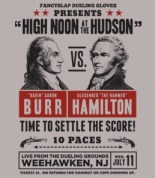 (Placing any of these books on your holiday book list, of course, assumes that you have already purchased this year’s “must have” gift for early Americanists, the Aaron Burr/Alexander Hamilton duel t-shirt, seen to the right.) Continue reading
Jeffersongate: The Case of Henry Wiencek

On October 16, Farrar, Straus and Giroux published Henry Wiencek’s third book, Master of the Mountain: Thomas Jefferson and His Slaves. His previous works both dealt with slavery, most notably his well-received An Imperfect God: George Washington, His Slaves, and the Creation of America. By contrast, his latest work has come under fire from leading Jefferson scholars around the country. Within days of the book’s release, highly critical reviews by academics appeared in online magazines. These reviews started online exchanges that have played out over the last two months and continue to do so.
Historians much more up to the task than myself—including Annette Gordon-Reed, Jan Lewis, and Lucia (Cinder) Stanton—have called into question Wiencek’s use of sources (both primary and secondary), his overall interpretation, and his motives. Therefore, I will not recapitulate all of them here. I have included a chronology with links to all the relevant articles below, with J.L. Bell’s posts at Boston 1775 providing excellent summaries of the most contentious points. Instead, I want to touch on two things: the main part of Wiencek’s argument and how it reflects his broader approach to history and the effects of Wiencek’s treatment of the historiography, both having to do with the larger relationship between popular and academic history. Continue reading
Welcome to The Junto!
“Have you met with any thing in the author you last read, remarkable, or suitable to be communicated to the Junto? particularly in history, morality, poetry, physics, travels, mechanic arts, or other parts of knowledge?”
-One of the questions Benjamin Franklin devised for his friday Junto meetings

We aim to have a bit more diversity than the original Junto group.
It is with great honor that I welcome you to The Junto, a new blog on early American history. Staffed by a host of junior academics studying a broad range of topics—our brief bios are found at the end of the post, and more details are found on each individual author’s page—we aim to provide frequent content related to the academic study of America prior(ish) to the Civil War. But more than just serving as a sounding board for our authors and a clearinghouse for various news, events, and calls for papers, we hope that The Junto will become a vibrant community for the field of early American studies. Continue reading
Coming Soon!
The Junto is a group blog made up of young early Americanists dedicated to providing content of general interest to other early Americanists and those interested in early American history, as well as a forum for discussion of relevant historical and academic topics. The blog’s launch date is set for December 10, 2012.
In the meantime, please like us on Facebook and follow us on Twitter (@TheJuntoBlog).

