Traces of Early America: Conference Recap

Traces

Today’s post is a joint effort between two contributors to The Junto: Michael Blaakman and Sara Damiano. 

Three years ago, during a graduate-seminar discussion of Prosperos America, Walter Woodward’s study of Puritans and alchemy, John Demos made a bold and challenging point.[1] After a century or so of professional scholarship, many of American history’s most obvious stories have been told in the ways it seems easiest to tell them. One of the greatest tasks for the rising generation of historians, Demos suggested, is to search beneath the surface of things for stories yet untold—for processes, events, ideas, and dynamics that subsequent history has largely obscured, and that often pose significant evidentiary problems for those who wish to write about them. In other words, the next generation of scholars will have to try harder than their predecessors to ask new questions and to find new methods for wringing answers out of the sources. Continue reading

Guest Post: On the Past’s Presence: Historians against Slavery

Today’s guest post comes from Nathan Jérémie-Brink, a Ph.D. student at Loyola University Chicago. His current research examines African-American print culture as it relates to religious and antislavery movements. Nathan also currently serves as the new media assistant for Common-place.

Historians Against SlaverySept. 19-21, 2013 marked the first annual conference of Historians Against Slavery, at the National Underground Railroad Freedom Center in Cincinnati, Ohio. It is true that very few historians today would endorse John C. Calhoun’s opinion that slavery was in history or is now “a positive good.” Even so, historians rarely consider the valuable role that our research, and our teaching may play in present-day antislavery movements. The fear of presentism remains an obstacle to the historian’s meaningful involvement in modern-day activism. Certainly, historians must avoid anachronistic descriptions of slavery that undermine the specific realities of the early-modern Atlantic world and the early American republic. But there ought to be openness in the academy and in the discipline to let the historical record elucidate comparisons or contrasts between slaveries of the past and the present.  Continue reading

The Week in Early American History

TWEAH

We’ll start the roundup this week by pointing readers to the recently revamped Teaching United States History blog, which featured a slew of posts over the last seven days. Be sure and check out Ben Wright’s post on teaching students the differences between academic, public and popular history and Blake Ellis’s thoughts on teaching US history in a diverse classroom. Of particular interest to (at least some) readers of The Junto will be Drew Bledsoe’s taxonomy of Civil War history studentsContinue reading

Traces of Early America

Traces

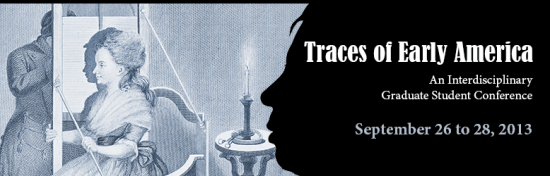
Early American History, interdisciplinarity, digital humanities, invigorating conversation, and early-career camaraderie. What more could anyone ask from the McNeil Center for Early American Studies’s biennial graduate-student conference? The answer is:  you.

Continue reading

SHEAR 2013: Conference Recap

SHEAR 2013: Conference Recap

shear2013Last weekend, historians of the early Republic convened in St Louis for the SHEAR annual meeting. As is normal for a meeting that takes place each year in mid-July, the heat and humidity during the day was rather intense (I somehow suspect this is a deliberate design to make the air-conditioned conference rooms a welcome solace!). As with Tom’s post covering the Omohundro conference last month, I can’t possibly hope to give complete coverage. As ever, the number of panels I wanted to attend was greater than the number of panels I could physically attend—the sign of an invigorating conference, for sure, but also a conference whose scope can’t be summed up in 1000 words. If you attended, please add your own reflections in the comments. Continue reading

Beyond the Valley of Mexico

Expanding the boundaries of early America has been a hot topic of conversation this summer. At both the Omohundro Institute conference last month, and at SHEAR last weekend, plenary sessions discussed a broader view of the past. Having internalized the Atlantic turn, scholars are now turning their energies toward the interior, asking how we should integrate the trans-Appalachian and trans-Mississippian West into our stories and interpretations.

Continue reading

SHEAR 2013: Presidential Plenary Session

This post comes to you from the annual meeting of the Society for Historians of the Early American Republic in St Louis. If you’re at the conference, please come and say hello!

The SHEAR Annual Meeting kicked off this year with the Presidential Plenary session, “Missouri: Crossroads of the Early Republic?” Using the conference’s location as a jumping-off point for discussions of the diverse and multifaceted history of the early nineteenth century, four distinguished historians offered reflections as if located in Missouri, looking across the North American continent in different directions. Walter Johnson then concluded the roundtable with the notional title “Looking Forward,” but calling attention to some ways in which the session might profitably be used by historians looking to introduce new themes and stories into their teaching. Continue reading

An Omohundro Conference Recap

This year’s annual meeting of the Omohundro Institute for Early American History and Culture was hosted with panache by Philip Morgan at Johns Hopkins University. It was apt that it took place in Baltimore, the birthplace of Ron Hoffman, whom the conference honoured as he steps down from a long tenure presiding over the institute. At the closing roundtable, a number of senior scholars movingly—and in some cases hilariously—recounted their experiences as Ron’s colleagues and friends, and paid tribute to his work as editor of the Carroll papers and historian of the Revolutionary war and its dissenters. Tongue firmly in cheek, Ron responded to the tribute manfully, by quoting Charles Carroll’s response to a biography of himself: what you have said, he told the biographer, makes me seem a much greater man than I ever believed, yet you have said nothing that is not absolutely true. Continue reading

Guest Post: Report from RAAC 2013

Today’s guest poster, Charlie McCrary, is a PhD student in American religious history at Florida State. His MA thesis is about 19th-century Methodist circuit riders’ autobiographies. He is now researching religion, secularism, and public education in the early republic. Here, he reports on the Conference on Religion and American Culture earlier this month.

RAACThe Center for the Study of Religion and American Culture at IUPUI held its Third Biennial Conference on Religion and American Culture in Indianapolis over June 6th through 9th (see the program here; see also #RAAC2013) The conference, a relatively small affair—made to feel smaller and more intimate by its democratizing conference-in-the-round spatial arrangement—brought together scholars, from esteemed pillars of the field to graduate students, to discuss and debate the present and future of the study of American religions. Many of the presentations focused on case studies from the recent past and/or broader methodological issues, but pre–1865 topics received some explicit mention as well. In this brief report, I have compiled a highlight reel of scenes most interesting to the Junto’s readers. Continue reading

Guest Post: “Good Newes from ye olde World”

banner-redehjaHere at The Junto, we like to hear from early Americanists at work around the world. Today’s guest post comes from Lauric Henneton, Associate Professor at the Université de Versailles Saint-Quentin and Vice Président of the Réseau pour le Développement Européen de l’Histoire de la Jeune Amérique (REDEHJA)

In case the honorable readers of The Junto were wondering, we do Early American and Atlantic history in the “Old World” and not just in good old “Blighty.” This post is about how the Réseau pour le Développement Européen de l’Histoire de la Jeune Amérique (REDEHJA) came together and what we’ve done over the last few years. This is the story of a group of friends/colleagues who decided to come together institutionally after a few years holding small-scale events in and around Paris. Continue reading
