This week at The Junto, we’ll be featuring a roundtable on Francis Spufford’s 2016 novel, Golden Hill (London: Faber & Faber, 2016). Set in colonial New York city, and written in self-conscious homage to eighteenth-century literary style, Golden Hill has plenty of resonance for anyone interested in the period. Following my post today, we’ll hear from Junto members Jordan Taylor and Katy Lasdow, as well as Hannah Farber, and a Q&A with Spufford himself. We will warn you if a post contains plot spoilers!
 Many novels are about struggles to know the truth, and to live in a world of ambiguity, secrets, and false pretences. In Golden Hill, those themes are given eighteenth-century specificities. They appear in all sorts of symbolic guises, but none more frequently and clearly stated than the murky, miscellaneous substance of eighteenth-century money. If Golden Hill is a novel about what it means to take something—or somebody—at face value, that metaphor is made literal when the protagonist Richard Smith walks into a merchant’s office in the book’s opening pages and presents “a paper worth a thousand pounds.” Continue reading
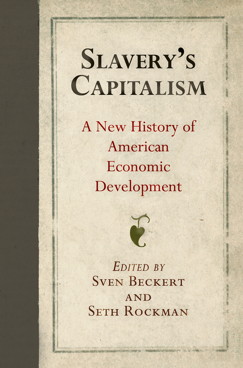 Slavery’s Capitalism is a timely collection of essays which details the necessity of placing slavery at the center of the economic history of the United States of America. The editors convincingly contend that the nation’s economic rise is inextricably linked to the institution of slavery. Moreover, they demonstrate the necessity of understanding the rise of capitalism in the U.S. as global—the institution of slavery was essential to the rise of capitalism throughout the Western world. Part III, “Networks of Interest and the North,” examines northerners’ investments in the business of slavery—the buying and selling of goods and people that sustained plantations throughout the Americas and the financial systems that were established to facilitate those trades.
 The Junto