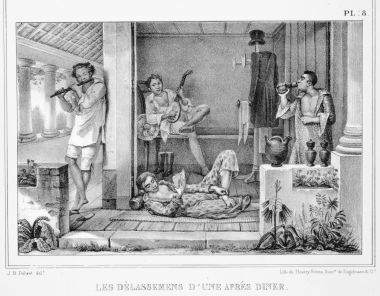
Jean-Baptiste Debret, “Les dèlassemens d’une aprés diner,” from Voyage Pittoresque et Historique au Brésil, vol. 2 (Paris: Firmin Didot Frerès, 1835)
Today’s guest post comes from Rachel Zimmerman (Ph.D., University of Delaware), Assistant Professor of Art History at Colorado State University-Pueblo. She has been studying the art and architecture of the Brazilian town of Minas Gerais since her first trip to the region in 2006. She began examining consumption in colonial Brazil for her dissertation, “Global Luxuries at Home: The Material Possessions of an Elite Family in Eighteenth-Century Minas Gerais, Brazil,” and is continuing research for a book project on elite material culture in the city of Mariana. Follow her work here.
According to the early nineteenth-century English merchant John Luccock, it was customary for Brazilian men to discard stiff outer layers when at home and wear only a cotton shirt, often unbuttoned, knee-length breeches, and clogs.[1] Brazilian standards of decorum permitted informal dress in domestic settings, even when receiving guests. Examination of colonial-era probate inventories from Minas Gerais, the gold mining district, reveals that a small number of educated elite men transformed their state of undress from ordinary to stylish with the addition of a nightgown. Continue reading
 Happy New Year from all of us at The Junto! We hope you had a restful and enjoyable holiday break. For historians, the turn of the calendar to 2015 means that many of us are en route to the AHA Annual Meeting in New York City. Having grown up in the area, I’d like to welcome you all to New York, where the bagels and pizza are really just better, and we stand “on line” for coffee, not “in line.”
 In Rome, art restorers have uncovered what they say are
  The Junto