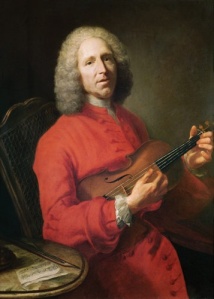
 Recently I’ve been taken by the music of Jean-Philippe Rameau, a French Baroque composer and Enlightenment-era music theorist. Rameau was a divisive figure in his day because he broke from the supremely elegant and nuanced style that had made the court of Louis XIV the center of late-17th-century musical life in Europe. This excerpt from Jean-Baptiste Lully’s 1676 opera Atys gives a sense of the sensitivity and sophistication of 17th-c. French music. Compared to Lully, Rameau’s music was daring and experimental. He turned the orchestra into a powerful beast and wrote music that more dense, more harmonically adventuresome, and more aggressive. He was Frank Sinatra to Lully’s Bing Crosby, the Rolling Stones to Herman’s Hermits, N.W.A. to De La Soul; etc. (making analogies is curiously addictive). Continue reading →
 Happy Mother’s Day! Go call your Mom, then come back and take a look at our weekly round-up.
 The Junto