 Let’s get to the links…
Tag Archives: Slavery
The Week in Early American History
Happy Easter and Passover to all celebrating!
With all the excitement around the Junto’s March Madness tournament (we even have a hashtag!), it’s a useful reminder that there are other things going on this week around the blogosphere. Once you’ve found all the Easter eggs (or, if you hid it really well on Monday, the afikoman), sit down and try out a few of these posts and stories.
The Week in Early American History
 This week brings a rich harvest of material on slavery, memory, and public history.
First, we have two fascinating filmed conversations. At the Graduate Center at CUNY, James Oakes talks to Sean Wilentz about his new book, Freedom National: The Destruction of Slavery in the United States, 1861-1865. And at the New-York Historical Society, Harold Holzer speaks with Tony Kushner on the subject of Lincoln (and, of course, Lincoln).
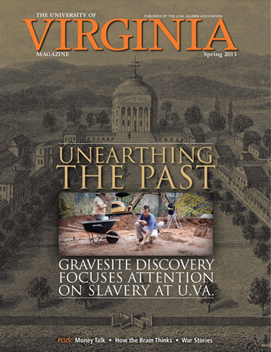
Next, we take a look into slavery at Jefferson’s university. In an article in University of Virginia Magazine and a blogpost for Encyclopedia Virginia, Brendan Wolfe contextualizes a recent archaeological discovery.
In the Washington Post, meanwhile, J. Freedom du Lac reports on Colonial Williamsburg’s difficulty recruiting slave interpreters. And how did 19th-century African American portray their own emancipations? Good interviews Deborah Willis and Barbara Krauthamer about their photographic history.
The Week in Early American History
Mail service was suspended in New England on Saturday (sadly, a possible harbinger of things to come), but a massive snowstorm (and the pain of shoveling) cannot stop the Junto’s week-in-review post.
It seems odd that the day is passing with relatively little fanfare, but today is actually the 250th anniversary of the Treaty of Paris ending the Seven Years’ War. A momentous occasion with enormous consequences (that were, as often happens, largely unforeseen at the time).
In any event, on with the links!
The Week in Early American History
Good morning and Happy Inauguration Day! Since in early America the inaugural was a March event, no links to that event today, but plenty to keep you occupied until noon based on the collective wisdom of the Junto.
The Week in Early American History
 Happy New Year! We took last week off while so many of us were in New Orleans for AHA, so the set of links covers just a bit more than the past seven days. From here on we should be back to our regular schedule every Sunday morning.
The Abolitionists in Primetime: Two Responses
 This week, PBS’s American Experience aired the first episode of The Abolitionists, a new three-part documentary. If you missed it, you can still watch it online. It is written and directed by Rob Rapley. The next two episodes will air on January 15 and 22.
The film profiles Frederick Douglass, William Lloyd Garrison, Harriet Beecher Stowe, John Brown, and Angelina Grimké. Part I covers the 1820s and 1830s, fitting it comfortably into The Junto’s portfolio. Kenneth Owen, an Assistant Professor of History at the University of Illinois at Springfield, and Jonathan Wilson, a PhD candidate at Syracuse University, have a review.
The Plantation as Crime Scene: Quentin Tarantino’s “Django Unchained”

Between this and Abraham Lincoln, Vampire Hunter, it’s been a banner year for antebellum shades.
“It’s a flesh for cash business—just like slavery.” So the German bounty hunter Dr. Schultz describes his profession to the ex-slave title character near the beginning of Quentin Tarantino’s Django Unchained. It’s an apt introduction to the film’s broader portrait of American slavery — a rendering that emphasizes the tortured flesh, the sordid cash, and the gruesome business of bondage at every turn. In this regard, Django Unchained fits comfortably within the familiar canon of Tarantino crime films, which have nearly always probed the intersection between the brutally physical and the cynically transactional.
The old gang’s all here: the vicious mob boss, the wisecracking assassin, the tight-lipped, vengeance-minded hero. So why should anyone, let alone early American historians, bother to consider the historical perspective of a film that in many ways is just Reservoir Dogs with snazzier waistcoats and more primitive sunglasses? Continue reading
Then, Thenceforward, and Forever Free
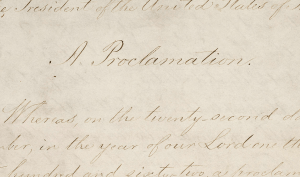 We can’t let 2013 begin without marking the 150th anniversary of the Emancipation Proclamation, which Abraham Lincoln issued on January 1, 1863.
Harold Holzer describes the anxiety many Americans felt on that day as they waited for confirmation of the act. Allen Guelzo weighs Lincoln’s legal options. Annette Gordon-Reed discusses the document’s significance. Eric Foner discusses what it did–and did not do. Continue reading
Jeffersongate: The Case of Henry Wiencek

On October 16, Farrar, Straus and Giroux published Henry Wiencek’s third book, Master of the Mountain: Thomas Jefferson and His Slaves. His previous works both dealt with slavery, most notably his well-received An Imperfect God: George Washington, His Slaves, and the Creation of America. By contrast, his latest work has come under fire from leading Jefferson scholars around the country. Within days of the book’s release, highly critical reviews by academics appeared in online magazines. These reviews started online exchanges that have played out over the last two months and continue to do so.
Historians much more up to the task than myself—including Annette Gordon-Reed, Jan Lewis, and Lucia (Cinder) Stanton—have called into question Wiencek’s use of sources (both primary and secondary), his overall interpretation, and his motives. Therefore, I will not recapitulate all of them here. I have included a chronology with links to all the relevant articles below, with J.L. Bell’s posts at Boston 1775 providing excellent summaries of the most contentious points. Instead, I want to touch on two things: the main part of Wiencek’s argument and how it reflects his broader approach to history and the effects of Wiencek’s treatment of the historiography, both having to do with the larger relationship between popular and academic history. Continue reading
 The Junto