This is a guest post by Dr E. M. Rose. Dr Rose is a Visiting Fellow, Department of History, Harvard University, and can be reached at emrose@fas.harvard.edu. These observations emerged during research Rose conducted in the spring of 2017 as Visiting Fellow at The Omohundro Institute of Early American History and Culture (OIEAHC)/Jamestown Rediscovery Foundation at Historic Jamestowne.
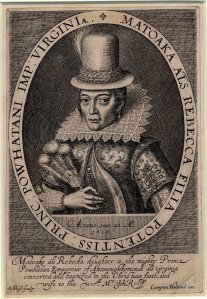
Two of the most famous Native Americans in early colonial history may well have met in London. Matoaka, nicknamed Pocahontas, who lived near the Jamestown settlement in Virginia and Tisquantum, better known as Squanto, who greeted the Pilgrims in Plymouth, Massachusetts, were apparently living near other in the English capital in late 1616. Pocahontas and Squanto were both part of a small and complexly entwined commercial community of merchants, sea captains, and maritime entrepreneurs, whose ventures spanned the globe. The two Native Americans were kidnapped in America within a year of each other and eventually came to England, where they were welcomed enthusiastically.[1] Although there is, as yet, no documentation to prove that such a meeting took place, circumstantial evidence suggests that they met when they were staying only a few hundred yards down the street from each other in the homes of men with interlocking business interests. Although the histories of Jamestown and Plymouth are usually treated as separate chapters in most narratives of American history, they were closely linked. Continue reading
 In his now classic study of early nationalism, historian Benedict Anderson wrote “I propose the following definition of the nation: it is an imagined political community—and imagined as both inherently limited and sovereign. It is imagined because the members of even the smallest nation will never know most of their fellow-members, meet them, or even hear of them, yet in the minds of each lives the image of their communion…. Communities are to be distinguished, not by their falsity/genuineness, but by the style in which they are imagined….”[1] While Puritan society was not a “nation” in the sense that Anderson meant it, his reflections nonetheless are evident in Ric Burns’ documentary, The Pilgrims. Burns seeks not to merely retell the Thanksgiving story, but to understand why Plimouth Rock and the popular Thanksgiving story (much of which is inaccurate) is such a pervasive part of the American origins story.
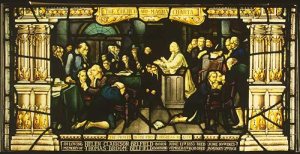 Joseph Yesurun Pinto, a 31 year-old Anglo-Dutch émigré in the autumn of 1760, had led New York’s
  Whether writing or grading term papers has kept you from all things early American, here’s a quick recap of some of the top news stories of the week(s)!

 The Junto