This Colonial Couture post is by Laura E. Johnson, associate curator at Historic New England. The exhibition Mementos: Jewelry of Life and Love from Historic New England, which she curated, will open at the Eustis Estate Museum in Milton, Massachusetts, in May 2017.

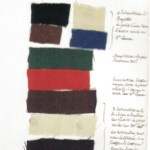
“Echatillons Etouffes d’angleterre a l’usage des Espagnolesen Europe y en Amerique,” (Samples of English stuffs in use by the Spanish in Europe and America), Joseph Downs Collection, Winterthur Museum and Library
I’d like to build on Kimberly Alexander’s question from last week, “How can we write history when we do not have the original object?” There are many ways to examine a textile and its context without the physical object, as she demonstrated so ably. Much of my research on Native peoples, identity construction, and the Atlantic textile trade is based by necessity on a combination of archival resources, rare portraits, and archaeological evidence. Trade records, price lists, descriptions of treaty meetings, and other archival sources offer a wide range of evidence about textiles and how Natives consumed them, even in the absence of the pieces themselves.
Textiles were among the most lucrative and desirable of imported objects in the early Atlantic economy.[1] The French, Dutch, and British all relied heavily on textile production for a substantial portion of their national revenue. Woolens and linens raised, spun, woven and finished in these areas drove international commerce from the 13th century.[2] Native Americans presented an enormous potential market for their products as the domestic market became increasingly saturated. As one scholar has stated, it could have been termed the “cloth trade as easily as the deerskin trade.”[3] Continue reading
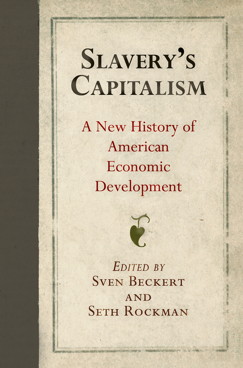 Slavery’s Capitalism is a timely collection of essays which details the necessity of placing slavery at the center of the economic history of the United States of America. The editors convincingly contend that the nation’s economic rise is inextricably linked to the institution of slavery. Moreover, they demonstrate the necessity of understanding the rise of capitalism in the U.S. as global—the institution of slavery was essential to the rise of capitalism throughout the Western world. Part III, “Networks of Interest and the North,” examines northerners’ investments in the business of slavery—the buying and selling of goods and people that sustained plantations throughout the Americas and the financial systems that were established to facilitate those trades.
 The Junto