Junto March Madness: Round One Results

The following are results from the first round of voting. Thanks to everyone that participated! Each matchup received an average of 170 votes, so we are pleased with the turnout. After listing the results, I’ll ask some questions and then hope to get some discussion in the comments.

Round Two starts tomorrow! Continue reading

Junto March Madness Round 1, Day 2: Brackets 3 and 4

The first day of voting, which included the first round of brackets one and two, is found here. Results for yesterday’s and today’s voting will be announced tomorrow. Just like the first post, this will include a handful of quick takes on the brackets in question, followed by voting. For the entire brackets, and overall rules, see here.

Please add your answers to the questions, as well as any general thoughts on today’s brackets, in the comments. Continue reading

Junto March Madness Round 1, Day 1: Brackets 1 and 2

Michael Buffer placed his money on a Morgan vs. Brown championship match.

Michael Buffer placed his money on a Morgan vs. Brown championship match.

The time for predictions is past; the time for voting is now.

(For the entire bracket, as well as an overview of the tournament, see here.)

At the end of this post, you will have the opportunity to vote on all the first round match-ups from Brackets 1 and 2. We would ask that everyone votes just once, though we encourage you to get friends, family, and people using the computers next to you to vote as well. Voting will close at midnight, eastern time. Continue reading

The Junto March Madness: Nominating Books for the Early American History Brackets

What happens when you mix early American history nerdyness with basketball geekyness? Junto March Madness!

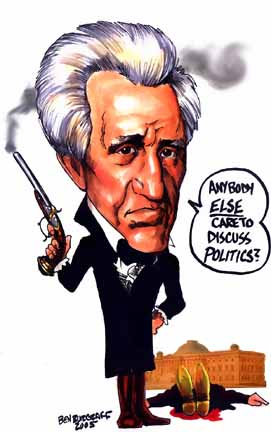
Jackson would obviously have won any physical competition, likely by cheating, but will any books dealing with Jacksonian America win the historiographical tournament?

Jackson would obviously have won any physical competition, likely by cheating, but will any books dealing with Jacksonian America win the historiographical tournament?

In honor of the NCAA Tournament games tipping off in a few hours, and in reaction to the recent announcement of Bancroft Prize winners (which tragically did not include any book explicitly dedicated to early America), we here at the Junto decided to jump in on the competition atmosphere with brackets of our own: a several-bracket-tournament of books in early American history. Today, we submit competitors. The Junto team will then narrow the field to either 32 or, if we get enough submissions, 64, and rank them in brackets. (The organization of brackets is still up in the air—we could go with thematic regions like political, cultural, religious, and synthetic, or we could even go chronological with colonial, revolutionary, early republic, or Civil War-era, or we could even go with histiographical eras—and largely depends on the submissions. We are very open to suggestions, though, so please chime in in the comments!)

IMPORTANT NOTICE: The beauty of this competition depends on being fun, so the first and most important rule is not to take it too seriously. Deciding the winner is purely subjective and based on what are likely a widely variegated criteria of excellence including, but not limited to, most influential, best-written, most sophisticated, or even most popular. When in question, go with your gut reaction. Or, just go with your favorite. A debate between Laurel Ulrich’s A Midwife’s Tale and Eric Foner’s The Fiery Trial is, of course, silly, because both books can be categorized as the top of the field yet they examine completely different issues through very different approaches. But it is, nonetheless, fun to compare, debate, and, indeed, vote. This is designed to be fun, people, so once again: DO NOT TAKE THIS SERIOUSLY. (But we still expect the winner to add this great accolade to the top of her/his C.V.) Continue reading

This Week in American History

TWEAHAlright folks, it’s time for another roundup of links from the past seven days. New England is finally dethawing from Nemo, Valentines Day was celebrated, the Dunk Contest was held, and spring is only a month away, so I’d say things are looking up.
The newest issue of Journal of American History is now available online, so your bedside reading for the next week is ready. Make sure to read Nathalie Caron and Naomi Wulf’s thoughtful “American Enlightenments: Continuity and Renewal,” as well as our own Joseph Adelman’s overview of some important new online resources.

Over at the excellent U.S. Intellectual History Blog, there was a vibrant debate over the boundaries of the field. Nils Gilman offered a pretty rigid “qualitative” analysis of “text-based” interpretation, and Edward J. Blum offered a thoughtful response. Sparks flew both on the blog and in an explosive discussion on Twitter, Storified by our own Michael Hattem.  Continue reading

Articles of Note: Early 2013

Scholarship can come at such a fast clip nowadays that it can be tough to keep up. Actually, scratch that; it is impossible to keep up with the massive amounts of articles that come out at an unrelenting rate. With the number of journals out there publishing quality work in early American history—journals that are both dedicated to our field or just sometimes carry work in our field amongst other periods—there is often an avalanche of new work that one can feel overwhelmed. Whether you receive hard copies of the many journals, use those from your institution’s library, or just get all of the content online (guilty), your reading list is always at such a ridiculous height that it is difficult to just keep track of all the recent articles, let alone read them. Such are the #firstworldproblems of the modern-day academic.

Well, that’s where the Junto comes in. Periodically, we hope to highlight recent articles that we found especially noteworthy. I’ll list a handful in the post (that are, of course, reflective of my own interests), and then we will rely on you, our dear reader, to share other recent articles you found important. Together, perhaps we can slay the beast that is the growing mound of unread articles. Continue reading

The NNPH: Odds, Ends, and Some Concluding Statements

Political history goes marching on.

Political history goes marching on.

Unfortunately, we were unable to post the final scheduled post for the roundtable, which was set to be on race. So instead of someone trying to scrounge up a full post last-minute on this important topic, a few of us decided to put up some brief concluding thoughts on various topics related to the New New Political History. We ask that these be read as more informal than the previous three posts, and more as a touchstone for possible discussion. If things go right, we should have a response to the roundtable from Andrew Robertson sometime soon.

Besides engaging with any points in this or other posts in the roundtable, please feel free to bring up any other issues that we didn’t address related to the NNPH. Continue reading

The New, New Political History: A Roundtable (Introduction)

This will hopefully be the first of many roundtables hosted by The Junto, in which a bunch of young whipper-snappers take aim at various topics of early American history, with the occasional response from seasoned scholars to set us straight. This particular roundtable, which will hopefully set a pattern for others to follow, includes contributions every day this week, each on a different topic related to the broader theme, and then a conclusion/response next Monday. We hope these roundtables, starting with this one on the current state of political history, will start a fruitful discussion both on the blog and elsewhere.

In 2005, Chris Beneke published an essay in Reviews in American History titled “The New, New Political History.”[1] This label did not originate with him—indeed, one of the chapters in the book he was reviewing used the same description[2]—but it was meant to capture the arguably fresh take on early American politics. The editors of Beyond the Founders, Beneke wrote, “enter a nearly decade-long discussion on the direction of political history.”[3] Was the field thriving or faltering? Well, he reasoned, it depended on how you defined the field. And after looking at this manifesto-volume, Beneke concluded that the movement was diverse, scattered, and unsystematic, yet promising. In the face of the ever-constant “founders chic,” a continuation of America’s fascination with a small group of people who allegedly embodied America’s pride and glory, this historical movement sought to widen the scope and centralize the peripheries. Sometimes, for academics, the Joseph Ellises and David McCulloughs of the world are not quite enough. Continue reading

The Early Americanist Holiday Book List; Or, My Favorite Books from 2012

If there is a better purpose for an academic blog than to make lists of must-have books and dents in your Amazon budget, I am not aware of it. As the first of what I hope will be an annual tradition, here are ten of my favorite books from the past 12 months. It is obvious that I have particular interests and tastes (early republic, religion, politics), but I tried to expand my comfort zone and include a few titles from other fields. So if you are looking for books you may have missed, need a reminder for books you still need to buy, or require evidence to present to your significant other, you have come to the right place.

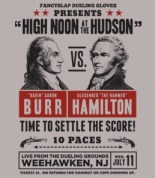
(Placing any of these books on your holiday book list, of course, assumes that you have already purchased this year’s “must have” gift for early Americanists, the Aaron Burr/Alexander Hamilton duel t-shirt, seen to the right.) Continue reading

Welcome to The Junto!

“Have you met with any thing in the author you last read, remarkable, or suitable to be communicated to the Junto? particularly in history, morality, poetry, physics, travels, mechanic arts, or other parts of knowledge?”

-One of the questions Benjamin Franklin devised for his friday Junto meetings

We aim to have a bit more diversity than the original Junto group.

We aim to have a bit more diversity than the original Junto group.

It is with great honor that I welcome you to The Junto, a new blog on early American history. Staffed by a host of junior academics studying a broad range of topics—our brief bios are found at the end of the post, and more details are found on each individual author’s page—we aim to provide frequent content related to the academic study of America prior(ish) to the Civil War. But more than just serving as a sounding board for our authors and a clearinghouse for various news, events, and calls for papers, we hope that The Junto will become a vibrant community for the field of early American studies. Continue reading