 In designing courses, professors and teachers face a number of competing claims for time and attention: skill development appropriate to the level of the course, the content described in the course catalog, campus, system, or state requirements for content, the primary sources and scholarship that will promote the best discussions and consideration of the course topic. As many of us have written here at the Junto, not to mention elsewhere, much therefore ends up on the cutting room floor—and some of it painfully so.
Author Archives: Joseph M. Adelman
Teaching History Without Chronology
 Most history courses follow a relatively simple formula: take a geographic space X, select a time span from A to B, add topics, and you’ve got yourself a course. It varies, of course, but works for both introductory courses, where you might survey the political, social, and cultural development of the people living in a geographic area, to upper-level courses with topical focuses. As a field whose primary concern is change over time, that formula makes sense. That consistency also means that students expect it from their high school and college history courses. And how else would you organize a history course?
I found out last semester.
Early America at AHA 2016
 It’s hard to believe that this is our fourth annual roundup of panels and presentations about early America and the Atlantic World at the annual meeting of the American Historical Association. Convening this year in Atlanta beginning today (January 7) and running through January 10, the program this year offers a theme of “Global Migrations: Empires, Nations, and Neighbors.”
People go to the AHA for many reasons, and we wish all of you a good conference experience (most especially those of you interviewing for jobs). As we have for the past few years, below you’ll find a guide to many of the panels that include our colleagues and readers who work on topics related to early America and the Atlantic world. We’ve done our best to capture as many panels of interest to our readership, in the spirit of “vast Early America,” as Omohundro Institute Director Karin Wulf put it earlier this week. But we also surely missed a few panels of interest, so please feel free to suggest other possibilities in the comments.
With that said, scroll down for a day-by-day rundown, with links to the program description for each panel. (You can also browse the full program, of course.)
The Revolution Will Be Live-Tweeted
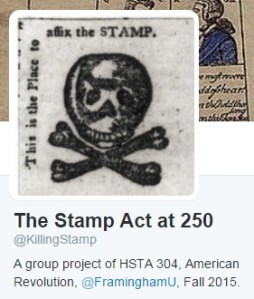 As many of our readers already know, this fall has marked the 250th anniversary since the protests against the Stamp Act, one of the earliest major actions of the imperial crisis that resulted in the American Revolution. Over the course of a year—from the first arrival of the Act in May 1765 until news of its repeal arrived in May 1766—colonists in the “thirteen original” colonies (as well as the “other thirteen”) passed resolutions, argued in essays, marched in the streets, forced resignations, and otherwise made clear their displeasure with paying a tax on their printed goods.
Alternative Fractions
 Earlier this week historian Rebecca Onion published an essay in Aeon arguing that historians should take more seriously the concept of counterfactuals. Though often derided by professional historians, Onion argues quite effectively that such an approach to the past can force us to reconsider our assumptions about what actually did happen and ask new and perhaps even more creative questions about the past.
Guest Post: Revisiting Women of the Republic with Linda Kerber at the American Antiquarian Society
Carl Robert Keyes is an Associate Professor of History at Assumption College in Worcester, Massachusetts. He recently launched the #Adverts250 Project, featuring advertisements published 250 years ago in colonial American newspapers accompanied by brief commentary, via his Twitter profile (@TradeCardCarl).
 My Revolutionary America class recently visited the American Antiquarian Society for a behind-the-scenes tour followed by a document workshop in the Council Room. As we passed through the closed stacks I remarked to one of the curators, “This still blows me away, yet nothing can compare to the first time I came back here. Taking this all in for the first time is an experience that cannot be re-created.”
The Day the Presses Went Silent
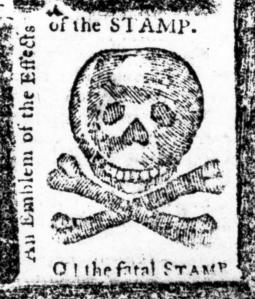 250 years ago today, the Stamp Act was in legal effect throughout the British North American colonies—including not only the “Thirteen Colonies” but also British possessions in Canada and the West Indies. As those who study the American Revolution know, the matter was rather different when it came to the on-the-ground impact.
Guest Post: Emerging Histories of the French Atlantic
Robert Taber, a postdoctoral associate with the University of Florida Writing Program, wrote his dissertation on the connection between family life and grassroots politics in colonial Saint-Domingue and is the author of Navigating Haiti’s History: Saint-Domingue and the Haitian Revolution.
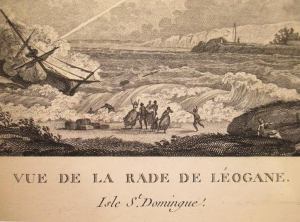 More than 30 scholars from three continents gathered at the Williamsburg Inn from October 16th through the 18th to present emerging histories of the French Atlantic. Sponsored by the Omohundro Institute, and made possible through considerable labor and financial investment, one hundred scholars were able to enjoy a great conference atmosphere. Three days of panels, workshops, and roundtables pushed for our collective knowledge of the French Atlantic to be wider, deeper, and better integrated, fulfilling a plan first sketched out in the summer of 2010.
Guest Post: British Group in Early American History Conference Recap
Today’s guest post comes from Abigail B. Chandler, an Assistant Professor of History at the University of Massachusetts-Lowell.
 The annual British Group of Early Americanists Conference was held from September 3-6 at the University of Sheffield in Sheffield, England and drew a wide variety of scholars from the United Kingdom, the United States and France. In keeping with BGEAH traditions, there were many excellent papers, a key note address on Thursday night, a book club discussion on Friday and a conference dinner on Saturday, while newer traditions were started with some panels providing pre-circulated papers.
Hamilton, Art, History, and Truth
 By now you’ve probably heard or read something about Hamilton: An American Musical, the hip-hop biography of Alexander Hamilton now running on Broadway. (If not, you can start with our reviews by Chris Minty and Nora Slonimsky and Ben Carp.) I went to see it last week with a group of historians (how’s that for a nerdy event?) and had an amazing time. First of all, the show is fantastic on all of the standard measures of the experience—the acting, the music, the singing and choreography, the set—they’re all great. You should see it if you can, because it’s really that good. But what makes Hamilton a bit different is how interesting it is as a vessel for conveying history to the general public, the argument it makes about Hamilton’s life, and the use of artistic license to make such an incisive historical argument.
 The Junto