Today, we continue “The Ideological Origins of the American Revolution at 50,” our joint roundtable with the S-USIH blog with a post by Kenneth Owen, an Assistant Professor of Early American History at the University of Illinois Springfield, whose research interests focus on political mobilization and organization in the revolutionary and early national eras.
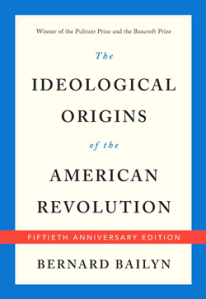 It took me a long time to warm to The Ideological Origins of the American Revolution. I don’t think this is an uncommon experience for an early Americanist. Fifty years after its publication, Bailyn’s seminal work still features prominently on graduate and undergraduate reading lists. Yet it is hard to say that the book is beloved. Often, simply mentioning Bailyn’s name can be a pejorative shorthand—an outmoded view of the past that celebrates elites at the expense of the darker underbelly of the Revolution. As an undergraduate, I too railed against the book. How far, I asked with youthful bluster, were minutemen really inspired by the cautionary tale of seventeenth-century Denmark? And yet, like the profession itself, I have found it hard to shake Bailyn’s shadow. How is it that a book that is often only grudgingly admired still occupies such a large part of the field’s mental imagination? Continue reading
 At a time when political events seem to place the very meaning of American democracy under the microscope, it is perhaps unsurprising that so many recent works have looked to re-evaluate the American Founding. Books focusing on the mid-1770s in general have included Kevin Philips’s 1775, Richard Beeman’s Our Lives, Our Fortunes, & Our Sacred Honor, and Joseph Ellis’s American Quartet. Recent books that have looked more specifically at the Declaration of Independence itself include Danielle Allen’s Our Declaration. Robert Parkinson’s The Common Cause, too, has called for a re-evaluation of what motivated those who fought for Independence, though his work calls for a much less celebratory conclusion. Such a list demonstrates the importance of the mid-1770s to America’s national identity. With The Heart of the Declaration, Steven Pincus throws his hat into the ring, too.
 International pageants such as World’s Fairs or Olympic Games are strange beasts of their very nature. While trying to project an image of a modern, vibrant place, they must necessarily also draw on the familiar in order to reach a wide audience. Sometimes this can be done in eye-catching and engaging fashion—think of the 2012 London Olympics, and their juxtaposition of Horse Guard’s Parade with beach volleyball. Thus these international pageants provide a curious mix of looking to the future at the same time as looking at the past.
  How does a crony capitalist son of a whore, and a militarist pumped up by delusional aspirations of honor, grow up to be feted by liberal scholars? [*]
 When I consider the non-early-American history books that have had the greatest impact on the way I think, two stand out in particular. One is Ross McKibbin’s The Evolution of the Labour Party, 1910-1924; the other, CLR James’s Beyond A Boundary. The former is the most obviously “academic” of the two; the opportunity to write a Junto post primarily concerned with cricket, however, means that today I’ll focus on the latter.[1]
 Revolutionary America was a politicized society. All of the most important conflicts of the American Revolution, from the Stamp Act through Independence to the ratification of the Constitution, were sharply divisive events which demanded citizens take sides. Even neutrals were compelled to give outward displays of support to either patriots or loyalists (often both!). There were very little chances to avoid conflict over such weighty issues—they would reshape and redefine friendships, families, and communities.
  Back in April, I had a rather surreal teaching experience. A class project, focusing on tweeting the assassination and funeral train of Abraham Lincoln, attracted a good deal of media attention in central Illinois. My class ended up appearancing in local newspapers, radio, and even with
  If there is a current orthodoxy among historians of the American Revolution, it is that the study of the Revolution has lost its focus. In their introduction to the
  On September 18th millions of voters in Scotland will head to the polls to answer a simple question: “Should Scotland be an independent country?” As an historian of the American Revolution living and working in Scotland I am struck by the parallels not just between the two movements for independence, but more significantly between the ways in which the British government in the eighteenth century and the UK government in the twenty-first century have challenged those who sought and seek independence.
  The Junto