 The Junto has published a number of posts about early America in popular culture and media. Until the last few years, films and television shows about early America have been relatively scarce, outside a number of multi-episode public television and cable documentaries. However, in addition to HBO’s John Adams, there are a number of projects in the works including a television series about the Sons of Liberty and another about John Brown. As the semester nears and my teaching duties turn to the American Revolution, I have inevitably been thinking about early American multimedia in the undergraduate classroom. Continue reading
Category Archives: Film
Guilty Pleasures: 1776
 It’s the middle of the summer, so most of us are hard at work on drafting new syllabi, writing and revising articles, dissertations, book manuscripts (or sometimes all three simultaneously), catching up on reading, and all sorts of myriad tasks that aren’t possible during the academic year.
The American Revolution: The TV Series
 A couple of weeks ago, the American History Guys at Backstory took on the issue of representations of history in film. Of most direct interest to those of us here at the Junto was the interview of Mark Peterson by Peter Onuf, asking why there were so few movies about the American Revolution, and why they were so terrible. The answer Peterson proffered was about patricide. The difficulty of evoking sympathy for the killing of a father figure that wasn’t manifestly evil led the British to be portrayed as caricatured villains – and even Hollywood audiences weren’t buying a tale so badly spun. Continue reading
The Week in Early American History
 A relatively quiet week here; with the semester now underway everywhere, it’s probably not such a bad thing that we have fewer links to share. In any case, a little Revolution, an unidentified diary, and a forgotten war … on to the links!
The Abolitionists: A Recap
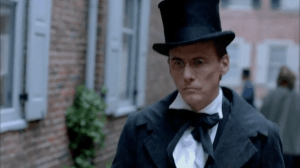 Over the last three weeks, Jonathan Wilson and Ken Owen have reviewed the PBS documentary series The Abolitionists. Their reviews of part 1, part 2, and part 3 are already available for you to read. In this final post, Wilson and Owen will discuss the series as a whole, focusing especially on its value for history professors in the classroom.
Ken: Jonathan, I thought that we might start this discussion by looking at the producers’ public statements on what they were attempting with the series. For reference, there is a video entitled ‘Why We Made The Abolitionists‘, and an article ‘From The Executive Producer‘. For me, the most striking statement of the video is the opening assertion that no transformative moment in American history ‘stems from the actions of ordinary Americans as much as the abolitionists’. The producers then say that the five characters that they chose were deliberately intended to invoke different strands of the abolitionist movement.
The Abolitionists Go to War: Part 3
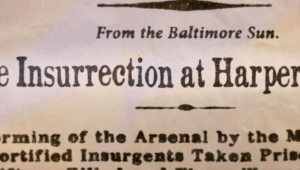 The final episode of The Abolitionists aired this week on PBS. The entire three-hour documentary is now available online here (Part 3 begins at the 1:40 mark). A full transcript is also available. Kenneth Owen and Jonathan Wilson previously discussed the first two episodes for The Junto. Today, we discuss the final hour.
Jonathan Wilson:
We’ve been fairly hard on The Abolitionists thus far, so I’m happy to say I thought the final chapter of the film is the strongest, both historiographically and dramatically. This episode reflects recent scholarship on slave rebellions, and on John Brown in particular, by meditating in a fairly sophisticated way on the uses and languages of violence.
The Abolitionists Ride Again: Part 2
 Last week, The Junto brought you a pair of responses to Part 1 of PBS’s new American Experience documentary on The Abolitionists. Kenneth Owen and Jonathan Wilson were cautiously critical of the first episode–particularly its treatment of religious belief and the activities of less famous abolitionists. Today, they weigh in again with brief responses to the second episode, which aired Tuesday night. (It is still available to watch online; skip ahead to Chapter 8 or the 50:40 mark.) Continue reading
The Week in Early American History
 Happy New Year! We took last week off while so many of us were in New Orleans for AHA, so the set of links covers just a bit more than the past seven days. From here on we should be back to our regular schedule every Sunday morning.
The Abolitionists in Primetime: Two Responses
 This week, PBS’s American Experience aired the first episode of The Abolitionists, a new three-part documentary. If you missed it, you can still watch it online. It is written and directed by Rob Rapley. The next two episodes will air on January 15 and 22.
The film profiles Frederick Douglass, William Lloyd Garrison, Harriet Beecher Stowe, John Brown, and Angelina Grimké. Part I covers the 1820s and 1830s, fitting it comfortably into The Junto’s portfolio. Kenneth Owen, an Assistant Professor of History at the University of Illinois at Springfield, and Jonathan Wilson, a PhD candidate at Syracuse University, have a review.
The Plantation as Crime Scene: Quentin Tarantino’s “Django Unchained”

Between this and Abraham Lincoln, Vampire Hunter, it’s been a banner year for antebellum shades.
“It’s a flesh for cash business—just like slavery.” So the German bounty hunter Dr. Schultz describes his profession to the ex-slave title character near the beginning of Quentin Tarantino’s Django Unchained. It’s an apt introduction to the film’s broader portrait of American slavery — a rendering that emphasizes the tortured flesh, the sordid cash, and the gruesome business of bondage at every turn. In this regard, Django Unchained fits comfortably within the familiar canon of Tarantino crime films, which have nearly always probed the intersection between the brutally physical and the cynically transactional.
The old gang’s all here: the vicious mob boss, the wisecracking assassin, the tight-lipped, vengeance-minded hero. So why should anyone, let alone early American historians, bother to consider the historical perspective of a film that in many ways is just Reservoir Dogs with snazzier waistcoats and more primitive sunglasses? Continue reading
 The Junto