
At River’s End

On the Riverwalk, New Orleans (Jan. 2013)

Last week, the Mississippi River surged against the levees, finally shattering restraints near St. Louis. Up and down the waterway, authorities hurried to secure hometowns, farmlands, and highways against the potential breach. “It could be anytime,” the Rivers Pointe fire chief told The St. Louis Post-Dispatch. “The hope is to keep Highway 94 open.” Even now, watching the water flow higher and faster still, it is worth thinking about how or why Americans have chosen to embrace life along the river: the shifting networks of politics and profit, the deep imprint of slavery on the region’s past, and the legacy of a South that may or may not have grown closer to the world, in the many ways that the Confederates or others have intended over time. This conscious construction of a river culture—as it was made and understood by the region’s black and white nineteenth-century predecessors, men and women who were also sensitive to sudden danger, but eager to maintain the dense traffic of the cotton trade—permeates Walter Johnson’s River of Dark Dreams and guides his expert analysis through their winding stories. Continue reading


To See The World In A Bale of Cotton

JohnsonThe promise of a tie between the local and the global—a thread to join the dense fiber of individual life to the vast patterns of human interaction—has long lingered at the edge of the historian’s vision. “The hours should be instructed by the ages, and the ages explained by the hours,” wrote Emerson in “History.” “Each new fact in . . . private experience flashes a light on what great bodies of men have done.” Even the less Transcendental among us are lured by a link between the intimate and the infinite: every globalist, no matter how ambitious, must find their ground-level characters and illustrative anecdotes; the best microhistorians train their lenses to reveal not just cell particles but a whole cosmos. Few recent works in early American history, however, are so explicit in their equal pursuit of the local and the global, the hours and the ages, as Walter Johnson’s River of Dark Dreams (Cambridge: Belknap Press of Harvard University Press, 2013). Continue reading

Walter Johnson’s “River of Dark Dreams”

cotton_boll_blue_sky

Walter Johnson’s River of Dark Dreams is a meditation on the making of the Cotton Kingdom in the nineteenth century American South. The book is rich with the intimacies and delicacies of detail—details that describe the fundamental material circumstances in which enslaved men, women, and children forcibly transformed Native America into cultivated grids of mono-crop culture at the behest of “Manifest Destiny”; details that are gut-wrenching in their vivid depictions of the social relations of white supremacy—the torture, the hunger, the bleeding, and the raping of the enslaved—the malignant, violent underbelly that made and forcibly maintained the Cotton Kingdom; details that connect the smallest common denominators of plantation life, whether measured in lashes (upon flesh), or pounds (of cotton), or any other metric of rule—to the global economy, which itself connected slaveholders and merchant capitalists from the fields and riverbanks of New Orleans to the factories of Manchester and Liverpool. Continue reading

The Week in Early American History

TWEAHIt seems to have become a tradition to open this post with a weather report for New England. This morning we’re looking at a slushy Sunday, which while annoying is quite an improvement over the snowpocalypse of a few weeks ago. In any case, a little sleet/snow won’t stand any longer between you and your weekly supply of links. On we go!
Continue reading

A Very Old Book: The Case for Eric Hobsbawm’s Age of Revolution

DraperOhara

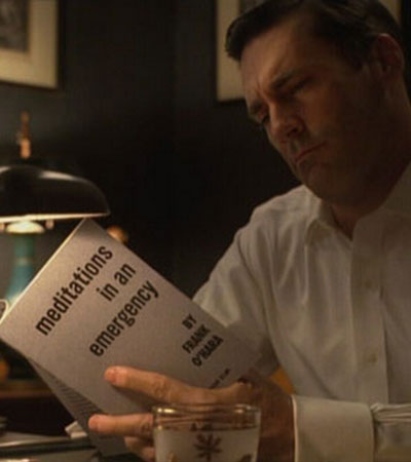
Put the poetry down, Don. It’s time to get your Chartism on.

Last year marked the fiftieth anniversary of the publication of Eric Hobsbawm’s Age of Revolution, 1789-1848, a milestone that was largely overlooked in the more general hubbub over the great historian’s death in October. But it’s an impressive number all the same, and an inescapable reminder that when we return to The Age of Revolution we are dealing with a Very Old Book. The battered cover of my own 1962 Signet paperback (see below), whose author still preferred the high-academic modesty of “E.J. Hobsbawm,” offers a striking visual proof of the antiquities that lie within. It is after all technically possible, and perhaps not as improbable as you may think, for this book to have lain on Don Draper’s desk. When he was still married to Betty Draper.

What can a 21st century early American historian learn from such an artifact? Amid the clamors and confusions of the debate over the New New Political History, why should anyone bother to resuscitate the  Old? Can we learn anything vital about the Age of Revolution in a book written during the Age of Draper? Well, obviously, the answer is yes. Continue reading

The Plantation as Crime Scene: Quentin Tarantino’s “Django Unchained”

Between this and Abraham Lincoln, Vampire Hunter, it's been a banner year for antebellum shades.

Between this and Abraham Lincoln, Vampire Hunter, it’s been a banner year for antebellum shades.

“It’s a flesh for cash business—just like slavery.” So the German bounty hunter Dr. Schultz describes his profession to the ex-slave title character near the beginning of Quentin Tarantino’s Django Unchained. It’s an apt introduction to the film’s broader portrait of American slavery — a rendering that emphasizes the tortured flesh, the sordid cash, and the gruesome business of bondage at every turn. In this regard, Django Unchained fits comfortably within the familiar canon of Tarantino crime films, which have nearly always probed the intersection between the brutally physical and the cynically transactional.

The old gang’s all here: the vicious mob boss, the wisecracking assassin, the tight-lipped, vengeance-minded hero. So why should anyone, let alone early American historians, bother to consider the historical perspective of a film that in many ways is just Reservoir Dogs with snazzier waistcoats and more primitive sunglasses? Continue reading

Jay Gitlin’s French Frontier

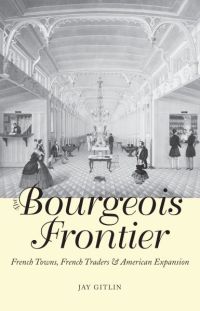
Jay Gitlin, The Bourgeois Frontier: French Towns, French Traders, and American Expansion. The Lamar Series in Western History. New Haven: Yale University Press, 2010.

Jay Gitlin"Bourgeois Frontier" begins this history of the francophone West with geologist William Keating, on an 1823 scientific expedition to the United States’s western frontier, marveling at the number of French speakers he encountered in the Mississippi basin. Who were these people? And why were so many of them still around, six decades after the Seven Years’ War had supposedly terminated the French presence in North America? The Bourgeois Frontier aims to answer these questions, and to explain why—two centuries later—Americans remain as ignorant of these people as Keating had been. The result is a compelling account of the francophone towns that formed a crescent-shaped constellation along the western fringe of the early American republic. In eight chapters of buoyant prose chronicling the 1760s through the Civil War, Gitlin shows how the French Creoles who inhabited these towns adjusted and adapted as American expansion changed their world. Continue reading