 After a brief hiatus, “The JuntoCast” returns with its tenth episode, this time covering gender in early America. Continue reading
Tag Archives: Gender
Introducing The History Carousel: Bringing the Past Full-Circle with the Present
 We at The Junto are very excited to announce the birth of a new podcast. “The History Carousel” will connect the past with the present, and will feature a rotating cast of Junto members and guests. It’s part of our equally-new podcast network, which is going to allow for all sorts of podcasting shenanigans—many thanks to Michael Hattem for helping to set it up. Continue reading
Interviews with Historians: Carol Berkin
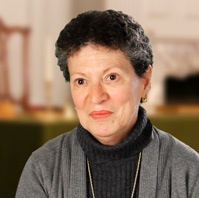 Carol Berkin is Presidential Professor Emerita at Baruch College and the CUNY Graduate Center. She received her bachelor’s degree at Barnard College. In 1972, she received her PhD at Columbia University, where she also worked on the Papers of John Jay and Alexander Hamilton. Her dissertation on Jonathan Sewall won the Bancroft Award for Outstanding Dissertation and the subsequent book, Jonathan Sewall: Odyssey of an American Loyalist, was nominated for the Pulitzer Prize in 1974. She then spent her entire teaching career at Baruch College and the CUNY Graduate Center. Her most popular works include A Brilliant Solution (2002), which has been translated into Polish and Chinese, First Generations: Women in Colonial America (1996), Revolutionary Mothers: Women in the Struggle for American Independence (2005), and Civil War Wives (2009). She is a pioneer in early American women’s history and also the author and editor of numerous textbooks, readers, and teaching guides for women’s history including Women of America (1980), Women’s Voices, Women’s Lives: Documents in Early American History (1998), In the Words of Women: The Revolutionary War and the Birth of the Nation, 1765 – 1799 (2011), and Clio in the Classroom: A Guide to Teaching Women’s History (2009). She is also the editor of History Now, an online magazine published by the Gilder Lehrman Institute of American History. She has appeared in numerous television documentaries, including Founding Brothers and Founding Fathers on the History Channel and Ric Burns’ New York on PBS. Continue reading
Conference Panels and Intellectual Connections
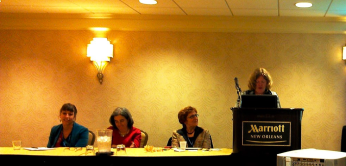 For early Americanists, fall is conference-planning season. Proposals for the Omohundro Institute Conference were due in mid-September, SHEAR is accepting proposals until December 1, and a bevy of other conferences have posted CFPs in recent months. Watching this flurry of activity has led me to think about the intellectual goals that structure the formation of conference panels.
Of course, the conference panels we form—and whom we invite to participate in them—are partly functions of pragmatism. Each of us wants to find our way onto the program of our desired meeting, and mobilizing our networks is one way to do this. We scramble to find friends, colleagues, friends-of-friends, and acquaintances from research trips and prior conferences to join us on our panels. But if one of the goals of conferences is to enter into scholarly conversations, rather than simply to share our work with academic audiences, then it is essential to think about the kinds of questions our panels are asking and answering. Continue reading
Everyday Connections of Colonial Economies: Conference Recap
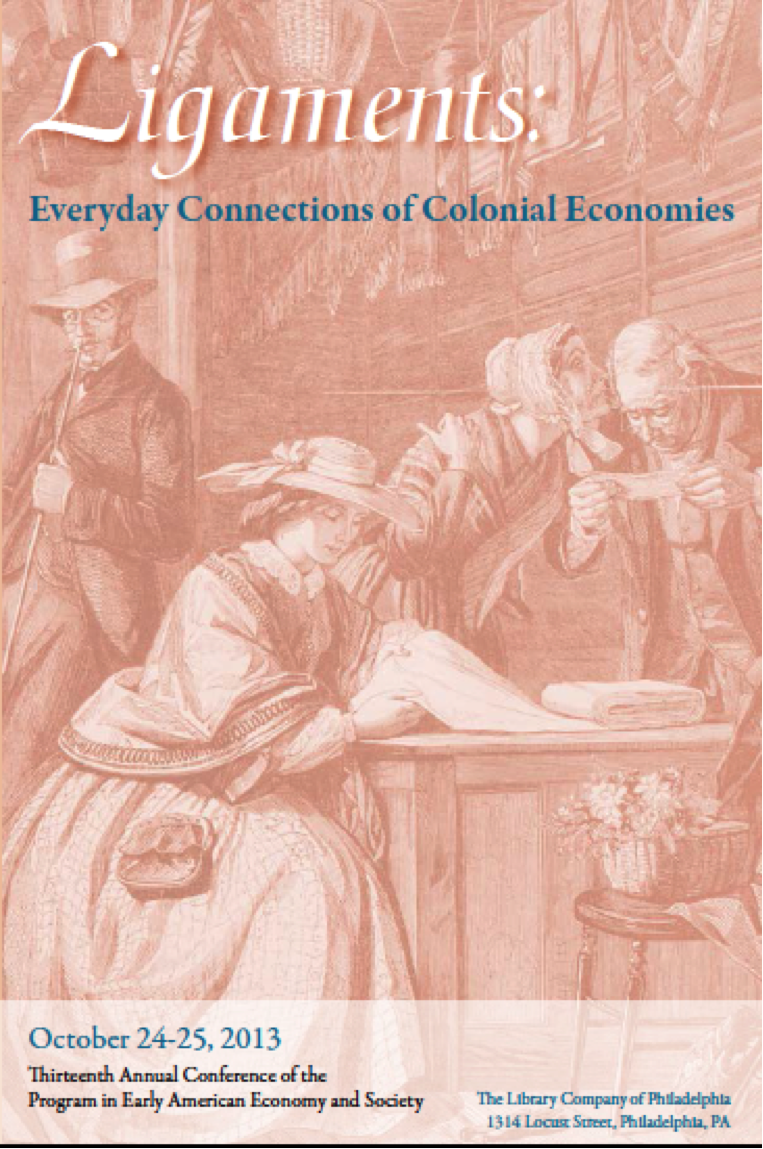 In our writing and teaching, we often refer broadly to “the early American economy,” suggesting that various systems of production, consumption, and exchange formed a collective whole. But what were connections that bound together this early American economy? Fifteen presenters—and a large and engaged audience—considered this question at the Program in Early American Economy and Society’s annual conference at the Library Company of Philadelphia on October 24th and 25th.
The conference title, “Ligaments,” referenced the connections and linkages that gave shape to the early modern economy. As PEAES director Cathy Matson explained in her introduction, the conference assembled some of the many scholars who are currently examining “ordinary, pragmatic economic connections” and using their investigation of these seemingly mundane topics to shed light on “big ideas” and longstanding questions. Continue reading
Guest Post: Pauline Maier and the History of Women in History
Sara Damiano is a Ph.D. candidate at Johns Hopkins University. Her dissertation is entitled, “Gender, Law, and the Culture of Credit in New England, 1730-1790.”
 How should we choose to remember the lives and works of historians, and what do these choices say about our profession? The recent deaths of Edmund Morgan and Pauline Maier have led me to ponder these questions. I have watched with interest as historians have taken to social media—blogs, H-Net listservs, Twitter, and Facebook—to celebrate the lives of Morgan and Maier and to critique commemorations in the national press.
Guest Post: Teaching with Legal Sources: The Case of Ann Hibbens
Today’s guest poster is Sara Damiano, a Ph.D. candidate at Johns Hopkins University. Her dissertation is entitled, “Gender, Law, and the Culture of Credit in New England, 1730-1790.”

As we plunge into syllabus-writing season, I would like to contribute to The Junto’s ongoing conversation on teaching with primary sources. (Joseph Adelman and Glenda Goodman have previously written on favorite sources in the survey and on music in the classroom, respectively.) I’m a historian of gender and law, so I would like to make the argument for including legal sources in our syllabi, even for courses that aren’t explicitly focused on legal history. By way of illustration, I would also like to recommend one of my favorite legal history sources for teaching: the 1640 trial of Ann Hibbens before the First Church of Boston.
Beyond the Valley of Mexico

Expanding the boundaries of early America has been a hot topic of conversation this summer. At both the Omohundro Institute conference last month, and at SHEAR last weekend, plenary sessions discussed a broader view of the past. Having internalized the Atlantic turn, scholars are now turning their energies toward the interior, asking how we should integrate the trans-Appalachian and trans-Mississippian West into our stories and interpretations.
“There was a great argument yesterday on female excellence”: Gender & the Newest Political history
One of the most striking features of the “newest political histories” has been their careful attention to questions of gender. Four essays (for example) in Beyond the Founders, the capstone-cum-manifesto of this particular historiographical moment, deal directly with the political nature of gender identities in the early American republic.[1] The privileged place of gender in these histories makes a great deal of sense–if the goal of the “newest political histories” is to broaden cast of characters in political history and explore the intersection of “cultural” and “ordinary” and “traditional” politics then questions of masculinity, femininity, and sexuality should be central. Gender, along with race, was a key way to demarcate between who was in and who was out of respectable politics in the new nation.
The most productive, and perhaps influential, use of gender as an interpretive lens has been in the political history of women. Many of the earliest works of what could be called the “newest political history,” and those which best exemplify the movement, are histories of women and politics.[2] This generation of historians has shown that women were clear actors in early national politics and print culture–through newspapers, the theater, parades, books, and the salon. Not only were women a direct participant in politics “out of doors” and in print, femininity was deeply politicized in the early national period. In the highly charged politics of the early republic, much was up for grabs–a great deal of prestige and power would be gained (or lost) depending on where the line of respectable political behavior of men and women was drawn. Continue reading
 The Junto