Yesterday, Tom Cutterham kicked off our week-long roundtable on the Origins of the American Revolution with a discussion of Nick Bunker’s recent book, An Empire on the Edge. Today, we continue with a discussion of religion and the American Revolution.

George Whitefield Preaching in Philadelphia
In 1781, as the American Revolution raged, a Connecticut magazine reported that a spectral George Whitefield (1714-1770) had appeared over a regiment of British troops, including Benedict Arnold. So frightened were these British regulars, the magazine claimed, that they burned their British finery. Those familiar with the consumer politics of the Revolutionary period will recognize the political statement implicit in the burning of British goods. With refinement, British clothing, textiles, and other goods had become attractive to well-heeled colonists, who emulated the latest London fashions. As T.H. Breen and others have noted, the wearing of British fashions became problematic during the Revolution. Textiles and other factories began to crop up in the northeast, the start of an American industry.[1]

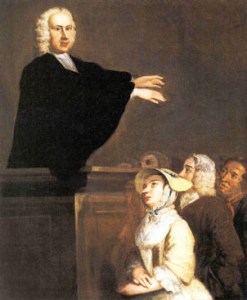 Those familiar with the first great awakening will undoubtedly recognize George Whitefield as a key figure of eighteenth century evangelical culture in Britain and its American colonies. Like many associated with the Methodist movement in Whitefield’s time, the prolific preacher and publisher saw himself as an Anglican in discussion with the Church of England about reform and an allowance for a broader religious experience. However, his theology, the new birth doctrine, the gathered church, etc., all alienated Whitefield from the Anglican hierarchy within the first few years of his missionary career.
 In 1740, during George Whitefield’s first visit to New England, Connecticut minister Reverend Daniel Wadsworth wrote in his diary: “met with the famous life of Whitefield: but what is it?”[1] Wadsworth’s comments no doubt reflected both the excitement and the unease that Whitefield’s visit provoked among New England clergy, who both looked to him as a man who could renew piety and New England, but also feared his potential for exacerbating existing religious tensions. Nonetheless, it is a poignant question, and one anyone who is familiar with “the Grand Itinerant” might ask.
  The Junto