 In line with Matt Karp’s look back on Eric Hobsbawm’s Age of Revolution from last month, I’d like to take this opportunity to reconsider a classic work in early American history, Edmund Morgan’s The Birth of the Republic, 1763-89, which has just recently made it to its fourth edition. I have a long relationship with this slim volume. For many years before I began my undergraduate work as a 30-year old non-trad, I had been reading early American history, particularly classic works in the historiography, which has fascinated me since the beginning. I spent years going through the New York and Brooklyn Public Libraries’ 970 shelves and one of the earliest books I read was Birth of the Republic. A decade later, I am now extremely fortunate to be doing my doctoral work at Yale University, where Morgan taught and worked for three decades. Though he has long since retired into reclusion (having just turned 97 last month), he still casts a large shadow over the department. Graduate students here (myself included) whisper about a rare Morgan sighting and get excited when they find one of his books at a book sale with his name (and/or marginalia) written in it. So I very much appreciate this opportunity to return to and reassess this work. Continue reading
Tag Archives: historiography
The NNPH: Odds, Ends, and Some Concluding Statements
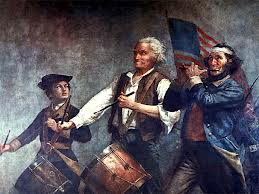
Political history goes marching on.
Unfortunately, we were unable to post the final scheduled post for the roundtable, which was set to be on race. So instead of someone trying to scrounge up a full post last-minute on this important topic, a few of us decided to put up some brief concluding thoughts on various topics related to the New New Political History. We ask that these be read as more informal than the previous three posts, and more as a touchstone for possible discussion. If things go right, we should have a response to the roundtable from Andrew Robertson sometime soon.
Besides engaging with any points in this or other posts in the roundtable, please feel free to bring up any other issues that we didn’t address related to the NNPH. Continue reading
Politically Incorrect?
I consider myself a child of the ‘new new political history’. When I first started in graduate school, books like Simon Newman’s Parades and the Politics of the Street and David Waldstreicher’s In The Midst of Perpetual Fetes helped a constitutional geek recognize the necessity of taking a broad definition not just of political activity, but also of political actors. Beyond the Founders was a wonderful introduction to the possibilities of political history – the way in which a whole host of diverse experiences influenced and shaped political culture during the early republic. Their portrayal of early American political culture was a welcome change from previous histories focusing excessively on elites (and thus tending to promote ideology ahead of political action), or social histories whose model of class consciousness seemed a bit too heavily grafted on to a period in which some (if by no means all) elite political leaders possessed a real claim to widespread popularity.
Of course, the plea to get historians to move ‘Beyond the Founders’ hasn’t been a wholesale success. While Chris Beneke may have suggested that the plethora of books about ‘Founders’ would inevitably slow down, even some Beyond the Founders contributors themselves contributed essays to Alfred Young, Ray Raphael and Gary Nash’s recent Revolutionary Founders. In both popular culture and in academic circles, the trope of ‘founders’ or ‘framers’ or a ‘revolutionary generation’ still looms large. The question I want to explore in this blog post, then, is this: If the NNPH promised to provide a history that synthesized political narratives with social and cultural history, why do we seem to find it so hard to move beyond the founders? My suggestion will be this: for all that the NNPH revitalized political history after the ‘social turn’, much of it was strangely detached from high politics. Continue reading
“There was a great argument yesterday on female excellence”: Gender & the Newest Political history
One of the most striking features of the “newest political histories” has been their careful attention to questions of gender. Four essays (for example) in Beyond the Founders, the capstone-cum-manifesto of this particular historiographical moment, deal directly with the political nature of gender identities in the early American republic.[1] The privileged place of gender in these histories makes a great deal of sense–if the goal of the “newest political histories” is to broaden cast of characters in political history and explore the intersection of “cultural” and “ordinary” and “traditional” politics then questions of masculinity, femininity, and sexuality should be central. Gender, along with race, was a key way to demarcate between who was in and who was out of respectable politics in the new nation.
The most productive, and perhaps influential, use of gender as an interpretive lens has been in the political history of women. Many of the earliest works of what could be called the “newest political history,” and those which best exemplify the movement, are histories of women and politics.[2] This generation of historians has shown that women were clear actors in early national politics and print culture–through newspapers, the theater, parades, books, and the salon. Not only were women a direct participant in politics “out of doors” and in print, femininity was deeply politicized in the early national period. In the highly charged politics of the early republic, much was up for grabs–a great deal of prestige and power would be gained (or lost) depending on where the line of respectable political behavior of men and women was drawn. Continue reading
National Identity and the American Revolution
 In his recent review of Kevin Phillips’s 1775: A Good Year for Revolution, Jack Rakove argues that in tackling the causes of independence, “Phillips deals with political loyalties more fundamental than the mere matter of party allegiance.” The inference is clear—deciding to be a member or an activist for a political party is one thing; but your nationality is something that defines you in perpetuity. Once revolutionaries chose to take on the label ‘American’, there was no turning back. It was who they were; while that American identity might be complex and multifaceted, there is something about “national character” that stands above the rough and tumble of party politics. Continue reading
Enough Already! Or, Do We Really Need More Haitian Scholarship?
My apologies for my first Junto post being a bit of shameless self-promotion. But here it is: a piece I just wrote for The New York Times on Haiti’s role in the Civil War. In short, it’s about how a small but significant portion of black Americans saw Haiti as a better option than the United States during the conflict. As Matt Karp wrote on his Junto post today, the most groundbreaking Haiti-related scholarship today deals with what happened after the Haitian Revolution, that is, post-1804. Continue reading
Journal Articles in 2012: A Retrospective
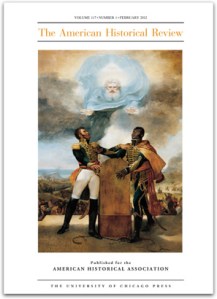
BuzzFeed would point out that God is totally portrait-bombing Pétion and Dessalines here.
“The list,” says Umberto Eco, “is the origin of culture… What does culture want? To make infinity comprehensible.” This impossible project has inspired dauntless gallants from Homer to BuzzFeed, and even in our own brief existence, The Junto has already made a valuable contribution to that noblest of list genres, the year-in-review inventory.
Today I’ll attempt to advance the cause of culture with a few notes on the particular infinity of early American history articles published in 2012. Unfortunately I can’t apologize for my own personal and intellectual biases, which lean toward international politics, slavery and abolition, and historiography, all of it within the nineteenth century. A successful list is usually just private prejudice, artfully compressed and shrewdly disguised—Homer, after all, chose to focus on the Achaeans’ black ships and famous spearmen rather than their haircuts or favorite foods; the BuzzFeed guy sems to have a thing for marine mammals. But you should know where I’m coming from before we proceed. Continue reading
The Agonies of “Christian Republicans”
This is not, sadly, a post about the troubled relationship between the modern Republican Party and politicized Christianity. I’d like to discuss, rather, a powerful and provocative synthesis of American political, theological, and religious history published a decade ago – Mark Noll’s America’s God. Noll’s magisterial tome brings together over a generation of scholarship on the relationship between American politics and religion (the “democratization thesis”), civic humanism (the “republican thesis”), and Scottish commonsense philosophy in the early national and antebellum United States.[1] America’s God is in many ways a capstone to Noll’s truly outstanding career as a great historian and public intellectual. Continue reading
Jay Gitlin’s French Frontier
Jay Gitlin, The Bourgeois Frontier: French Towns, French Traders, and American Expansion. The Lamar Series in Western History. New Haven: Yale University Press, 2010.
Jay Gitlin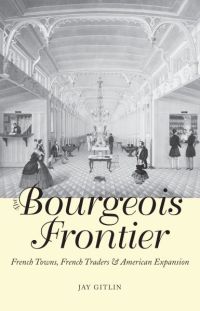 begins this history of the francophone West with geologist William Keating, on an 1823 scientific expedition to the United States’s western frontier, marveling at the number of French speakers he encountered in the Mississippi basin. Who were these people? And why were so many of them still around, six decades after the Seven Years’ War had supposedly terminated the French presence in North America? The Bourgeois Frontier aims to answer these questions, and to explain why—two centuries later—Americans remain as ignorant of these people as Keating had been. The result is a compelling account of the francophone towns that formed a crescent-shaped constellation along the western fringe of the early American republic. In eight chapters of buoyant prose chronicling the 1760s through the Civil War, Gitlin shows how the French Creoles who inhabited these towns adjusted and adapted as American expansion changed their world. Continue reading
Sympathy for the Founders
One day soon, someone will write the history of the bankers, fund managers, lawyers and accountants who helped make our present financial crisis. When they do, they’ll need to be careful not to lose sight of the far larger group of people – really, everyone – who were also part of that process, the suffering they endured and the resistance they enacted. It would need to be a cultural, intellectual, legal, political, and social history that gave account not only of how the financial elite thought and acted, but how that thought and action was shaped by structures and events. It would see the world reflected in their eyes. In that moment, it might show a little sympathy.
 That’s how I feel about my own project, a history of power and ideology among American elites in the 1780s. The first question that troubles me – why study elites? – tends to dissolve into a slightly different one – what does it mean to study elites? To be meaningful it has to be a way of studying how historical change happens and how the conditions of life are produced. Elites are both separate and inseparable from the rest of society, linked in a complex, ambivalent embrace that constitutes a kind of class struggle. And class struggle is history in action.
 The Junto