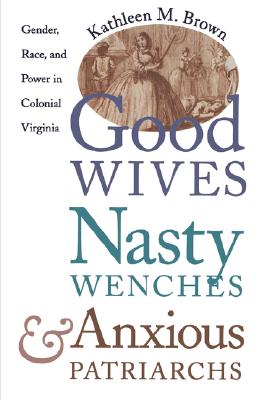
 Welcome to the semifinal edition of the Junto Summer Book Club! Before we head into the closing week, let’s pause at Chapters 8 and 9 of Kathleen Brown’s Good Wives, Nasty Wenches, and Anxious Patriarchs, to remember the ladies—and gentlemen—who invested in creating Virginian society. Continue reading
Tag Archives: Slavery
The Week in Early American History
 Welcome to another installment of The Week in Early American History. Continue reading
Summer Book Club, Week 4
 After a hiatus for Independence
 Day Week, we’re back today for chapters six and seven of Good Wives, Nasty Wenches, and Anxious Patriarchs. These chapters guide us into the eighteenth century, showing how an increasingly recognizable racial order, predicated on the authority of white householders, took shape in Virginia.
The Week in Early American History
This week, we’re bringing in a bumper crop of cultural opportunities and political teachable moments. Continue reading
Summer Book Club, Week 3
This week in the Junto Summer Book Club we’ll be looking at chapters 4 and 5, in which Brown looks first at the beginnings of Virginia’s slave system in the mid-seventeenth century, and then at the memorable—and highly teachable—events of Bacon’s Rebellion in the 1670s. Continue reading
Summer Book Club, Week 2
Welcome to the second installment of the Junto Summer Book Club! We discussed the introduction and first chapter of Kathleen Brown’s Good Wives, Nasty Wenches, and Anxious Patriarchs during Week 1. This week we’ll consider Chapters 2 and 3. With these chapters, Brown transports us across the Atlantic Ocean, shifting her focus from early modern Britain to the early years of English settlement in Virginia.
Summer Book Club, Week 1

Welcome to the Junto Summer Book Club, where over the next six Fridays we will be reading and discussing Kathleen Brown’s 1996 book, Good Wives, Nasty Wenches, & Anxious Patriarchs. Each week, a Junto representative will write a brief post on that week’s chapters to offer a few opening remarks and raise some questions to get the discussion started. We will then open up the comments section for you to address any topic related to the book—its argument, Brown’s use of sources, the historiography, using it in the classroom or in a public setting, to name just a few. We look forward to a lively conversation and to seeing how it develops over the next several weeks.
This week, we begin our conversation with the Introduction and Chapter 1, “Gender and English Identity on the Eve of Colonial Settlement.”
The Details Matter: On Ta-Nehisi Coates and Reparations
 The attention Ta-Nehisi Coates’ essay on reparations has received is remarkable and welcome. But like most of the folks he’s directly appealing to—educated, mainstream liberals who read The Atlantic—I approached his essay skeptically, assuming reparations was an impractical, even irresponsible way to redress the crimes of slavery and the way its legacy, racism, continues to disadvantage all African Americans today. But by the end of it, I was convinced. A major reason why is because by reparations Coates, or at least the leading advocates for reparations he quotes in approval, aren’t arguing for simple payouts to African Americans. Coates knows too well that, lacking a more rigorous understanding of our nation’s history with slavery, and the continuing problems of institutionalized racism, cash payouts risk becoming little more than “hush-money.” Continue reading
Slavery and Reparations: A Voice from Barbados and a Report from Ghana
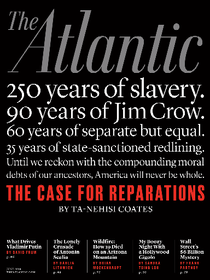 You’ve probably heard about Ta-Nehisi Coates’s powerful Atlantic cover essay, “The Case for Reparations,” which appeared two weeks ago and has ignited a nationwide political conversation about the legacy of slavery and racial oppression in the United States. The level of debate among Coates’s many academic admirers and critics—including political commentators on both the Left and the Right—has been very high. Continue reading
Announcing the Junto Summer Book Club
With summer upon us, many of us are turning our attention to reading lists, whether for upcoming graduate exams, syllabus preparation, research, or pleasure. For many, it’s an opportunity to catch up on new work that sat neglected during the push through the final weeks of the semester and exams, but it’s also an opportunity to return to more classic books that have shaped the field and deserve reconsideration. Plus, we at the Junto love nothing more than to discuss and argue about history. Therefore, we would like to introduce a new feature: the Junto Summer Book Club.
 The Junto