Godly Heritage and Plantation Chic: The Case of Vision Forum

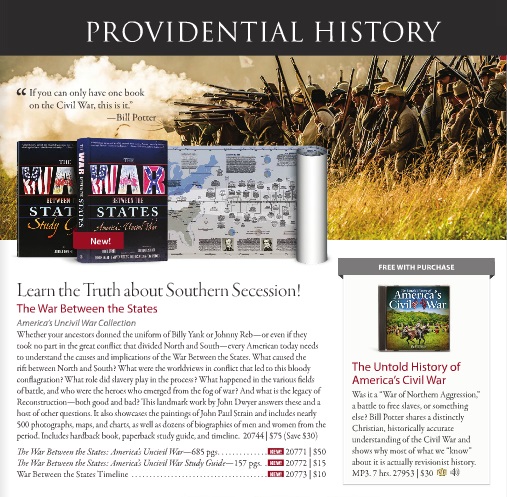
Detail from a page of the Vision Forum 2014 catalogA recent news story has me thinking about the weird enduring appeal of the Lost Cause. It seems to me that this news story about a contemporary religious organization might lead us into an interesting case study. Why, at this late date, do so many Americans still want to see the antebellum South as a tragically vanished world of nobility and grace?

Most early Americanists are familiar with David Barton, a conservative activist who argues that the United States was founded as a Christian nation. He’s been mentioned here several times as the most visible proponent of a view that’s common among members of the “Religious Right.”[1] What’s less widely understood is how often his Christian-founding ideology overlaps with a claim advanced by a few other evangelical conservatives: that the Confederacy—and antebellum southern culture, if not slavery itself—are also part of “America’s Godly heritage.”[2] In these circles, in other words, the Founding is sometimes wrapped up with the Old South.

Continue reading

The Week in Early American History

TWEAHThe biggest early-America news in popular culture this week may be the film adaptation of 12 Years a Slave, which will enter wide release in the US on November 1. In an interview with Terry Gross, director Steve McQueen says he wants Solomon Northup’s story to enter public consciousness the way Anne Frank’s diary has. David Blight discussed it with Terry Gross and recommended 12 Years a Slave as “a very good corrective” to ordinary Hollywood treatments of slavery. In the New Yorker, Annette Gordon-Reed uses the film to discuss some of the opportunities and problems slave narratives present to historians. At Grandland, Wesley Morris describes how the film “presents savagery in civil terms.”

Continue reading

The Week in Early American History

TWEAHThanks to the United States Congress, it’s been a good week for the Founders—or a bad one, depending on your point of view. Continue reading

Locating the Literati: Charles Brockden Brown in Philadelphia

Charles Brockden Brown - NYPL Digital GalleryIt’s hard to write about early American print culture or intellect without thinking a lot about geography. Scholars like Trish Loughran, Richard John, John Fea, John Brooke, and Mary Kelley have suggested, in all sorts of ways, that it’s often wise to understand “the” early American public as a web of fundamentally local reading and writing publics. Intellectual culture meant something different from what it means in an age of mass media. But tricky questions come up when you try to write a local history of ideas or culture. Just how local can we reasonably go? How much detail can we actually use in an intellectual map of the early United States without getting lost in coincidences and irrelevance?

Continue reading

Seeing Dead People: Biography in the Survey

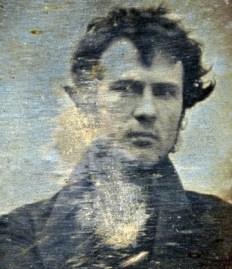
Robert Cornelius, Phila., 1839. Possibly the first American photo portrait.This fall, I’m teaching a freshman U.S. history survey with a couple of unusual requirements. First, my class covers American history, from the seventeenth century to the twentieth, in a single frenzied semester. Second, and also by school policy, all the readings in the course must be biographical. Continue reading

The Week in Early American History

TWEAHLast week, we heard the news that Mitch Daniels, formerly governor of Indiana and now president of Purdue University, apparently tried to keep “terrible anti-American academic” Howard Zinn’s People’s History out of Indiana’s schools and universities. This week, Indiana University’s Carl Weinberg revealed how he actually used Zinn’s text in a training course for Indiana high school teachers. Continue reading

The Week in Early American History

TWEAHIt’s been an exciting week for history in the news. First, we learned that Karen Nipps has discovered buried treasure in Harvard’s Houghton Library–650 signatures of Boston citizens pledging to boycott British goods taxed by the Townshend Acts in 1767. The signatories include Paul Revere, John Wheatley (owner of Phillis), and several of Boston’s women.

Continue reading

In Memoriam: Edmund S. Morgan, 1916-2013

edmundsmorgan-bydavidlevineYesterday, the New York Times and Associated Press reported the death of Edmund Morgan at age 97. The man Bruce Kuklick called “arguably the finest living American historian” needs no introduction here, but today we’re featuring tributes, reflections, and some favorite articles from around the Web. The Junto will be hosting a week-long roundtable on the legacy of Morgan and his most important works in the first week of August.

In the meantime, please feel free to use the comments here to discuss the scholar and his work.

Continue reading

“The True Key of the Universe Is Love”

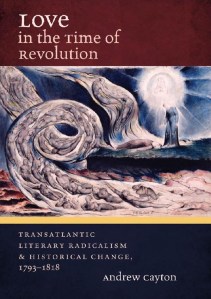
Cayton - Love in the Time of Revolution - UNC Press

During a panel at this summer’s Revolution conference in Philadelphia, someone asked Annette Gordon-Reed whether she sees any hope for a synthesis of contemporary scholarship on race, class, and gender. She answered that she tries to achieve this by talking about people—that is, telling stories about particular lives.

Whether biography represents the culmination of decades of historical scholarship on identity and social power or an admission of its shortcomings is an interesting question. Either way, biography, including biographical microhistory, has a growing place in the field.[1] British and American historians have taken part in the “biographical turn” with special enthusiasm, though it is hardly unique to us.[2] 

With Love in the Time of Revolution: Transatlantic Literary Radicalism and Historical Change, 1793-1818, Andrew Cayton advances biographical historiography by binding it unusually securely to two other trends in early American historiography: studies of print culture, broadly conceived, and studies of the Atlantic world as a system. Cayton builds the family life of Mary Wollstonecraft into the center of a narrative about what it could mean to be a revolutionary intellectual in the Atlantic republic of letters. Continue reading

The Week in Early American History

TWEAHIn time for Memorial Day, we have several stories about time, memory, and narrative in general, as well as links to stories of early America.

First, two new book reviews: Mike Jay’s review of Suzanne Corkin’s Permanent Present Tense, on memory and personal identity, and James Gleick’s review of Lee Smolin’s Time Reborn, on the nature of time itself.

Then, has wider access to information done anything in recent years to restrain the “paranoid style in American politics”? Maggie Koerth-Baker says no.

Continue reading