 We hope you will forgive the spottiness of TWEAH recently, but it is likely to be a regular occurrence during the summer months. Nevertheless, here are some links for you this Independence Day holiday weekend… Continue reading
Author Archives: Michael D. Hattem
The Week in the Declaration of Independence
 “Is it the Fourth?” Indeed, it is. And, along with it comes no shortage of interesting conversations about the Declaration of Independence. So here is our quick roundup… Continue reading
The First Year of Founders Online: An Interview with Kathleen Williams
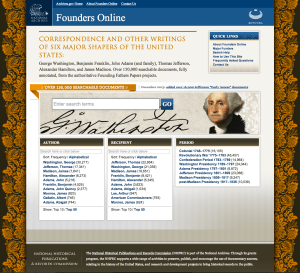 Founders Online launched just over a year ago on June 13, 2013. Today, The Junto catches up with Kathleen Williams, the Executive Director of the National Historical Publications and Records Commission (NHPRC), to get a sense of how Founders Online is being used, how much it is being used, and who is using it. We also discussed what the future may hold in store for Founders Online in terms of further website and content development. (NB: In my capacity as a Research Assistant at the Franklin Papers, I have been proofreading the Founders Online transcriptions of the Franklin volumes. I have also used the database for research, both for pieces I have written for the blog as well as my dissertation.) Continue reading
The JuntoCast, Episode 11: The Declaration of Independence
 What better way to get ready for celebrating July 4th than to listen to the newest episode of “The JuntoCast” on the Declaration of Independence? Continue reading
Benjamin Franklin and “our Seamen who were Prisoners in England”
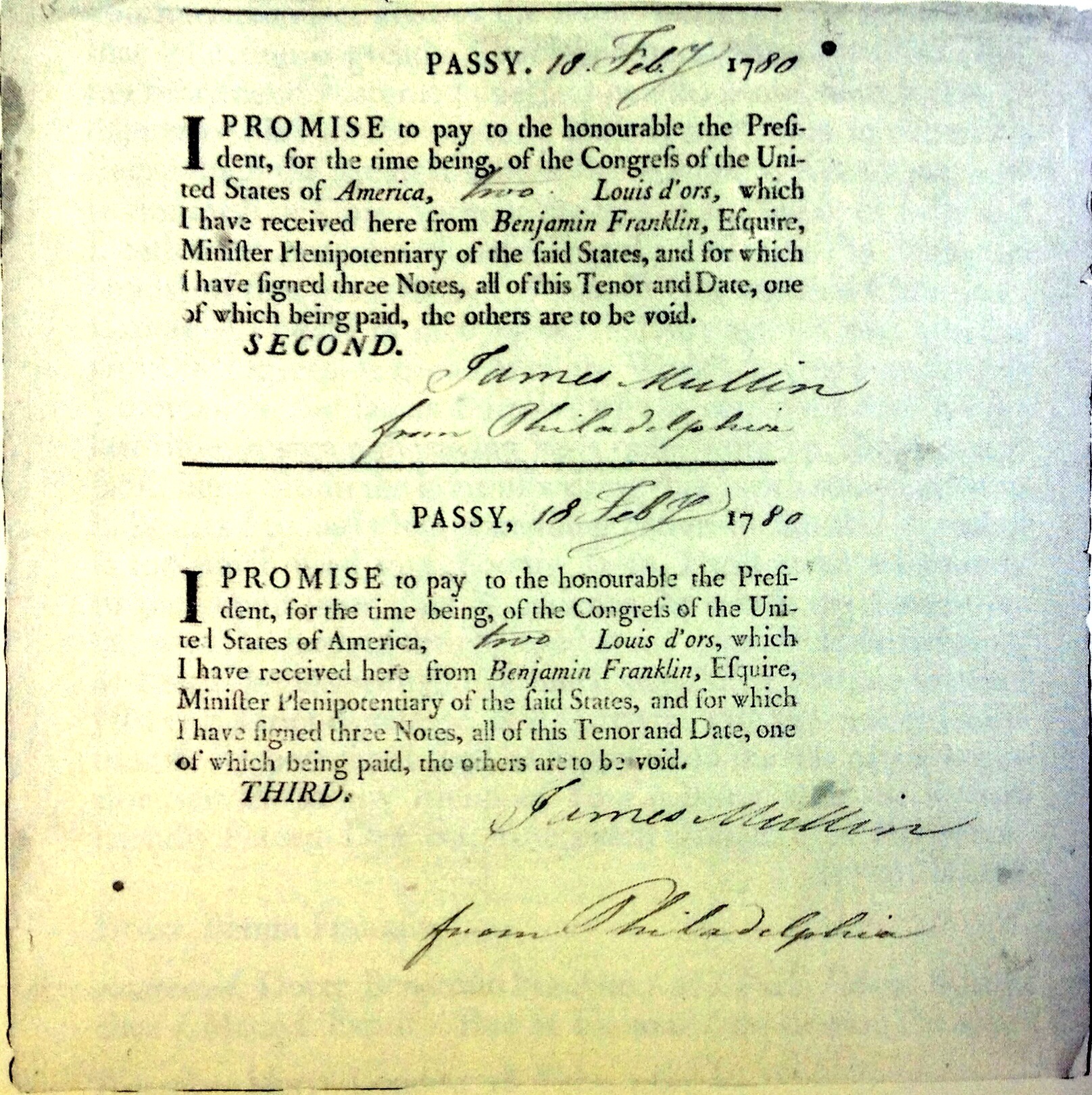 Earlier this week, I found myself sitting at my desk at the Franklin Papers faced with photostat copies of an “Alphabetical List of Escaped Prisoners” and a huge pile of promissory notes printed in triplicate by Franklin himself on the press he kept at his home in Passy, a suburb outside Paris. While I was going through them, I could not help but think back to the recent events surrounding the return of U.S. Army Sergeant, Bowe Bergdahl, the last remaining prisoner of the nation’s longest continuous period of war since the American Revolution. Politics aside, the Bergdahl affair speaks to the importance placed on coming to the aid of Americans detained in wartime. And what I had before me at my desk spoke to the same during the War for Independence. These men—largely privateersmen who had been captured on the high seas by the British and transported to English prisons—were among the very first Americans imprisoned on foreign soil during wartime and these documents reveal an often untold story about how the United States government and Benjamin Franklin dealt with this new problem.
The Week in Early American History
 You’ve worked hard all week. Your reward? Links, of course… Continue reading
Grade Inflation or Compression?
 Back in December, the Dean of Undergraduate Education at Harvard was quoted from a meeting of the Faculty of Arts & Sciences saying, “The median grade in Harvard College is indeed an A-. The most frequently awarded grade in Harvard College is actually a straight A.” This statistic was highly shocking to the general public (or at least the general media). Yale itself moved last year to address the problem when it turned out that 62% of grades given to undergraduates in a two-year period were A-minuses. Just a few weeks ago, the Teaching Center at Yale hosted a day-long seminar entitled, “Are All Yale Students ‘A’ Students? A Forum on Grading.” Most recently, Rebecca Schuman published a piece on grading at Slate entitled, “Confessions of a Grade Inflator.” However, rather than only seeing what has happened as the inflation of individual students’ grades, we should also see it—from the instructor’s perspective—as a compressing of the grading scale itself. Doing so reveals multiple repercussions for both students and faculty that the individualized, student-centered notion of “grade inflation” misses. We need to keep in mind that grade inflation or compression does not just benefit unworthy students; it actually has negative effects on both students and faculty, which should be the real causes for wanting to address the problem.
The Week in Early American History
Happy Mother’s Day! Consider our gift to the mothers amongst our readership to be the following links, links, and more links… Continue reading
The JuntoCast, Episode 10: Gender in Early America
 After a brief hiatus, “The JuntoCast” returns with its tenth episode, this time covering gender in early America. Continue reading
On Assigning Undergraduate Reading
 During my first year as a Teaching Fellow, I’ve done a number of pedagogy-related posts, covering student preparation, undergraduate writing, and lecturing. Having finished that first year, I have found myself thinking about different approaches I’ve witnessed to assigning readings. The question I have is: What is the best approach to assigning undergraduate reading? Continue reading
 The Junto