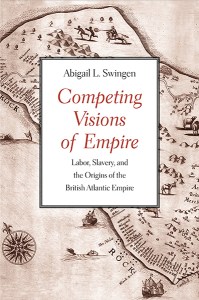
 Abigail Swingen is an Assistant Professor of History at Texas Tech University (Lubbock, TX). She received her Ph.D. in History from the University of Chicago. She specializes in the Early Modern British Atlantic Political Economy. Competing Visions of Empire is her first book and was reviewed here yesterday. The following is part of our (relatively) new tradition of reviewing a book and then offering a Q & A with the author the following day. [NB: You can find my review from yesterday here.] Continue reading
Author Archives: Jessica Parr
Review: Abigail Swingen, Competing Visions of Empire
Abigail L. Swingen, Competing Visions of Empire: Labor, Slavery, and the Origins of the British Atlantic Empire (New Haven: Yale University Press, 2015).
There have been some fantastic new contributions of late that explore connections between slavery, economics, and empire. In his 2008 analysis of the American political economy, economic historian Gavin Wright concluded that the dependence on slave labor came not because of any institutional efficiency on the part of plantations, but rather, that no other form of coerced labor could have been made to meet the labor demands. Sven Beckart’s Bancroft Prize-winning book, Empire of Cotton, analyzes connections between cotton, and the slave labor behind it, and the rise of modern capitalism. Ed Baptist’s book, The Half Has Never Been Told, explores slavery’s role in the making of American capitalism.
Recap: “So Sudden an Alteration” Conference (9-11 April 2015)
 Two weeks ago, 175 historians descended upon the Massachusetts Historical Society (MHS) in Boston for a three-day conference that considered the political, social, economic, and global parameters of the American Revolution. The conference consisted of eight panels (with pre-circulated papers), two keynotes, and some special presentations on digital projects. The conference proceedings were live-tweeted under #RevReborn2, and fellow Juntoist Joseph Adelman provided some live coverage on the blog. The Junto has also had some post-conference commentaries, including “You Say You Want a Revolution” by Joseph Adelman and “The Suddenness of the Alteration: Some Afterthoughts on #RevReborn2” by Michael Hattem.
This Week in Early American History
 Welcome to another edition of This Week in Early American History! We wish a safe and healthy holiday to those who are observing Easter this weekend, and a Chag Kasher V’Sameach to those who are celebrating Passover. Now, on to the links….
This Week in Early American History
Welcome to this week’s news in Early American History! Continue reading
Guest Post: Why Shoes?
Kimberly Alexander is an Adjunct Professor in the History Department at UNH, Durham, where she teaches courses in museum studies and material culture. She earned her Ph.D. in Art & Architectural History from Boston University and was a founding Curator of Architecture and Design at the MIT Museum. She’s also served as Curator of Architecture and Design at the Peabody Essex Museum and Chief Curator of Strawbery Banke Museum in Portsmouth, NH. Dr. Alexander has published several books and essays, and has recently had papers presented at history of fashion conferences in London and Florence. Her current catalog and exhibition project is titled “Cosmopolitan Consumption: Georgian Shoe Stories From the Long 18th Century.”
 How does one select a sampling of dozens of pairs of eighteenth-century shoes and translate the assemblage into a coherent museum exhibit housed in one charming, but tiny gallery? How does one translate a five-year study of eighteenth-century consumption patterns, cultural diffusion, and gentility in the Atlantic shoe trade into a show that will excite the imaginations of early Atlantic scholars yet appeal to the general public? How does present a material culture and fashion history exhibition in a refined Athenaeum situated in a corner of New Hampshire? Continue reading
Q&A with Stephen R. Berry, Author of A Path in the Mighty Waters
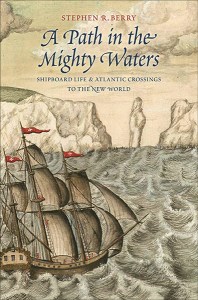 The following is an interview with Stephen R. Berry, an Associate Professor of History at Simmons College. My review of Berry’s recently-released book, A Path in the Mighty Waters: Shipboard Life and Atlantic Crossings to the New World (New Haven: Yale University Press, 2015) appeared on the blog yesterday. Today, he agreed to answer some follow-up questions about his book and his future research plans. Continue reading
Tempests and Tedium in the Transatlantic: Shipboard Life in the 18th Century
Stephen R. Berry, A Path in the Mighty Waters: Shipboard Life in Atlantic Crossings to the New World. New Haven: Yale University Press, 2015.
When colonial Georgia was founded in 1732, it carved out a brand new space in the New World. The founders’ intentions were in part for it to serve as a charitable colony, where Britons from overcrowded debtor’s prisons could start anew. It also carved out an English space to serve as a geographic barrier between wealthy South Carolina and rival Spanish Florida. But, as Stephen R. Berry demonstrates in this highly original new study, colonies were not the only spaces that were created and negotiated as the Atlantic World expanded. The ocean, and indeed the ships that carried passengers to and from the New World should also be viewed as spaces in their own right.
Guest Post: Will the Real Paul Cuffe Please Stand Up?
Today’s guest poster, Jeffrey A. Fortin, is an Assistant Professor of History at Emmanuel College, Boston. He is currently finishing up a book on Paul Cuffe, an African-American Quaker and merchant in the early republic.
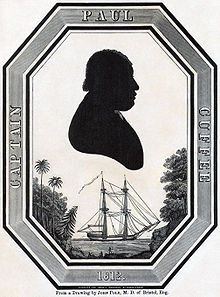 Credit cards, electronic banking, online shopping, and a host of other modern forms of commerce did not exist at the turn of the nineteenth century. Merchants throughout the Atlantic relied on reputation and good character when determining a customer’s credit worthiness. Not exactly a foolproof way to do business but seemingly less risky than our fully electronic world of money and banking in twenty-first century America. Yet, identity theft and fraud were still a part of doing business.
Archives, Representativeness, and the Inner Life of Slaves
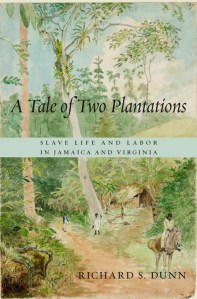 When Walter Johnson published Soul by Soul in 2001, he unleashed a critical analysis of the inner life of slavery.[1] More than just an exploration of the plantation complex, or even the indignities and tragedies of slavery, Johnson elucidated how the buying and selling of black bodies affected (in Johnson’s argument, corrupted) the participants in slavery. Johnson had identified a critical hole in the historiography. And now, Richard S. Dunn’s newest contribution to the scholarly discourse, A Tale of Two Plantations, compares life at two plantations—Mt. Airy (MD) and Mesopotamia (Jamaica)—to understand how slavery affected these two plantations, and conversely, how conditions on these plantations affected the enslaved.
 The Junto