 Happy 2015 to our Junto readers! Continue reading
Author Archives: Jessica Parr
The Week in Early American History
The past two weeks have been busy ones in Early American History! Continue reading
Q&A with Dane Morrison, Author of True Yankees
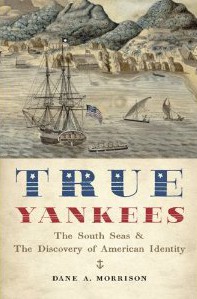
The following is an interview with Dane A. Morrison, about his recently-released book, True Yankees: The South Seas & the Discovery of American Identity (Baltimore: The Johns Hopkins University Press, 2014). Morrison is Professor of History at Salem State University (MA). Continue reading
A Junto Birthday Party: Whitefield at 300 Roundtable
Today’s guest poster, Thomas S. Kidd, is professor of history at Baylor University and the author, most recently, of George Whitefield: America’s Spiritual Founding Father (New Haven: Yale University Press, 2014).
A Long Afterlife (Jessica Parr)
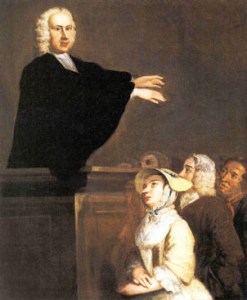 Those familiar with the first great awakening will undoubtedly recognize George Whitefield as a key figure of eighteenth century evangelical culture in Britain and its American colonies. Like many associated with the Methodist movement in Whitefield’s time, the prolific preacher and publisher saw himself as an Anglican in discussion with the Church of England about reform and an allowance for a broader religious experience. However, his theology, the new birth doctrine, the gathered church, etc., all alienated Whitefield from the Anglican hierarchy within the first few years of his missionary career.
Guest Post: Teaching Toilets in an Age of American Ebola
K.A. Woytonik is a PhD Candidate in the Department of History at the University of New Hampshire. In 2013-2014, she was a Research Associate at the McNeil Center for Early American Studies. Her dissertation is a cultural history of the Pennsylvania Hospital in Early Republic Philadelphia.
 A bevy of esteemed scholars across fields have established the devastating effects of early modern epidemics, from Europe’s plagues to the decimation of Native American populations in North America. Epidemics occupied the minds of colonists, who, depending on region and demographics, participated in prevention strategies including quarantine, the destruction of soiled linens belonging to sick individuals, days of fasting and prayer, and immunity-building efforts such as inoculation and changes in diet. In today’s academy, epidemics offer historians avenues of interdisciplinary discussion, as the impact of contagious disease can be read not only in the archive, but in literature, in artwork, and in archaeological findings.
Skype in the Classroom: Applications for the History Classroom
 Depending on whom you ask, the introduction of technology into the classroom is either a blessing or a curse. The proliferation of technology has provoked some good discussions, in addition to expletives involving use (abuse?) of Powerpoint slides in lecture. For one senior (non-UNH) colleague, who shall remain nameless, the mere mention of the word “Powerpoint” is akin to a bell ring for Pavlov’s dog, though with incarnadine face and froth at the mouth the outcome rather than drooling. Continue reading
Creating a Public History Program
 Public history is having a bit of a renaissance right now. The data is a few years old now, but in 2008, job announcements in public history rose 27.9 percent. There was an increase the following year.[1] Most in the history profession will note 2008 not only as the year of the recession, but also as a year that saw a sharp downturn in the already-atrocious academic job market. This job market data refers to faculty jobs to train public history, but it is indicative of an increased focus by history departments to expand or introduce public history curricula.
Guest Post: Reclaiming a Buried Past: Slavery, Memory, Public History, and Portsmouth’s African Burying Ground
Jessica Parr received her PhD from the University of New Hampshire at Durham in 2012. Her research interests are race and religion in the Early Modern British Atlantic. Her first book, Inventing George Whitefield: Race, Revivalism, and the Making of a Religious Icon is forthcoming from the University Press of Mississippi (2015). She currently teaches at the University of New Hampshire at Manchester. This is her second guest post for The Junto.
 It was a scene that has been repeated in several American cities. In 2003, during an infrastructure project, 13 coffins containing unidentified human remains were found in Portsmouth, NH. Eight of the remains were exhumed for examination and confirmed as being of African descent, and later as part of a 1705 African Burying Ground, once on the city’s outskirts. As Portsmouth expanded, burying ground was built over and largely forgotten. Five additional sets of remains were found in 2008 during an archaeological dig on the site. Experts believe that 200 or more burials could have taken place in this 1705 African Burying Ground.[1] Continue reading
Guest Post: “George Whitefield at 300” Conference Recap
Jessica Parr received her PhD from the University of New Hampshire at Durham in 2012. Her research interests are on race and religion in the Early Modern British Atlantic. Her first book, Inventing George Whitefield: Race, Revivalism, and the Making of a Religious Icon is forthcoming from the University Press of Mississippi (2015). She currently teaches at the University of New Hampshire at Manchester. Here she recaps the recent “George Whitefield at 300” conference.
 In 1740, during George Whitefield’s first visit to New England, Connecticut minister Reverend Daniel Wadsworth wrote in his diary: “met with the famous life of Whitefield: but what is it?”[1] Wadsworth’s comments no doubt reflected both the excitement and the unease that Whitefield’s visit provoked among New England clergy, who both looked to him as a man who could renew piety and New England, but also feared his potential for exacerbating existing religious tensions. Nonetheless, it is a poignant question, and one anyone who is familiar with “the Grand Itinerant” might ask. Continue reading
 The Junto