
If only Don had read Hofstadter on the paranoid style.
Like many of my friends, I’ve spent the past few weeks anxiously awaiting the series finale of Mad Men. I started watching a bit late, but caught up, and eagerly watched each week in April and May to find out how show creator Matthew Weiner would leave the stories of the main characters. And in the past few days, I’ve been mulling over the finale and in particular how it ended. Then yesterday, I realized that the finale of a beloved TV series actually has quite a bit to tell us (and possibly our students) about the omnipresent specter of teleology in the study of the past. [NOTE: Spoilers ahead, just in case.]

 Last year, my university shifted its policy on assignments, meaning that faculty members suddenly got the option to change extant assignments, make new ones, and alter the weighting of any of them. This was a big transition, given that in previous years assignments were set by the department and students in each of our three class years could expect similar assignments in their courses. As a result, I’ve been playing around with assignments of zero or very little weight to try to prepare students—especially first year students—for the sometimes daunting task of the final essay assignment. Whereas before there was one low-weighted writing assignment before the final essay was due, I now have the low-weighted writing assignment (it’s half the length it was in previous years), an unassessed research proposal, and an annotated bibliography worth 10%. I want to talk about one of the problems with this last assignment.
 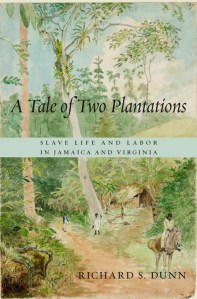 Richard Dunn has written a big book. Normally, big books like Dunn’s are primarily meant for fellow academics, grad students who need to pad their comps list, and the super-interested general public. (That category still exists, right? Right?) For academics, these types of books influence two aspects of our scholarly life: our own academic projects and our classroom instruction. The previous participants in the roundtable have focused on A Tale of Two Plantations’s contribution to the former category, while I would like to focus my remarks on the latter. So I am going to skip the basic parameters of a book review—namely, identifying the key arguments and weaknesses of the volume—and focus on how this book can work with undergraduate students.

 We at The Junto would like to thank everyone who read along with us for the
 The Junto