Yesterday Princeton historian Sean Wilentz published his latest piece opposing the 1619 Project at The Atlantic. In it, Wilentz argues that he—along with the other historians who signed a letter to the editors of the New York Times Magazine questioning the Project’s conclusions—are taking issue as a “matter of facts” that were presented in the 1619 Project, in particular in the essay authored by Nikole Hannah-Jones, the lead editor for the magazine’s issue, and in the letter of response from the Magazine’s editor, Jack Silverstein.
Author Archives: Joseph M. Adelman
Digital Databases and the Illusion of Comprehension
This post is part of a joint series entitled “Digital Research, Digital Age: Blogging New Approaches to Early American Studies,” the Panorama and the Junto. This joint series stems from stemming from a conference entitled “Revolutionary Texts in a Digital Age: Thomas Paine’s Publishing Networks, Past and Present,” organized by Nora Slonimsky at Iona College in October 2018. This series will feature one post every day this week, hosted by both the Panorama and the Junto, and Dr. Slonimsky’s introductory post is found here. The first post at the Panorama is by Lindsay Chervinsky, “High Politics and Physical Space: Rethinking How We Commemorate Place.”
The rise of the digital humanities over the past decade has brought attention and support to a wide range of projects. In its most triumphalist form, the narrative about digital humanities suggests that digital projects have made early American materials far more accessible than they ever have been. Where once researchers could only access materials by visiting an archive or perhaps using microfilm or microfiche when available, now we can work from our homes in our pajamas to read manuscript and printed sources from the seventeenth, eighteenth, and nineteenth centuries. And we can gather massive data sets about the past for quantitative or qualitative analysis.
Flashing Before My Eyes
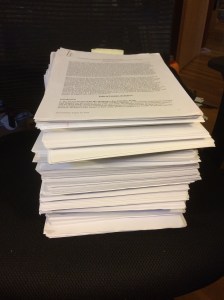
Some of the chapter drafts I’ve found in my office.
As I spent the final months of 2018 completing the copy editing and page proof process for my book, I found myself surprised at how easy it was to say goodbye to the book. Before last summer, I assumed I would find myself despondent at the thought of never being able to work on it again, that I would worry about finding typos or other errors, that I wouldn’t be able to make final decisions on anything. But other than the stress of actually going through the manuscript in a short period of time, I’ve instead felt excitement to check items off the final to-do list.
The Low Road: Unrevolutionary Bastardy
Today’s guest post is by Hannah Farber, an assistant professor of history at Columbia University. Her manuscript in progress, tentatively titled Underwriters of the United States, explains how the transnational system of marine insurance, by governing the behavior of American merchants, influenced the establishment and early development of the American republic.
Bruce Norris’s new play The Low Road, which had its U.S. premiere in spring 2018 at New York’s Public Theater, asks a very important question. What if a bastard, orphan, son of a whore sets out to seek his fortune in revolutionary America … but instead of becoming a hero and a scholar, he simply reveals himself to be a terrible person?
Did Hamilton Write Too Much For His Own Good?
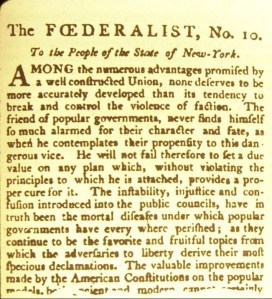 Hamilton wrote … the other FIFTY-ONE!
You probably know that line about the Federalist from the Act One finale of Hamilton, “Non-Stop,” in which Aaron Burr repeatedly asks Hamilton, “how do you write like you’re running out of time?” In the musical, his indefatigable pen is treated as a virtue (and yes, I have at times listened to the number on repeat to motivate my own writing). By contrast, scholars frequently point out that the eighty-five Federalist essays were not widely reprinted when they were first written in late 1787 and early 1788, even if they have since garnered attention as a clear statement of the views of (some of) the Founders on the meaning of the Constitution.[1]
Roundtable: Teaching Amid Political Tension
For many teachers in both primary and secondary education, the classroom feels like a far more tense place as we head back for the 2017-2018 academic year than it did just a year ago, thanks to what seem like tectonic shifts in America’s political and social landscape. American history has become ever more politicized as metaphors and analogies abound between contemporary politics and earlier eras and figures―the founding and Andrew Jackson among the most prominent.
Roundtable: Johnny Tremain and Me
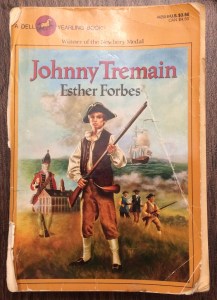 More than anything else, people remember the hand. Bring up Johnny Tremain in a group of adults, and for those who read it, they’re most likely to remember the disfigurement that serves as the hinge for much of the novel’s plot, the story within the story of the coming of the Revolution in Boston. A few people have told me that the hand by itself made the book unpalatable; for my part, it always served as a matter of fascination. And it’s one of two things that most stand out for me about the novel (the other being that it was the first place I heard that Biblical injunction that “pride goeth before fall;” make of that what you will). Continue reading
Guest Post: Dr. Strangehonor, Or: How I Learned to Stop Worrying and Love Snapchat
Today’s guest post is by Honor Sachs, an assistant professor of history at Western Carolina University and author of Home Rule: Households, Manhood, and National Expansion on the Eighteenth-Century Kentucky Frontier.
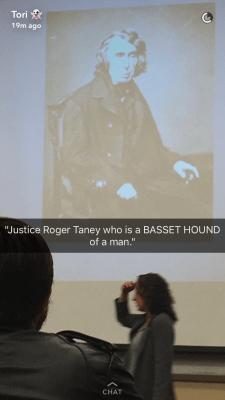 Several years ago, I attended a seminar on digital pedagogy. I thought it might be worthwhile to explore new opportunities out there for social media in the classroom. It was indeed an eye-opening experience, though not in the way I had hoped. Seminar leaders regaled us with software package after software package filled with whistles, bells, alerts, gimmicks, everything, they claimed, one would need to connect with this generation of “digital natives” (their term, not mine.) Students these days spend so much time on social media, they claimed, that faculty need to learn to connect with them online in order to really engage. “Here’s a program that allows you to text your students!” “Here’s another that allows you to collect data on how much time your students spend on homework!” “Here’s a program where you can instant message your student and remind them to study!” Continue reading
A Resource I Want: The Bible in Early America
 This month in class I’m teaching the Puritans, which means that an idea I’ve had for several years has returned, and I’ve been mulling it for a few days. As most of our readers already know, the Bible was easily the most widely owned and widely read publication in the British North American colonies (in particular in New England). Protestant Christian settlers were deeply versed in the Bible – they could cite and quote regularly from a broad range of prophecies, parables, and psalms. But they also read and understood the Bible in historically specific ways, focusing on certain books of the Bible in their study and reflection, quoting certain passages with higher frequency than others. For those of us who are not religious historians (and/or were raised ourselves in traditions in which textual exegesis was not strongly emphasized), figuring out not only the meaning of Biblical passages but also the ways in which specific historical actors used them would require significant reading.
So You Want to Write a Job Letter

“How do you like them apples?” is probably not a good closing line for your letter.
With summer winding down and the fall semester upon us (or nearly so), that means it’s also time for those headed onto the job market to make sure their materials are in order as the first application deadlines approach. There’s lots of advice out there about how to do that (enough that I can’t begin to link to the many essays). But as I advanced from years on the job market into a position myself—including work on a department search—I’ve thought about what advice I would offer based on my perspective of the process. Rather than offer a bullet-point list of do’s and don’ts (though you can see those at the end), I’d like to provide some perspective on the audiences of the job letter. It’s a weird genre of writing, so it bears consideration as you put together your materials.
 The Junto