Today’s guest poster is Robert Gamble, Visiting Assistant Professor of History at the University of Kansas. He is currently at work on a manuscript entitled “The Civic Economy: Regulating Urban Space and Capitalism in the Early American Republic,” and has written a chapter on secondhand goods for Capitalism by Gaslight: Illuminating the Economy of Nineteenth-Century America (Brian Luskey and Wendy Woloson, eds.).
 The death of Freddie Gray three weeks ago and the ensuing protests prompted many people to seek richer historical context for what happened. Consider that Seth Rockman’s twelve-year-old Common-place essay on rioting in early Baltimore had garnered some one million re-tweets by last Tuesday afternoon, according to his estimate. Justly concerned about half-baked historical parallels, Rockman doubts “the 1830s is [the] most useful context for now.” Certainly, there are more recent sources and contexts to consider: the real estate and lending practices that fortified segregation, reeling public school systems, eroding city tax bases, deindustrialization and the exportation of jobs, transit systems that bypass largely black neighborhoods, a deteriorating housing stock encased in lead paint, the mutual distrust sown by the War on Drugs, militarization of the police, and so on. Baltimore’s bank riot of 1835, though a nice lesson in shifting attitudes toward capitalism and urban order, does little to make the issues of 2015 any more coherent.
Continue reading →

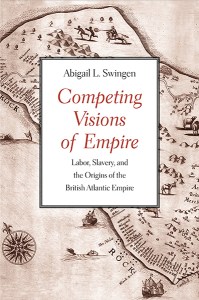 Abigail Swingen is an Assistant Professor of History at Texas Tech University (Lubbock, TX). She received her Ph.D. in History from the University of Chicago. She specializes in the Early Modern British Atlantic Political Economy. Competing Visions of Empire is her first book and was reviewed here yesterday. The following is part of our (relatively) new tradition of reviewing a book and then offering a Q & A with the author the following day. [NB: You can find my review from yesterday
  Paper soldiers on the march, and tin men tilting at swordpoint: these were the first battle ranks that
 The Junto