 Of course I cannot speak (or type) for everyone, but in the past six years, one specific word has never been far from the forefront of my mind: copyright. While I think that copyright is an incredibly fascinating and complex historical subject —and thus why wouldn’t everyone be talking about it all the time—it is probably because intellectual property was the subject of my dissertation that I spent so much time thinking, reading, and writing about it. I’m now in an exciting, strange, and surreal moment where I’ve defended my dissertation and am conceiving of what the manuscript will look like. And in this window two other words have come up: Austen and de Staël. Continue reading
Monthly Archives: May 2017
Where Historians Work: Q&A with Emily Swafford of the AHA
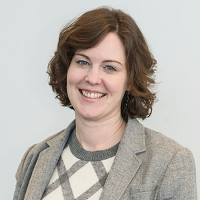 Welcome to the first installment of our “Where Historians Work: The View from Early America” series. Today, The Junto features a Q&A between Katy Lasdow and Dr. Emily Swafford, Manager of Academic Affairs for the American Historical Association in Washington, D.C.[1] Emily shares her experiences seeking out varied career options after graduate school. She also provides AHA resources for readers who wish to become more involved in the conversation about career diversity, whether as part of their own job searches, or within their graduate history departments.
Continue reading
Where Historians Work: The View from Early America — Welcome to the Series!
 In February 2017, The Junto sent out a call to historians working outside the professoriate to join us in a conversation about career diversity for early American history PhDs.[1] The response was exciting and full of interesting conversations with curators, scholars, archivists, librarians, and public historians who have chosen to pursue their passion for research, writing, and teaching in a variety of settings and occupations.
Starting tomorrow, and over the coming weeks, The Junto will feature Q&A’s between Columbia University PhD candidate and Public Historian Katy Lasdow, and a range of participants.
Q&A, Marisa Fuentes, Dispossessed Lives
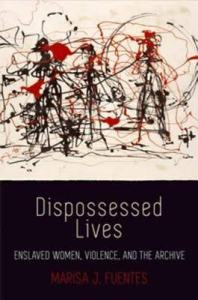 Marisa J. Fuentes is Associate Professor of Women’s and Gender Studies and History at Rutgers University, New Brunswick. Dispossessed Lives: Enslaved Women, Violence, and the Archives is her first book. Casey Schmitt previously reviewed Dispossessed Lives for The Junto. Continue reading
Good Wives, Nasty Wenches, Jamestown Women
I haven’t yet had the opportunity to watch the new TV series, Jamestown, that recently premiered in the UK. But the television critic Mark Lawson has. Last week he wrote a column that criticised the show, and other recent British period drama, for featuring female characters who were, in his own words, “feisty, cheeky and rebellious.” In the name of historical accuracy, Lawson called out the makers of Jamestown for pandering to 21st-century sensibilities. Apparently, he believes women four hundred years ago raised neither hand nor voice against the patriarchy. Instead, they “willingly accept[ed] sexual and social submission.”
Every Historian Her Own Adventurer
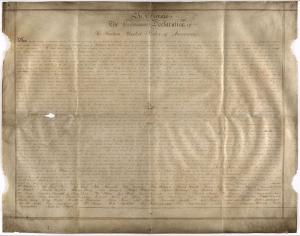 This spring, early Americanists were abuzz about “a bit of real-life archival drama,” as Harvard scholars Danielle Allen and Emily Sneff announced that they had discovered something pretty amazing: an unknown, manuscript, parchment copy of the Declaration of Independence. As friend-of-the-field Jennifer Schuessler playfully reported in the New York Times, it was all a little National Treasure. The apparently random order of the signatures on this manuscript, compared to other versions, points towards some interesting implications, involving Philadelphia Federalist James Wilson and attempts to build a unified American nationhood in the new republic. But reactions to Allen and Sneff’s announcement also, I think, tell us something about how knowledge of the past is structured, presented, and consumed. Continue reading
 The Junto