 Was the purpose of the constitution to protect democracy from being ruined by the people or to protect commerce from being ruined by democracy? This was one of the questions put to Gordon Wood and Woody Holton in a debate held a few weeks ago at the University of South Carolina. A full video of the event has just been released on YouTube, and is embedded below. For anyone familiar with the work of these two historians, the debate will constitute a useful recap of the distinction between their two interpretations of the origins of the federal constitution. And for others, I hope it might be a kind of teaser for their excellent books! Continue reading
Category Archives: Commentary
The Legends of Sleepy Hollow
 A scary story:
Once upon a time there was a story that was about . . . well, it was maybe about a lot of things, like frustrated masculinity, or colonialism, or early-national political uncertainties, but it was definitely not about a guy on a horse who really did not have a head. Or about his three companions, the other three horseman of the apocalypse. Or about the occult purposes of the Boston Tea Party. Or George Washington’s bible. The lost colony of Roanoke? Also no. And then that story was given a “modern-day twist” so as to be about all of those things. But the scary part is that the result is … fun. Even to an historian. Continue reading
What The Oatmeal Missed
NB: This post was originally published in 2013.
 When did you realize Christopher Columbus was a jerk?[1]
I’m not sure if I actually received the “traditional,” Samuel Eliot Morrison and Daniel Boorstin-inflected education on Columbus, during my child and young adulthood.[2] I remember that my high school history course (c. the early 2000s) sped through Columbus and discussed a bit about his bad human rights record. My excellent college-level history courses, of course, provided the standard explaination, found in virtually every modern textbook of repute, of the Columbian Exchange unleashed by early European exploration and conquests in the Americas.[3] I imbibed, during my childhood, the general story about Columbus in American culture—that “he sailed the ocean blue in 1492” and “discovered” America—but, if there were any lies my teachers told me, it certainly wasn’t about the earliest encounters between Native Americans and Europeans in the Caribbean.[4]
Historical Heroes
 I don’t like Abraham Lincoln. Working in Springfield, Illinois, that’s not an especially popular viewpoint to hold. Yet it is working in Springfield, Illinois, that has really led me to that conclusion. It’s almost impossible to escape the shadow of Honest Abe here. Bronze statues sit prominently in downtown; all sorts of programs and buildings at my university bear Lincoln’s name. His face even peers out from every license plate in the state. It’s a historical cult of personality that can feel alienating to a revolutionary specialist.
(Though he does have a good nose for sniffing out dodgy car dealers.) Continue reading
On Counting: A Reflection on Quantitative Research
 This summer, I counted. My dissertation, as my Contributor page at The Junto helpfully notes, includes both qualitative and quantitative analysis. And so, to enrich the latter portion of my project, I spent July at the archives, counting. Perhaps more so than most other forms of archival work, counting is an exercise in delayed gratification, the overall picture springing into focus only once the research and subsequent analysis are complete. This meant I had plenty of time to reflect on my methodology as I scanned through microfilm, paged through record books, examined case files, and counted, and counted, and counted. Continue reading
“Barbarities, Extortions and Monopolies”
 American colonists’ protest against the 1773 Tea Act involved more than just the Boston Tea Party; and it was provoked by more than just a tax. What sharpened the edge of colonial frustration was the short shrift given to American business interests in the balancing-act of imperial administration—and the triumph, by contrast, of the East India Company. American merchants and smugglers were the big losers in a larger effort to bail out the struggling corporation. As John Dickinson put it in his second “Letter from the Country,” the British policy aimed “not only to enforce the Revenue Act but to establish a monopoly for the East India Company, who have espoused the cause of the ministry; and hope to repair their broken fortunes by the ruin of American freedom and liberty!”[1] Continue reading
Was The American Revolution A Good Thing?
Readers of early American history blogs will undoubtedly have come across the recent kerfuffle regarding the divide between academic and public historians of the American Revolution, which stemmed from a series of posts by Peter Feinman assessing the conference. Much of the debate has centered around this post, in which Feinman chided academic historians for their failure to answer the question: “Was the American Revolution a good thing?” Roy Rogers posted an excellent response to this here last week; J.L. Bell at Boston 1775 had other reflections on Monday (and is continuing to address the topic in other posts).
When Was the Last Time You Loved America?
Few issues trouble historians of all stripes more than the disconnect between “popular” and “academic” history. Somewhere in the mists of the recent past the Age of Hofstadter gave way to, at best, the Age of McCulloch and, at worst, the Age of Barton.[1] The waning influence of professional historians in the public sphere particularly troubles the historical blogosphere. The popular-academic history disconnect is something addressed a lot here at The Junto, including with a podcast.
I am, as I said on the JuntoCast episode, particular dour about the possibility of bridging this gap. Academic historians, public historians, and interested members of the public more often than not talk past each other. How each group defines “good” or “useful” history is often so at cross-purposes that it sounds like one side is speaking English, another French, and another Dothraki.[2] My attention was recently drawn to a series of posts by Peter Feinman at New York History, which deeply entrenched my Eeyore-like-sullenness when it comes to these questions. Continue reading
Guest Post: Pauline Maier and the History of Women in History
Sara Damiano is a Ph.D. candidate at Johns Hopkins University. Her dissertation is entitled, “Gender, Law, and the Culture of Credit in New England, 1730-1790.”
 How should we choose to remember the lives and works of historians, and what do these choices say about our profession? The recent deaths of Edmund Morgan and Pauline Maier have led me to ponder these questions. I have watched with interest as historians have taken to social media—blogs, H-Net listservs, Twitter, and Facebook—to celebrate the lives of Morgan and Maier and to critique commemorations in the national press.
Manco Capac and the Global American Founding
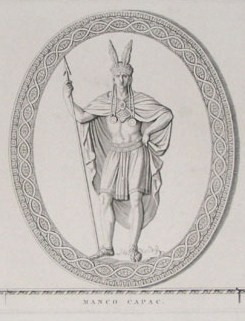 Everyone’s thinking more globally these days, historians included. But constructing a historical imagination that encompasses the whole planet isn’t only a project of the twenty-first century. The American Revolution took place in an age of global exploration, commerce, and empire. When people wrote and thought about the new nation’s founding, they didn’t look just to Europe and the classical world for connections and comparisons, but to Asia and South America as well. Writers were eager to show that the context in which they understood American events was a global one. Take for example the career of Manco Capac, founding father of the Inca kingdom of Cuzco. Continue reading
 The Junto