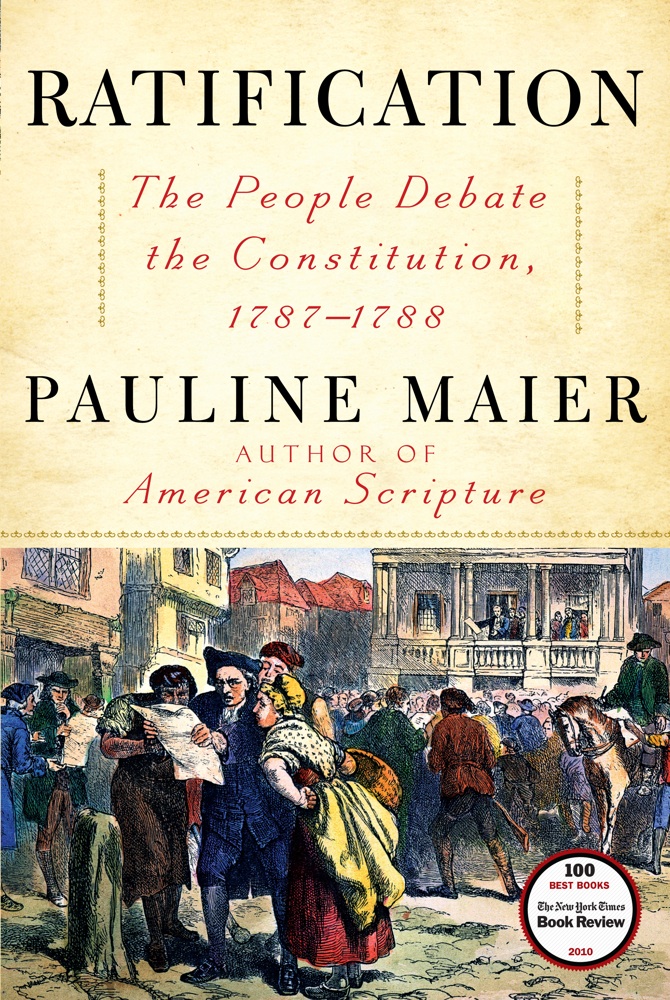
 The ratification of the Federal Constitution is a notoriously difficult historical event to categorize. On the one hand, it is a watershed moment; the creation of a consolidated federal government with extensive power is a clear break with the immediate post-Independence traditions of American governance. Yet at the same time, it is traditionally seen as the final achievement of a revolutionary generation—the fulfillment of the ideals of the Revolution.[1] Continue reading
Category Archives: Historiography
Cold Water and Living Documents

There is a breed of historians known, colloquially, as “cold water” historians for their drive to pour analytic “cold water” on the politically or historiographical fashionable arguments. Pauline Maier most certainly belongs to this historiographical polar bear club.[1] As anyone who read her New York Times obituary (or any other, really) knows, Maier is famous for describing Thomas Jefferson as “overrated.”[2] Her wonderful American Scripture: Making the Declaration of Independence brings the most powerful weapons of the skeptical historians— context and contingency—to bear on that central document of American political and national identity. Continue reading
The New Old Revolutionaries
 It’s often said that we tell old stories to get new ones, a truth self-evident in my favorite of Pauline Maier’s many works, The Old Revolutionaries: Political Lives in the Age of Samuel Adams (1980). And everything I admire about her as a scholar rolls in with the first lines of that barefaced preface: “Let me confess at the outset that this book, though it answers some questions of the sort historians are trained to ask, has also been—and was meant from the outset to be—a personal adventure. I wanted to know better what it was to be an American of the late eighteenth century and to live through the American Revolution” (xiii). Maier’s prosopography of five men and their “worlds,” accentuated by a thoughtful “interlude” on the rigors of political life in the colonies, marked a change in how historians used individual biographies to retell the Revolution to post-bicentennial Americans. First given as a series of lectures at New York University in 1976, the essays gather a fairly random matrix of people for a group shot of colonial life: Samuel Adams, Isaac Sears, Dr. Thomas Young, Richard Henry Lee, and Charles Carroll. Few had appeared in solo biographies, and if they did, it was often in fairly dim light. In fewer than 300 pages, Maier promised to deliver the story of “not just why Americans made the Revolution, but what the Revolution did to them.” How to get at it? Continue reading
Pauline Maier and the Republican Revolution
 One of the things that set Pauline Maier apart was the exuberance she brought to the work of history. That joyful zeal is charmingly expressed in the metaphor she used to evoke the intellectual atmosphere in which she wrote her dissertation and first book, From Resistance to Revolution (1972).[1] “In the heady days of the 1960s,” she recalled in 1991, a group of Bernard Bailyn’s graduate students shared the exciting “conviction” that “a great historical paradigm, an interpretation of the Revolution that had stood for most of the century, was collapsing like some great empire, and that another, equally powerful, was already coming into view” (v-vi). It was, indeed, a “‘revolution’ in historical understanding” (ix). Continue reading
Wood & Holton on the Constitution
 Was the purpose of the constitution to protect democracy from being ruined by the people or to protect commerce from being ruined by democracy? This was one of the questions put to Gordon Wood and Woody Holton in a debate held a few weeks ago at the University of South Carolina. A full video of the event has just been released on YouTube, and is embedded below. For anyone familiar with the work of these two historians, the debate will constitute a useful recap of the distinction between their two interpretations of the origins of the federal constitution. And for others, I hope it might be a kind of teaser for their excellent books! Continue reading
Teaching the Declension Narrative
This semester I’m teaching Revolutionary America, a class which has allowed me to ease into teaching because my dissertation (ahem: book manuscript) focused on the more narrow topic of Native and enslaved foodways during and after the war.
I’ve framed the class around the question of how ordinary people experienced the Revolution. Lately I’ve been talking with students about the declension narrative pervasive in Native American history, because it’s one of the things I’m contemplating as I begin to think about revisions.[1] Continue reading
“Charles Beard at 100”: A Roundtable Recap
 On October 14, Columbia University’s Center for American Studies sponsored the “Charles Beard at 100” roundtable to commemorate the centennial of Beard’s An Economic Interpretation of the Constitution of the United States. The event, organized by Columbia Historian and Director of the American Studies program Casey Blake, featured Eric Foner (Columbia), Jan Lewis (Rutgers), and David Waldstreicher (Temple) as panelists, with Herb Sloan (Barnard) as moderator. The following blog post synthesizes some of the main themes of the roundtable. I hope that many of the excellent points raised by the panelists can serve as a basis for discussion here on The Junto.
Guest Post: Weather Talk
Today’s guest post comes from Cambridge Ridley Lynch, a PhD student at the Graduate Center, CUNY. She is currently working on a project that links American weather study with larger shifts in American science and politics.

In their recent recap of the MCEAS’ “Traces of Early America” conference, Sara Damiano and Michael Blaakman spoke of the need to examine “processes, events, ideas, and dynamics that subsequent history has largely obscured, and that often pose significant evidentiary problems for those who wish to write about them.” Clearly, the work presented at the conference did much to flesh out adumbrations left throughout the historical record, often by focusing on close reading of specific events, personages, and texts. But what about a factor that is so ubiquitous so as to hardly be thought of at all, one that every single person in a historical moment and place experiences at the same time, and yet goes largely unremarked upon in historical texts? Naturally, I’m talking about the weather. Continue reading
Guest Post: The Problem of Loyalism before the American Revolution
Today’s guest poster is Christopher Minty, a PhD candidate at the University of Stirling. His dissertation focuses on Loyalists in New York.

Over the past four years, I’ve been fortunate enough to work on a group of colonists who would go on to become Loyalists in the American Revolution. My dissertation examines 9,341 future Loyalists during the imperial crisis, 1763–1775, in New York and, essentially, tries to follow their collective paths to either voluntarily signing their name to a declaration, petition and/or subscription list affirming their continued allegiance to the prevailing political order or taking the oath of allegiance. Continue reading
The Paradox of Popular Sovereignty
If Inventing The People is a work of consensus history, it is not one that seeks to celebrate blindly the development of an Anglo-American tradition of popular sovereignty. “The popular governments of Britain or the United States rest on fictions as much as the governments of Russia and China” (13). Indeed, many of Morgan’s most important conclusions in the book are remarkably radical—reminding us that all power is at some level arbitrary, and that appeals to rationality alone cannot justify any single system of government. Indeed, governments that try and conform to the letter of their appeals to the people could not long hope to survive. “The fiction must approach the fact but never reach it” (91). Thus, while Morgan unquestionably concludes there is a coalescence of ideas of popular sovereignty, it is not a reassuring consensus. The consensus on the dominance of popular sovereignty is necessary, for else a community can never be made fit to govern. Continue reading
 The Junto