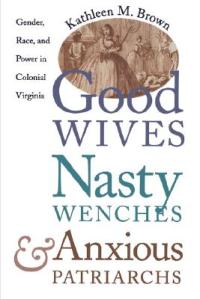
 After a hiatus for Independence
 Day Week, we’re back today for chapters six and seven of Good Wives, Nasty Wenches, and Anxious Patriarchs. These chapters guide us into the eighteenth century, showing how an increasingly recognizable racial order, predicated on the authority of white householders, took shape in Virginia.
Category Archives: Special Features
Guest Post: “George Whitefield at 300” Conference Recap
Jessica Parr received her PhD from the University of New Hampshire at Durham in 2012. Her research interests are on race and religion in the Early Modern British Atlantic. Her first book, Inventing George Whitefield: Race, Revivalism, and the Making of a Religious Icon is forthcoming from the University Press of Mississippi (2015). She currently teaches at the University of New Hampshire at Manchester. Here she recaps the recent “George Whitefield at 300” conference.
 In 1740, during George Whitefield’s first visit to New England, Connecticut minister Reverend Daniel Wadsworth wrote in his diary: “met with the famous life of Whitefield: but what is it?”[1] Wadsworth’s comments no doubt reflected both the excitement and the unease that Whitefield’s visit provoked among New England clergy, who both looked to him as a man who could renew piety and New England, but also feared his potential for exacerbating existing religious tensions. Nonetheless, it is a poignant question, and one anyone who is familiar with “the Grand Itinerant” might ask. Continue reading
Summer Book Club, Week 3
 This week in the Junto Summer Book Club we’ll be looking at chapters 4 and 5, in which Brown looks first at the beginnings of Virginia’s slave system in the mid-seventeenth century, and then at the memorable—and highly teachable—events of Bacon’s Rebellion in the 1670s. Continue reading
Guest Post: Of Class and Courts-Martial: The Case of Ensign McVicar
Today’s guest post is by Emily Merrill, a PhD candidate in the History Department at the University of Pennsylvania. Her research focuses on issues of gender and military history in the British Atlantic world during the 18th century. She is currently completing a dissertation entitled, “Judging Empire: British Military Courts and the Politics of the Body.”
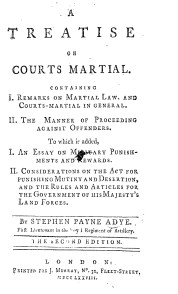 One of the most provocative aspects of the popular Netflix series Orange is the New Black is the way it grapples with the issue of class (as well as race, gender, and sexuality) as it relates to the contemporary American penal system. By contrasting the prison experiences of the main character, Piper, an upper middle class white woman, with those of a range of working class and minority characters, the show invites a deeper reflection on the complex ways in which class divisions help shape and organize a supposedly impartial system of justice. In my own research on British military courts during the Revolutionary War, I have found that class, specifically the divide between officers and enlisted men, also helped determine crucial aspects of the military justice system. Continue reading
Summer Book Club, Week 2
Welcome to the second installment of the Junto Summer Book Club! We discussed the introduction and first chapter of Kathleen Brown’s Good Wives, Nasty Wenches, and Anxious Patriarchs during Week 1. This week we’ll consider Chapters 2 and 3. With these chapters, Brown transports us across the Atlantic Ocean, shifting her focus from early modern Britain to the early years of English settlement in Virginia.
Summer Book Club, Week 1

Welcome to the Junto Summer Book Club, where over the next six Fridays we will be reading and discussing Kathleen Brown’s 1996 book, Good Wives, Nasty Wenches, & Anxious Patriarchs. Each week, a Junto representative will write a brief post on that week’s chapters to offer a few opening remarks and raise some questions to get the discussion started. We will then open up the comments section for you to address any topic related to the book—its argument, Brown’s use of sources, the historiography, using it in the classroom or in a public setting, to name just a few. We look forward to a lively conversation and to seeing how it develops over the next several weeks.
This week, we begin our conversation with the Introduction and Chapter 1, “Gender and English Identity on the Eve of Colonial Settlement.”
Announcing the Junto Summer Book Club
With summer upon us, many of us are turning our attention to reading lists, whether for upcoming graduate exams, syllabus preparation, research, or pleasure. For many, it’s an opportunity to catch up on new work that sat neglected during the push through the final weeks of the semester and exams, but it’s also an opportunity to return to more classic books that have shaped the field and deserve reconsideration. Plus, we at the Junto love nothing more than to discuss and argue about history. Therefore, we would like to introduce a new feature: the Junto Summer Book Club.
Guest Post: Authors, Athletes and Law’s Privilege
Today’s guest post is from Nora Slonimsky, a doctoral candidate in history at the CUNY Graduate Center. Her dissertation is on the relationship between literary property and politics in the Early Republic. She has previously blogged for the New York Public Library. For the 2013-2014 academic year Nora was co-chair of the CUNY Early American Republic Seminar.
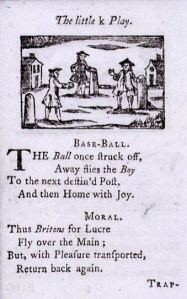 As most graduate students experience first-hand, the relationship between universities and unions can be complex. Our position as students, employees or a combination of the two varies largely by institution, particularly by whether or not our universities are public or private. However, if you’re a Division One football player with a potential NFL career in your future, the construct of a student-athlete underscores a specific question about the nature of labor in higher education. For those who participate in collegiate sports, are academic scholarships a privilege or a right, a special acknowledgement of their abilities on the field or a form of compensation for service to their institutions? Yet the tension between privileges and rights is as much about intellectual activity as it is about physical skills, dating all the way back to Andrew Law’s Privilege of 1781.
Guest Post: “Early Modern France and the Americas” Conference Recap
Craig Gallagher is a PhD candidate in History at Boston College. His dissertation analyzes Scots and their religious and economic networks in the late seventeenth century British Atlantic World.
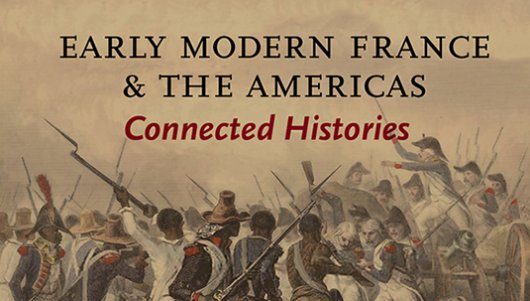 Atlantic history has always had at its heart a simple enough goal: to connect the histories of Europe, Africa, and the Americas so that historians can better understand each in relation to the others. Scholars have disagreed about how best to realize this goal, and about whether it is a goal worth realizing at all, but few have denied that Atlantic history as a pursuit has enriched our understanding of the early modern world. Although this has been particularly true for historians of the British and Spanish empires in the Americas, it is a more recent development among scholars of the French empire. By convening the “Early Modern France and the Americas: Connected Histories” Symposium (Program; #FrenchAtlantic on Twitter) at Boston College on May 2-3 – an event co-sponsored by the Institut des Amériques – the organizers, Owen Stanwood (Boston College) and Bertrand van Ruymbeke (Université de Paris VIII), sought to showcase those historians of France and French North America whose work, either in print or in progress, has extended an Atlantic perspective to the history of France and its early modern empire in the Americas.
The Public Sphere and Early American Democracy
 How did the particular formation of democratic politics, a rambunctious public sphere, and capitalist social relations come about in the early American republic? I began to talk about this question last month when I asked, ‘how did democracy become a good thing?‘ I argued that the crucial factor was an unprecedented separation between economic and political power, which made democractic politics incapable of seriously interfering with capital accumulation. Today I want to show how Jürgen Habermas’ account of The Structural Transformation of the Public Sphere helps us see what went on in this crucial separation, and how his account relates to the American case in particular. Continue reading
 The Junto