 Lois Green Carr was a pioneer in both social history and women’s history. Originally from an upper-class family from Massachusetts, Carr made her greatest impact in studying the history of women from the seventeenth-century Chesapeake. Carr’s mother, Constance McLaughlin Green, was a well-respected historian, who had received her PhD from Yale University. Carr attended Swarthmore College before enrolling in the graduate program at Harvard in 1943. Along the way, life happened. She got married in 1946, moved with her husband to New York in 1947, and had a child in 1952. In 1956, she accepted a job as a junior archivist at the Maryland Hall of Records. Family responsibilities and then difficulties at the end of the decade had rendered her progress toward completing her PhD quite slow. In fact, by that point, she said, “I had done no work for years on my PhD dissertation because I could not get to New England for needed research.”[1] Her solution was to switch her research focus to Maryland and find an advisor willing to take her on, which she did. In 1961, Bernard Bailyn became her advisor and by 1968 she had finally graduated, twenty-five years after starting graduate school. By the end of 1967, she had taken a job as the historian for the St. Mary’s City Commission. a post she would hold for nearly five decades. Continue reading
Tag Archives: 17th Century
Guest Post, Vaughn Scribner: “Fabricating History PART TWO: The Curious Case Continues”
A few weeks ago, we hosted a guest post from Vaughn Scribner on mermaids. Since sequels are all the rage in Hollywood, we are having him back for seconds.

Figure 1: Image from Gottfried’s Histora Antipodum oder Newe Welt (1631). Image after de Bry. Accessed via ULB Sachsen-Anhalt.
Well, here we go again. Just when I thought I had figured out the riddle of Captain John Smith’s alleged seventeenth-century mermaid sighting, research threw me a curve ball. A quick recap: in a recent Junto post, I argued that Alexandre Dumas added a brief (supposedly legitimate) story of Smith meeting a mermaid into his fictional 1849 adventure tale. Dumas’ fabricated account, I demonstrated, steadily gained a life of its own as subsequent historians cited it as fact. I had solved the “Curious Case of John Smith, a Green-Haired Mermaid, and Alexandre Dumas.” Or so I thought. Continue reading
Q&A: Abigail Swingen, Competing Visions of Empire
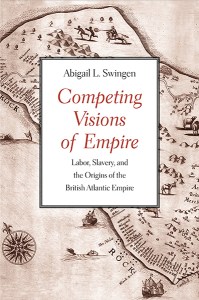 Abigail Swingen is an Assistant Professor of History at Texas Tech University (Lubbock, TX). She received her Ph.D. in History from the University of Chicago. She specializes in the Early Modern British Atlantic Political Economy. Competing Visions of Empire is her first book and was reviewed here yesterday. The following is part of our (relatively) new tradition of reviewing a book and then offering a Q & A with the author the following day. [NB: You can find my review from yesterday here.] Continue reading
Review: Abigail Swingen, Competing Visions of Empire
Abigail L. Swingen, Competing Visions of Empire: Labor, Slavery, and the Origins of the British Atlantic Empire (New Haven: Yale University Press, 2015).
There have been some fantastic new contributions of late that explore connections between slavery, economics, and empire. In his 2008 analysis of the American political economy, economic historian Gavin Wright concluded that the dependence on slave labor came not because of any institutional efficiency on the part of plantations, but rather, that no other form of coerced labor could have been made to meet the labor demands. Sven Beckart’s Bancroft Prize-winning book, Empire of Cotton, analyzes connections between cotton, and the slave labor behind it, and the rise of modern capitalism. Ed Baptist’s book, The Half Has Never Been Told, explores slavery’s role in the making of American capitalism.
Big History: Weighing the Benefits and Drawbacks of a Comparative Project
Casey Schmitt is a PhD candidate in History at the College of William & Mary, where she is writing a dissertation on the Iberian roots of seventeenth-century Anglo-American slave law. This is her second guest post, following her first on the value of storytelling and the use of audiobook primary sources in the classroom here.
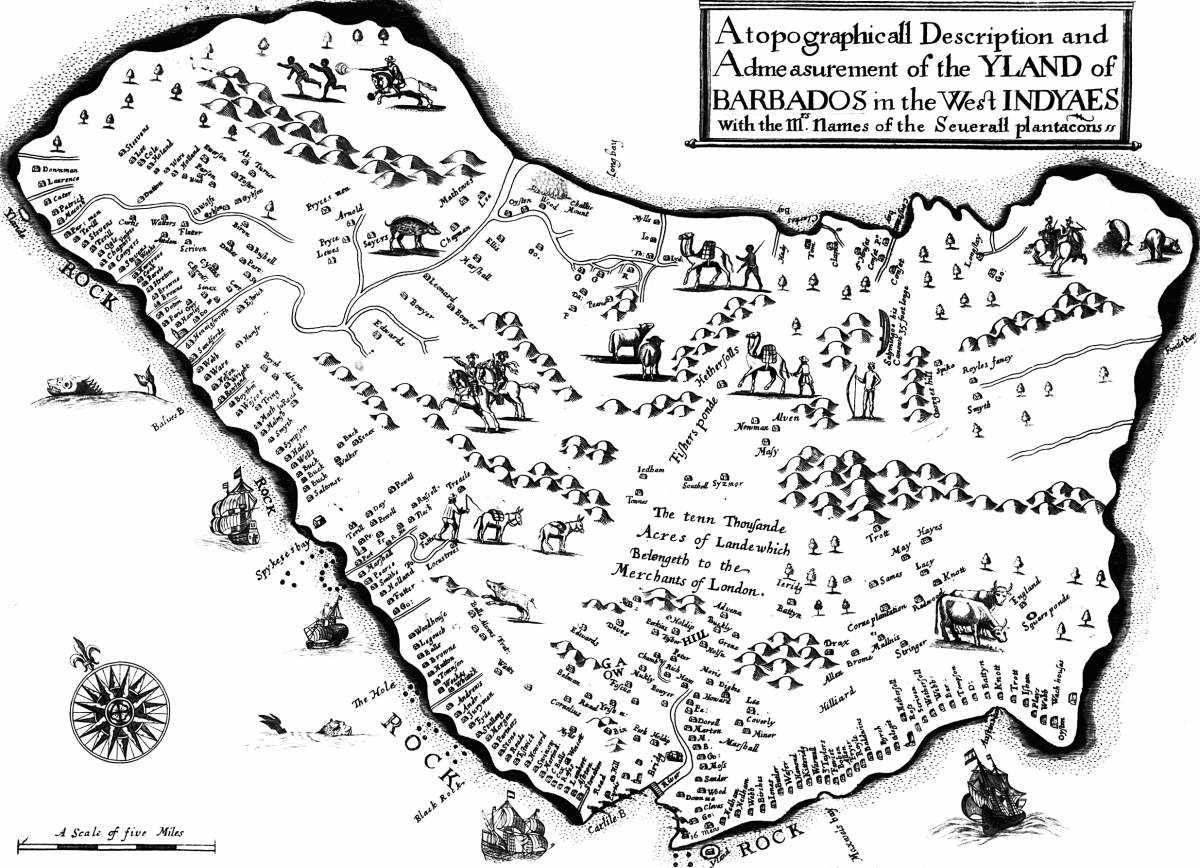 A little over a year ago, I switched research interests from the study of eighteenth-century contraband trade between Jamaica and Cartagena de Indias to a comparative study of the codification of slave law in the greater Caribbean. Admittedly not too drastic of a change, I was nonetheless daunted by moving from a historiography containing a select number of significant works to a field where innumerable scholars have dedicated entire careers. Like any graduate student, I began working through the library stacks here at the College of William and Mary, seeking answers to what I thought would be easy questions: Were the legal regimes of European slave societies shaped by their interactions with other slave societies in the Caribbean? Were English slaveholding practices modeled off of successful Portuguese or Spanish examples? Why were there so many institutionalized efforts to codify slave law in the seventeenth century and did these separate legal dialogues unfold in conversation with one another? As you can probably guess, none of these questions have proven as easy to answer as I thought. Continue reading
The “War on Christmas” in Early America
With Christmas right around the corner, we are re-posting this piece from three years ago. All of us at The Junto would like to wish happy holidays to all our readers.
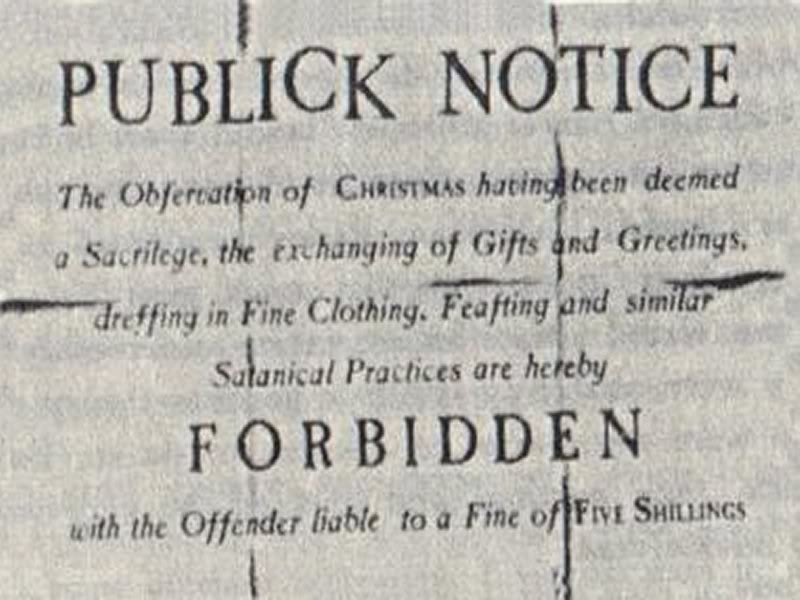
As an historian of early America, I suspect I am not alone in sighing a little bit to myself when hearing the often heated rhetoric about the “War on Christmas” emanating from right-wing and evangelical media outlets at this time of the year. That, of course, is because the real war on Christmas was not waged by 21st-century godless, liberal secular humanists and the ACLU but by 17th-century New England Puritans, particularly the clergy.
Saturnalia was a pagan Roman festival held annually from December 17-25. Its customary celebrations were both chaotic and violent and, hence, were popular amongst lower-class Romans. In the fourth century, as the Catholic Church sought to bring the pagan masses into the Christian fold, the Church adopted the final day of the festival as Jesus’s birthday, which the New Testament does not indicate and on which, until this time, there had been no widespread consensus. The Church effectively killed two birds with one stone. Throughout the centuries, the most violent aspects of the celebration (which, allegedly, may have included human sacrifices) fell away, but the customs of near-lawless revelry persisted, and indeed defined the celebrations in the early modern period.

At the start of the early modern period, the holiday was not yet the priority it has become, as Easter dominated the Catholic calendar. But the Reformation had a significant impact on the perception of Christmas, both positively and negatively. The holiday celebration customs were continued by the Church of England. The often uninhibited revelry of the holiday (which Puritans derisively referred to as “Foolstide”) appealed to the English lower classes while the gentry celebrated with “eating and drinking, [and] banqueting and feasting.”
In addition there was a distinct class aspect to one of the customs, in which the poorest man in the town was named “The Lord of Misrule” and treated like a gentleman.[1] Another custom, known as “wassailling” involved lower-class persons going to the homes of wealthy individuals and “asking” for food and drink, which they would then use to toast that individual. Due to the penchant for disorder, immodesty, gluttony, and the (temporary) breakdown of the social order, it should come as no surprise that in the late sixteenth and early seventeenth centuries, English dissenters began to take a very dim view of the holiday. Indeed, the hotter the Protestant, the stronger the aversion to Christmas. But their opposition to Christmas was not just due to the overtly social nature of its celebration. Puritan faith derived wholly from scripture, and, in 1645 and again in 1647, the Long Parliament declared the abolition of all holy days except the Sabbath, which was the only day described as such in the Bible.[2]
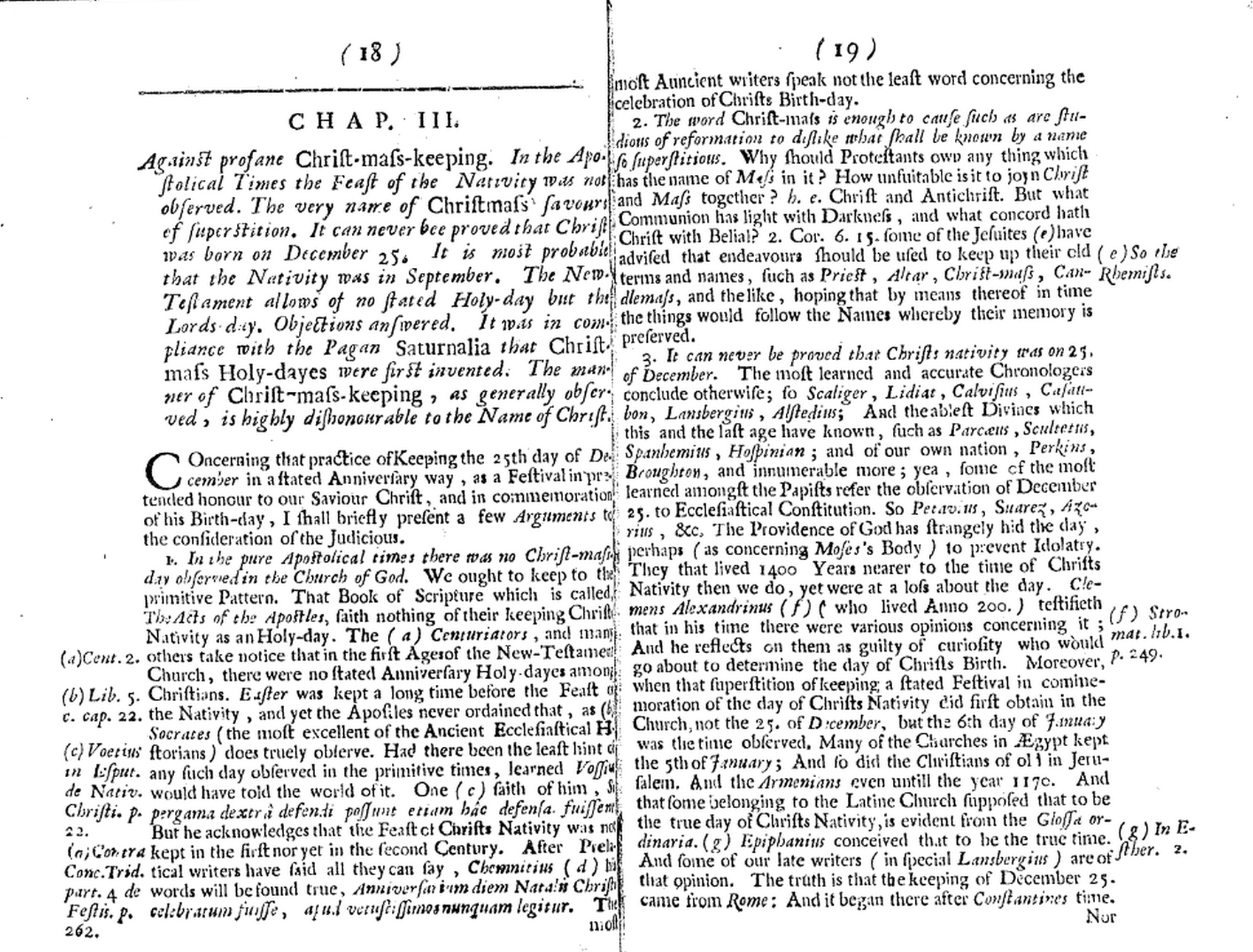
And so the first English dissenters who settled New England in the early seventeenth century were, like their brethren back home, decidedly anti-Christmas. Puritans were keenly aware of the holiday’s pagan origins, as Increase Mather wrote in A Testimony against Several Prophane and Superstitious Customs, Now Practiced by Some in New England: [3]
In the pure Apostolical times there was no Christ-mass day observed in the Church of God. We ought to keep the primitive Pattern. That Book of Scripture which is called The Acts of Apostles saith nothing of their keeping Christ’s Nativity as an Holy-day.
[. . .]
Why should Protestants own any thing which has the name of Mass in it? How unsuitable is it to join Christ and Mass together? [. . .] It can never be proved that Christ’s nativity was on 25 of December.
[. . .]
[They] who first of all observed the Feast of Christ’s Nativity in the latter end of December, did it not as thinking that Christ was born in that Month, but because the Heathens’ Saturnalia was at that time kept in Rome, and they were willing to have those Pagan Holidays metamorphosed into Christian ones.
By mid-century, the Puritan “City on a Hill” was already losing its spiritual homogeneity and the combination of new settlers and a new generation less committed to Puritan strictures forced the Massachusetts General Court to take action. On May 11, 1659, the following was entered into the General Court’s records:[4]
For preventing disorders, arising in several places within this jurisdiction by reason of some still observing such festivals as were superstitiously kept in other communities, to the great dishonor of God and offense of others: it is therefore ordered by this court and the authority thereof that whosoever shall be found observing any such day as Christmas or the like, either by forbearing of labor, feasting, or any other way, upon any such account as aforesaid, every such person so offending shall pay for every such offence five shilling as a fine to the county.
Despite being told to repeal the “penalty for keeping Christmas” as early as May of 1665 for its “being directly against the lawe of England,” the law was not stricken until 1681, followed by renewed pressure from Charles II.[5] But even though the legal war was over, the cultural war on Christmas continued. In 1686, the unpopular royal governor of the new Dominion of New England, Sir Edmund Andros, required an armed escort at a Christmas service he sponsored (somewhat brazenly) in Boston. Indeed, Christmas was not celebrated widely in New England through the eighteenth century, and, when it was, it was done privately. All this is not to imply that Christmas was celebrated broadly outside of New England. Even after the Revolution, the Congress was known to meet on Christmas Day, if they were in session. Throughout the nineteenth century, as well, there are numerous reports from all over the United States attesting to the lack Christmas observance, particularly by various Protestant and German Pietist sects.
A few days ago, Bill O’Reilly claimed that—thanks to him and Fox News—the “War on Christmas” had been won and Christmas had been saved for all the true Americans out there wishing to celebrate the “traditional American Christmas.” However, the history shows that waging a “war on Christmas” is one of the very oldest of all American traditions and is a far more American tradition than the current twentieth-century, commercial capitalist version of Christmas that Bill O’Reilly claims to have saved.
____________________
[1] This tradition had its roots in a Saturnalian custom of Masters exchanging roles with their servants.
[2] If there could be said to have been a war “over” Christmas, it would have been in the 1640s and 1650s as Oliver Cromwell and Parliament tried to enforce their ban on Christmas by attempting to stop public celebrations by Anglicans (and the few remaining Catholics) and force shop keepers to remain open. In many localities, the result was fighting in the street between the authorities and those intent on celebrating the holiday in its traditional manner. For more on the English context, see Chris Durston, “The Lords of Misrule: The Puritan War on Christmas, 1642-60” History Today 35, no. 12 (1985).
[3] Increase Mather, A Testimony against Several Prophane and Superstitious Customs, Now Practiced by Some in New England (London, 1687), 18-9; 35. Early English Books Online.
[4] Records of the Governor and Company of the Massachusetts Bay in New England, 5 vols., ed. Nathaniel B. Shurtleff (Boston: From the Press of W. White, printer to the Commonwealth, 1854), 4:366.
[5] Ibid., 5:212; For repeal, see William H. Whitmore, A Bibliographical Sketch of the Laws of the Massachusetts Colony from 1630 to 1686 (Boston: Rockwell and Churchill, City Printers, 1890), 126.
 The Junto