Roundtable: James Merrell’s “Exactly as they appear” and Published Editions of Manuscript Sources

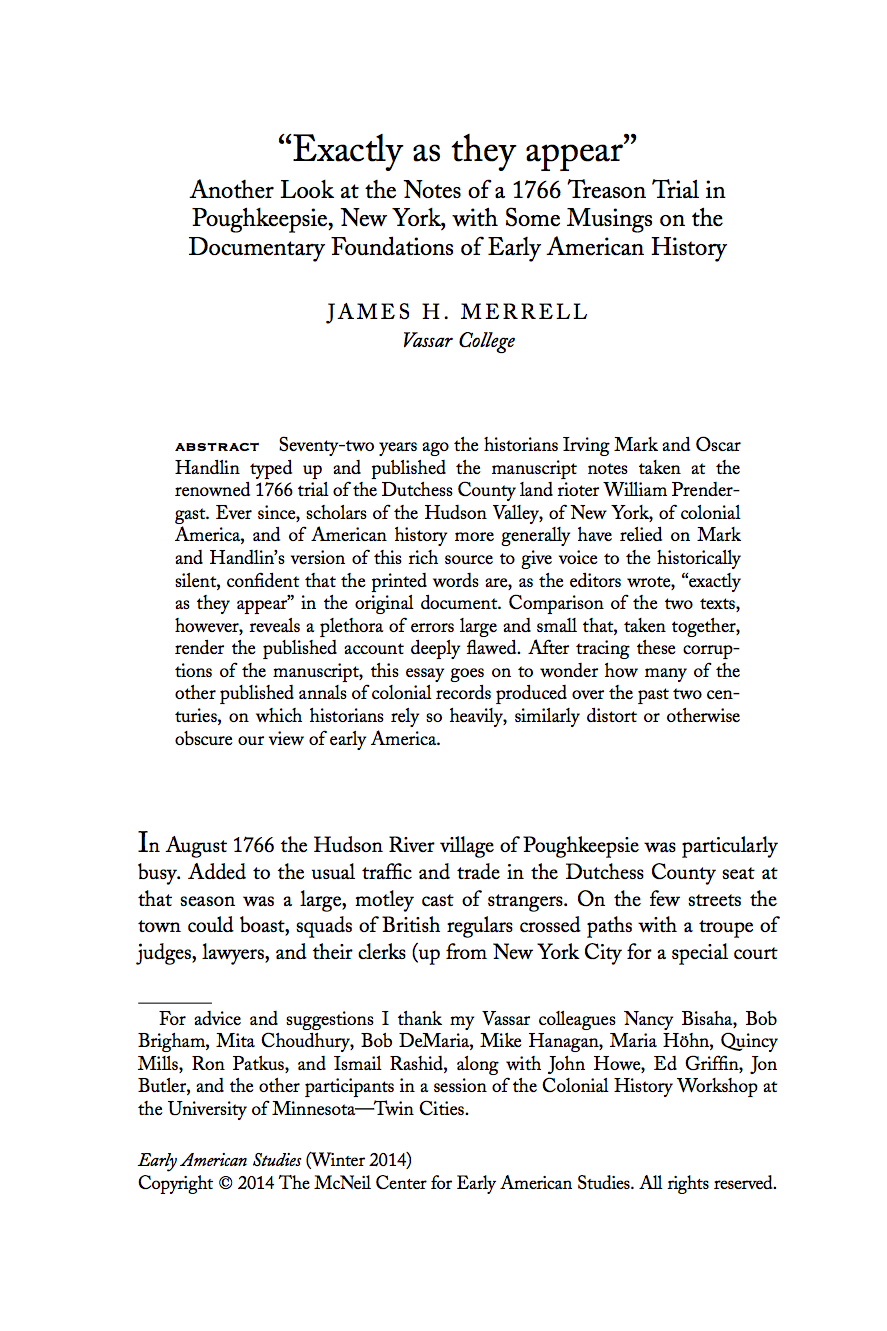
Merrell ArticleMany of us have been there. Sitting in front of our computers, we fret over how we will find the time and funding to examine important manuscript sources at faraway archives. And then, a few keystrokes later, we find that those sources are available in published form. Relief floods over us, replacing anxiety. But should we really be so relieved?

James H. Merrell’s recent article in Early American Studies asks exactly this question. Entitled “‘Exactly as they appear’: Another Look at the Notes of a 1766 Treason Trial in Poughkeepsie, New York, with Some Musings on the Documentary Foundations of Early American History,” it suggests that we should not be so quick to assume that published versions of manuscript sources faithfully reproduce the originals. [1]

Continue reading

The Week in Early American History

TWEAHGood morning and welcome to another Week in Early American History. I’m your host, Tom Cutterham. Continue reading

The Generation Game

The AHA recently announced the formation of an ad hoc committee to produce standard guidelines for evaluating digital scholarship. It is hoped that the guidelines will allow professional recognition of new scholarship in a way that can become codified within the tenure process. The committee is a veritable who’s who of digital humanities worthies—all with an excellent track record of traditional peer-reviewed scholarship and engagement with a variety of digital media. When this committee speaks, it will command attention.

This is an important step forward for the profession; having a rigorous set of guidelines for evaluation will serve as an important starting point for encouraging recalcitrant colleagues and administrators to take digital scholarship seriously. But there is one thing that is also notable about the committee—not to put too fine a point on it, it is rather old. All the scholars are safely tenured. Where are the voices of the new generation, of the digital natives? Continue reading

Introducing The History Carousel: Bringing the Past Full-Circle with the Present

The History CarouselWe at The Junto are very excited to announce the birth of a new podcast. “The History Carousel” will connect the past with the present, and will feature a rotating cast of Junto members and guests. It’s part of our equally-new podcast network, which is going to allow for all sorts of podcasting shenanigans—many thanks to Michael Hattem for helping to set it up. Continue reading

Preparing for Final Exams…Wait, What?

end of semesterI am still learning how things work in England. Prime example: a couple of months back, I referred to the place where one purchases delicious, delicious beer-battered cod and fries as a “fish and chippery” before a kind(?) soul on Twitter alerted me to the fact that it’s called a “chippy,” here. So perhaps it’s understandable that I still find it a little weird that my students are about to take their final exams. Continue reading

Interviews with Historians: Carol Berkin

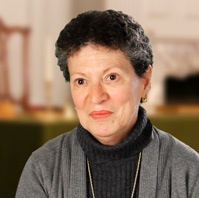
BerkinCarol Berkin is Presidential Professor Emerita at Baruch College and the CUNY Graduate Center. She received her bachelor’s degree at Barnard College. In 1972, she received her PhD at Columbia University, where she also worked on the Papers of John Jay and Alexander Hamilton. Her dissertation on Jonathan Sewall won the Bancroft Award for Outstanding Dissertation and the subsequent book, Jonathan Sewall: Odyssey of an American Loyalist, was nominated for the Pulitzer Prize in 1974. She then spent her entire teaching career at Baruch College and the CUNY Graduate Center. Her most popular works include A Brilliant Solution (2002), which has been translated into Polish and Chinese, First Generations: Women in Colonial America (1996), Revolutionary Mothers: Women in the Struggle for American Independence (2005), and Civil War Wives (2009). She is a pioneer in early American women’s history and also the author and editor of numerous textbooks, readers, and teaching guides for women’s history including Women of America (1980), Women’s Voices, Women’s Lives: Documents in Early American History (1998), In the Words of Women: The Revolutionary War and the Birth of the Nation, 1765 – 1799 (2011), and Clio in the Classroom: A Guide to Teaching Women’s History (2009). She is also the editor of History Now, an online magazine published by the Gilder Lehrman Institute of American History. She has appeared in numerous television documentaries, including Founding Brothers and Founding Fathers on the History Channel and Ric Burns’ New York on PBS. Continue reading
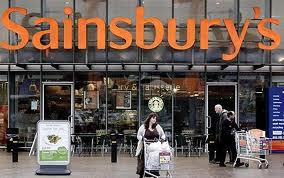
Connecting the Past with the Present: A Trip to the Grocery Store

Sainsbury'sI think it’s important for historians to try to make connections with the present, not only because it more thoroughly engages students, but also because the past is not static. I haven’t always been great at explicitly drawing these parallels, but when the first day of the U.S. government shutdown coincided with my first Revolutionary America class, I sort of lost it. I thought to myself, “I have to go into class prepared to talk about how people in thirteen disparate colonies—some of whom disliked each other immensely—managed to get it together enough to rebel against Great Britain?” It’s no wonder I ended up showing a pop music video and comparing the Revolution to the bad breakup of a dysfunctional relationship.[1] I assume that a teensy bit of pandering to students’ tastes didn’t hurt, either. Continue reading

The Week in Early American History

TWEAH

We have an abundance of links for your Sunday morning reading pleasure. Read on, fellow early Americanists:

Continue reading

Conference Panels and Intellectual Connections

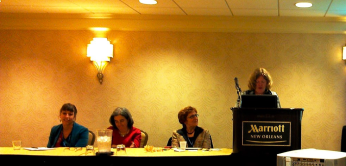
AHA PanelFor early Americanists, fall is conference-planning season. Proposals for the Omohundro Institute Conference were due in mid-September, SHEAR is accepting proposals until December 1, and a bevy of other conferences have posted CFPs in recent months. Watching this flurry of activity has led me to think about the intellectual goals that structure the formation of conference panels.
Of course, the conference panels we form—and whom we invite to participate in them—are partly functions of pragmatism. Each of us wants to find our way onto the program of our desired meeting, and mobilizing our networks is one way to do this. We scramble to find friends, colleagues, friends-of-friends, and acquaintances from research trips and prior conferences to join us on our panels. But if one of the goals of conferences is to enter into scholarly conversations, rather than simply to share our work with academic audiences, then it is essential to think about the kinds of questions our panels are asking and answering. Continue reading

Some Reflections of a First Time TA

Or, How I Stopped Hating Finance and Learned to Love the Business Major[1]

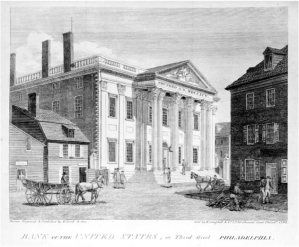
Branch Bank

Settling in to my first semester as a TA this fall, I was stoked. Yes, stoked. Unbelievably enthusiastic about my teaching assignment: Early American Maritime Culture. I thought about all the port cities we would study, the trade routes we would map, and maybe for good measure we’d throw in an impressment or two. This first-time TA was assigned to a course in her field. Huzzah!

But a week into the semester I received an email stating, “We write to inform you that your teaching assignment has been changed to The History of Finance.”[2] Continue reading