 With summer upon us, many of us are turning our attention to reading lists, whether for upcoming graduate exams, syllabus preparation, research, or pleasure. For many, it’s an opportunity to catch up on new work that sat neglected during the push through the final weeks of the semester and exams, but it’s also an opportunity to return to more classic books that have shaped the field and deserve reconsideration. Plus, we at the Junto love nothing more than to discuss and argue about history. Therefore, we would like to introduce a new feature: the Junto Summer Book Club.
Tag Archives: race
The Week in Early American History
 Happy Sunday! With the excitement from March Madness still ringing through the halls at The Junto, we look forward to bringing you more great content on a wide range of issues in early American history in the coming weeks (including an interview with Mike Jarvis, our champion!). In the meantime, let’s head right to this week’s links!
Continue reading
The Week in Early American History
Well, technically, this will be the last two weeks in early American history since we missed last Sunday. Let’s get to it: Continue reading
Review: Native Apostles: Black and Indian Missionaries in the British Atlantic World
Edward E. Andrews, Native Apostles: Black and Indian Missionaries in the British Atlantic World. Cambridge: Harvard University Press, 2013.
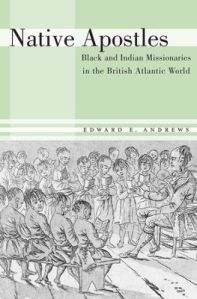 On the eve of the American Revolution, an unlikely band of ministers and benefactors devised a plan to send John Quamine, a free black man, and Bristol Yamma, a slave, as missionaries to Africa. The project was conceived by the two would-be missionaries themselves, and supported by controversial Congregationalist minister Samuel Hopkins and his more moderate colleague Ezra Stiles. In 1774, Stiles and Hopkins arranged for the duo to be sent to the College of New Jersey, where Presbyterian minister (and president of the College) John Witherspoon would train them. Their proposed mission gained some notoriety, and a diverse lot of supporters championed their cause, including Quaker abolitionist Anthony Benezet, New Jersey lawyer and politician Elias Boudinot, Scottish theologian John Erskine the noted black poet Phyllis Wheatley, Eleazar Wheelock and his Mohegan pupil-turned-preacher Samson Occum, and black Anglican missionary to Africa Phillip Quaque (though his endorsement came with serious reservations). The outbreak of war in 1775 and the subsequent death of Quamine in 1779 ultimately thwarted the planned mission. In spite of its failure, though, it remains an important but oft-ignored episode in what Edward E. Andrews calls “the tangled history of cultural encounter between Europe, Africa, and the Americas” (188). Continue reading
The American Dilemma

The influence of Edmund Morgan’s American Slavery, American Freedom: The Ordeal of Colonial Virginia is inarguable. For such a lean volume it casts a long shadow upon our understandings of colonial Virginia, the development of slavery in the American South, the relationship between racism and equality, and a variety of other interpretative problems large and small. Scholars since the book’s publication have revised and extended its arguments—into questions of gender and class consciousness—and more than a few have sought to topple its conclusions but Morgan’s central contention that “[r]acism made it possible for white Virginians to develop a devotion to the equality that English republicans had declared to be the soul of liberty” remains more or less intact.[1] During my graduate education, at both the master’s and doctoral levels, Morgan’s arguments have served as the starting point in many a seminar meeting’s discussion of America’s long history of racial inequality. Few interpretations of any historical question can claim such sustained influence.
The question I pondered, as I reread American Slavery, American Freedom for this essay, is simple: why? Why has Morgan’s interpretation of colonial Virginia survived, despite the many shifts in the historiographical winds over the last thirty-eight years, when many other powerfully argued interpretations have withered and died? What gives this book its continuing appeal to the historical profession? Continue reading
The Week in Early American History
 Last week, we heard the news that Mitch Daniels, formerly governor of Indiana and now president of Purdue University, apparently tried to keep “terrible anti-American academic” Howard Zinn’s People’s History out of Indiana’s schools and universities. This week, Indiana University’s Carl Weinberg revealed how he actually used Zinn’s text in a training course for Indiana high school teachers. Continue reading
 The Junto