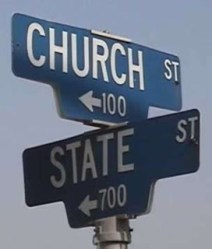
 Every sub-field has its classic books. It should not take long for most of us to rattle off a couple of titles. In my field of church-state relations in the early American republic (particularly in the upper South), few books tower over the field more than Thomas E. Buckley’s Church and State in Revolutionary Virginia, 1776-1787.[1] Despite being published thirty-six years ago references to this classic litter the footnotes of subsequent books from fellow classic histories like Rhys Isaac’s Transformation of Virginia to more recent works such as David Sehat’s Myth of American Religious Freedom.[2] Anyone grappling with the politics of religion in early national Virginia, that overheated cauldron of disestablishment, must grapple with Buckley’s work. But this great historian did not stop there; in a series of articles Buckley expanded his analysis to include much of the evolution of religious freedom in the Old Dominion over the nineteenth century.[3] Continue reading
Tag Archives: religion
The Week in Early American History
 Happy New Year! We took last week off while so many of us were in New Orleans for AHA, so the set of links covers just a bit more than the past seven days. From here on we should be back to our regular schedule every Sunday morning.
The Abolitionists in Primetime: Two Responses
 This week, PBS’s American Experience aired the first episode of The Abolitionists, a new three-part documentary. If you missed it, you can still watch it online. It is written and directed by Rob Rapley. The next two episodes will air on January 15 and 22.
The film profiles Frederick Douglass, William Lloyd Garrison, Harriet Beecher Stowe, John Brown, and Angelina Grimké. Part I covers the 1820s and 1830s, fitting it comfortably into The Junto’s portfolio. Kenneth Owen, an Assistant Professor of History at the University of Illinois at Springfield, and Jonathan Wilson, a PhD candidate at Syracuse University, have a review.
The Week in Early American History
 Happy New Year! A brief post today, and then the Junto will take a few days to observe the transition from 2012 to 2013 (before most of the members head to New Orleans for the AHA conference). Enjoy these reads!
About a Book

Ceci n’est pas une book.
She was encased in stolen books, buried in them as if in dirt. The thought of the countless hundreds of thousands of names that surrounded her, vainly scrawled in top right-hand corners – the weight of all that ignored ink, the endless proclamations that this is mine this is mine, every one of them snubbed simply and imperiously….The ease with which those little commands were broken.
She felt as if all around her, morose ghosts were milling, unable to accept that the volumes were no longer theirs.
China Miéville, The Scar
So, on the heels of Christopher’s eloquent framing of the questions of historical distance, a material-texts take on the joys of negotiating that distance by using dead people’s books: Continue reading
Narrative History and the Collapsing of Historical Distance
 Among the highlights of my Christmas was receiving Catherine Brekus’s recently-released volume, Sarah Osborn’s World: The Rise of Evangelical Christianity in Early America, a fascinating account of an eighteenth-century evangelical woman whose life experiences intersected with, and speak to, several importance events and themes from the period. At the time of writing, I’m about half-way through and can’t recommend it enough. At a future date, I’ll try and post a more formal review (or at least lengthier thoughts) of the book, but wanted to briefly reflect here on something Brekus briefly discusses in her preface. “Reading Sarah’s reflections on her life,” Brekus explains, “reminds us of how far away the past is—but also how close.” Solidly grounding her subject’s experiences in its eighteenth-century context, she continues: Continue reading
The Agonies of “Christian Republicans”
This is not, sadly, a post about the troubled relationship between the modern Republican Party and politicized Christianity. I’d like to discuss, rather, a powerful and provocative synthesis of American political, theological, and religious history published a decade ago – Mark Noll’s America’s God. Noll’s magisterial tome brings together over a generation of scholarship on the relationship between American politics and religion (the “democratization thesis”), civic humanism (the “republican thesis”), and Scottish commonsense philosophy in the early national and antebellum United States.[1] America’s God is in many ways a capstone to Noll’s truly outstanding career as a great historian and public intellectual. Continue reading
 The Junto