 Last Wednesday, the Brown Bag series at the McNeil Center for Early American Studies hosted a conversation with Dallett Hemphill, the current editor of Early American Studies. For those who were not able to attend, we at The Junto wanted to summarize the discussion and invite you to participate.
Tag Archives: teaching
Seeing Dead People: Biography in the Survey
 This fall, I’m teaching a freshman U.S. history survey with a couple of unusual requirements. First, my class covers American history, from the seventeenth century to the twentieth, in a single frenzied semester. Second, and also by school policy, all the readings in the course must be biographical. Continue reading
Unorthodox Assignments
 A few weeks ago, I discussed the experience of teaching the comparative history of Native America this past spring. With syllabus-writing season well underway, I thought it would be useful to pick up on one thread I left dangling in that post on how I designed the assignments.
Why A Brit Should Teach American Revolutionary History
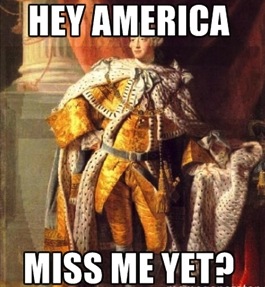 “There’s just one question I have to ask,” said the pleasant young man at the US Embassy, reviewing my visa application. “You are aware that we won, right?”
As a Brit teaching early American history in the U.S., I get some version of this question quite a lot. And it’s something I play up to in my own classes, as well. Many of my courses begin with the warning: “If you learn nothing else over the next 15 weeks, you will understand what it is like to be subject to arbitrary British despotism.” When teaching the Boston Massacre, I jest that I’m worried to give too much information, just in case my students get ideas. And in teaching colonial history, I remind my students that the history we cover is as British as it is American.
The Week in Early American History
 Here at The Junto, we’ve spent the last week with our noses buried in one really, really good book. But there’s been much afoot elsewhere, both on the web and beyond.
Savage Song
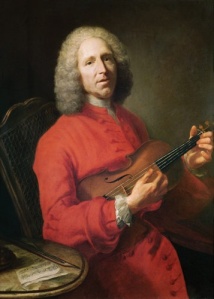 Recently I’ve been taken by the music of Jean-Philippe Rameau, a French Baroque composer and Enlightenment-era music theorist. Rameau was a divisive figure in his day because he broke from the supremely elegant and nuanced style that had made the court of Louis XIV the center of late-17th-century musical life in Europe. This excerpt from Jean-Baptiste Lully’s 1676 opera Atys gives a sense of the sensitivity and sophistication of 17th-c. French music. Compared to Lully, Rameau’s music was daring and experimental. He turned the orchestra into a powerful beast and wrote music that more dense, more harmonically adventuresome, and more aggressive. He was Frank Sinatra to Lully’s Bing Crosby, the Rolling Stones to Herman’s Hermits, N.W.A. to De La Soul; etc. (making analogies is curiously addictive). Continue reading
Democratizing Pedagogy: The Just Teach One Project

Last week when the Junto hosted the History Carnival we noted the creation of the “Just Teach One” project, co-sponsored by the American Antiquarian Society and Common-place. Today we’d like to take a closer look at what promises to be an exciting addition to thinking about how to teach early American studies (for both literary scholars and historians).
The Abolitionists: A Recap
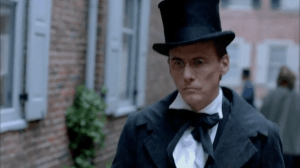 Over the last three weeks, Jonathan Wilson and Ken Owen have reviewed the PBS documentary series The Abolitionists. Their reviews of part 1, part 2, and part 3 are already available for you to read. In this final post, Wilson and Owen will discuss the series as a whole, focusing especially on its value for history professors in the classroom.
Ken: Jonathan, I thought that we might start this discussion by looking at the producers’ public statements on what they were attempting with the series. For reference, there is a video entitled ‘Why We Made The Abolitionists‘, and an article ‘From The Executive Producer‘. For me, the most striking statement of the video is the opening assertion that no transformative moment in American history ‘stems from the actions of ordinary Americans as much as the abolitionists’. The producers then say that the five characters that they chose were deliberately intended to invoke different strands of the abolitionist movement.
Shall We Listen to That Again?
I’m working on my syllabus for next semester. This is a new class at a relatively new job, and I have spent approximately 1,000 hours agonizing over the structure of the class and the difficulty of the readings, tweaking the language of the course description, and trying to find the most fair and opportune balance for the assignments. But mostly, making this syllabus has made me reconsider the role of listening in the classroom. Listening to music, that is.
Since I teach at an elite conservatory where all of the students are training to be (or already are) professional performers, we listen to music in every class meeting. This particular course, on representations of the “exotic” in western music from c. 1600 to today, features approximately 30 pieces of music. I treat these pieces like primary sources. The students are expected to listen to the assigned piece in advance, and in class we listen to excerpts in order to ground our discussion. I introduce other musical examples to illustrate points or guide the discussion in new directions. Sometimes the students draw on their own experiences as performers, making connections between the course materials and music they’ve encountered elsewhere. Continue reading
 The Junto