 Today’s episode, “Historical Fathers and Junto Dads,” features Joseph Adelman, Christopher Jones, Ben Park, and Rachel Herrmann discussing historical ideas about fatherhood in early America, and the challenges of being dads in academia. Continue reading
Monthly Archives: March 2014
Junto March Madness 2014: Round 1, Brackets 3 and 4
 Welcome to day two of voting! Your votes will decide who gets another shot at Junto glory. Continue reading
Junto March Madness 2014: Round 1, Brackets 1 and 2
The brackets have been compiled, the notes have been consulted. More importantly, you have had all weekend to consider the match-ups. Now all we wait for is your votes to decide who progresses to the next round. Continue reading
The Week in Early American History
 Well, technically, this will be the last two weeks in early American history since we missed last Sunday. Let’s get to it: Continue reading
Junto March Madness 2014: The Unveiling of the Bracket
Today is the day you’ve all been waiting for with eager anticipation—the official unveiling of the Junto’s March Madness bracket! Thank you to all who nominated books over the last couple of days—this whole project wouldn’t have been possible without you.
As with last year, we had an overwhelming response to our call for nominations, with over 150 books nominated, and over half of those receiving multiple nominations or seconds. Constructing the bracket from such a list was a difficult—each of us had to see books we wanted in the tournament fall by the wayside.
Junto March Madness 2014: Call For Nominations
Last week, we announced our plans for “Junto March Madness 2014” – a bracket tournament pitting our readers’ favorite early American history books published since 2000 against each other. Today, we begin the Call for Nominations. Check out the rules below and then add your nominations and seconds in the Comments section. Then, by the power of The Junto‘s bracketologists, we’ll compile the tournament brackets, and open it up for your votes starting next Monday. Continue reading
Throw John Smith Off Ship
Spring is in the air in Southern California! Well, to be fair, this isn’t usual: it always smells like flowers in Los Angeles (when it doesn’t smell like poisonous smog or wildfire smoke), but recent much needed rain has definitely made the city seem more verdant. My students are sunken-eyed and groggy from midterms, but spring break is just around the corner. What better time to take stock of how a new course is going?
Junto March Madness: Take Two!
The calendar has worked its way round to March, and here at The Junto that can only mean one thing: Junto March Madness is back! The principle is simple: we ask our readers to nominate books about early American history, then we pair them off against each other, until there’s only one book left standing. Last year’s tournament can be found here: Edmund Morgan’s American Slavery, American Freedom ultimately proved victorious.
This year, we’re going to be doing the same thing, only with a twist: entrants to the tournament will be limited to books published since 2000. Last time around, we noticed a tendency to reward older, more established books. We wanted to bring the same liveliness of discussion to more recent works, and to highlight recent work that deserves the prominence of old favorites. We’ll be asking for nominations next week, but we wanted to give you some advance notice so you could start thinking of the books you wanted to receive full consideration. Continue reading
Looking for “a World of Love”: Jonathan Edwards in the Big City
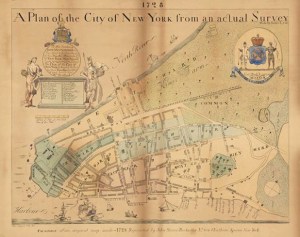 Jonathan Edwards is so strongly identified with Connecticut and Massachusetts that it’s easy to overlook where his pastoral ministry began: near the waterfront of New York City. In 1722, Edwards took a temporary position as the minister to a small Presbyterian congregation in Manhattan. He was about nineteen years old.
Edwards’s months in New York shaped him in at least two ways. First, according to his own account, Edwards developed a stronger desire for personal holiness. In New York, he wished increasingly to be “in everything a complete Christian.” Second, he grew in missionary zeal. Holding long religious conversations with his host family (who were immigrants from England) and observing life in the Atlantic port, he came to a more global awareness of the faith. He put it this way:
Audiences, Publicity, and Engaged Academics

Town crier, Provincetown, Cape Cod, Mass., courtesy Boston Public Library
Let me start by asking a question: how many people think that a producer, reporter, or intern for CNN, NBC, or any other news organization actually reads full articles in Nature, Science, or the New England Journal of Medicine to find out about the latest scientific and medical breakthroughs for their news reporting?
Yeah, me neither. So what’s really going on when journalists spend two weeks suggesting that journal articles are out of touch and inaccessible? And if there’s a kernel of truth to the claim, is there anything we as scholars can do to address the concern?
 The Junto