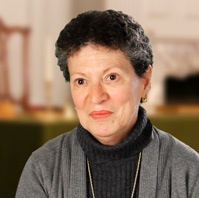
 Carol Berkin is Presidential Professor Emerita at Baruch College and the CUNY Graduate Center. She received her bachelor’s degree at Barnard College. In 1972, she received her PhD at Columbia University, where she also worked on the Papers of John Jay and Alexander Hamilton. Her dissertation on Jonathan Sewall won the Bancroft Award for Outstanding Dissertation and the subsequent book, Jonathan Sewall: Odyssey of an American Loyalist, was nominated for the Pulitzer Prize in 1974. She then spent her entire teaching career at Baruch College and the CUNY Graduate Center. Her most popular works include A Brilliant Solution (2002), which has been translated into Polish and Chinese, First Generations: Women in Colonial America (1996), Revolutionary Mothers: Women in the Struggle for American Independence (2005), and Civil War Wives (2009). She is a pioneer in early American women’s history and also the author and editor of numerous textbooks, readers, and teaching guides for women’s history including Women of America (1980), Women’s Voices, Women’s Lives: Documents in Early American History (1998), In the Words of Women: The Revolutionary War and the Birth of the Nation, 1765 – 1799 (2011), and Clio in the Classroom: A Guide to Teaching Women’s History (2009). She is also the editor of History Now, an online magazine published by the Gilder Lehrman Institute of American History. She has appeared in numerous television documentaries, including Founding Brothers and Founding Fathers on the History Channel and Ric Burns’ New York on PBS. Continue reading
Author Archives: Michael D. Hattem
The JuntoCast, Episode 7: The Great Awakening
 In this month’s episode of “The JuntoCast,” Ken Owen, Michael Hattem, Roy Rogers, and Mark Boonshoft discuss the Great Awakening, including its historiography, its relationship to the American Revolution, and its contemporary significance.
You can click here to listen to the mp3 in a new window or right-click to download and save for later. You can also subscribe to the podcast in iTunes. We would greatly appreciate it if our listeners could take a moment to rate or, better yet, review the podcast in iTunes. As always, any and all feedback from our listeners is greatly welcomed and appreciated. Continue reading
Roundtable: The Legacy of Pauline Maier
As promised back in August upon her untimely passing, this week The Junto will be dedicated to exploring the works and legacy of Pauline Maier. I will forego providing any biographical details since they can be found in The Junto‘s memoriam for Maier here.
 Pauline Maier spent her entire career working on the American Revolution, literally starting her career with the imperial crisis and ending it with the ratification of the Constitution. At each step along the way, she made significant and genuine contributions to our understanding of the Revolution. Whether it was drawing out the transatlantic aspects of the resistance to imperial reform, providing the most readable explication of the radical Whig ideological interpretation, or telling new stories about the ways in which colonists declared independence or citizens debated the Constitution, Maier found an often elusive sweet spot between intellectual history and social history. She took ideas seriously and showed how those ideas played out “on the ground,” beyond just the elites. From that mix, she developed a brand of political history in which popular participation was not just incorporated into the narrative; it was central. Indeed, that popular participation defines the Revolution in the canon that is Maier’s work. And so while Bernard Bailyn and Gordon Wood may have had higher academic profiles, it was Maier who best fulfilled the potential of the “Harvard interpretation,” thereby making her work more relevant to new generations of historians than that of either Bailyn or Wood. And, to me, that continuing relevance is the core of the legacy of Pauline Maier. Continue reading
My Lecturing Disjunction
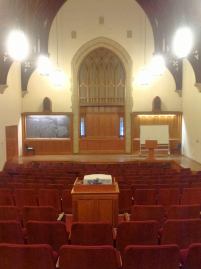 As I near the end of a somewhat unusual semester, I wanted to reflect a bit on my experiences as a Teaching Fellow for a course on the American Revolution. This semester I was fortunate enough to have the opportunity to deliver a number of lectures. And it has gotten me thinking about the lecture as both a piece of writing and a pedagogical tool. The purpose of this post is mostly to throw out some things that have occurred to me throughout the semester but to also get thoughts from those of you with experience giving lecture courses. Continue reading
The JuntoCast, Episode 6: The Continental Congress
Submitted for your approval . . . the November episode of “The JuntoCast.” This month, Ken Owen, Michael Hattem, and Roy Rogers discuss the Continental Congress, including a number of recent popular histories about it, its popular and academic historiography, and various aspects of its importance. Continue reading
The Week in Early American History
 It’s Sunday morning and that means . . . links!
Guest Post: The Dutch Revolt and New Netherland: 36th Annual New Netherland Seminar
Elizabeth M. Covart (PhD, UC-Davis, 2011) is an independent historian located in Boston, Massachusetts, who specializes in early American history. She also blogs at Uncommonplace Book: An Independent Historian’s Blog and is a Contributing Editor for the Journal of the Early Americas and contributor to the Journal of the American Revolution.
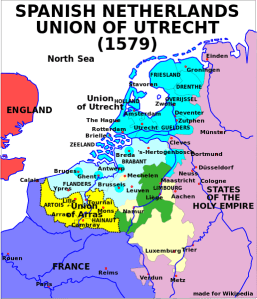
As my book project explores the cultural legacy of New Netherlanders who lived in Albany, NY, I attended the 36th Annual New Netherland Seminar on Saturday, October 5 at the New-York Historical Society. I admit that I attended the conference as an interloper; I study the revolutionary and early republic periods.
Sounds of Silence: Managing Student Preparation
 In all the teaching orientations and training manuals I’ve encountered, they all advise instructors not to be afraid of silence. The average student, they say, takes up to 8 seconds to mentally prepare an answer to an analytical query. But what happens when the silence isn’t because students are choosing which of their brilliant thoughts to share with the class but because most of them failed to do the reading? I suspect every college teacher has had a class session in which most questions were met with complete silence. What can we, as the instructors, do in such situations? And how can we better incentivize students to take their assigned reading seriously? Continue reading
The JuntoCast, Episode 5: The Constitution
The Junto is happy to present the fifth episode of “The JuntoCast,” a monthly podcast in which members of The Junto discuss issues of both academic and general interest related to early American history, pedagogy, and public history. Continue reading
The JuntoCast, Episode 4: Religion in Early America
The Junto is happy to present the fourth episode of “The JuntoCast.” In case you missed our first three episodes, “The JuntoCast” is a monthly podcast in which members of The Junto discuss issues of both academic and general interest related to early American history, pedagogy, and public history.
In this month’s episode, Ken Owen, Michael Hattem, and Roy Rogers discuss religion in early America, including its relationship to the American Revolution, historiographical developments, and, being the history nerds that they are, which 18th-century Protestant denomination’s theology best represents each panelist’s pedagogical style.
You can click here to listen to the mp3 in a new window or right-click to download and save for later. You can also subscribe to the podcast in iTunes.
 The Junto